
ARISTOCRATIC
SOCIAL NETWORKS AND HOMEOPATHY IN BRITAIN
by Peter Morrell (01)
In his interesting portrait of homeopathy in
nineteenth century Cambridge,(2) Mark
Weatherall opines that homeopaths used aristocratic social networks to
gain clients and win influence. His assertion that the ‘social networks’
of homeopaths included ‘patrons, the clergy, patients, chemists and
dispensaries’(3), implies that deliberate
cultivation of this device by homeopaths gave them an unfair advantage
over their regular colleagues in the medical marketplace. Being, at
least to me, a dubious assertion, it is my intention to explore the
background to this theme.

Dr Frederick Hervey Foster Quin, in 1820
We shall consider two somewhat interconnected topics.
Firstly, an account of Dr F H F Quin,
and his introduction of homeopathy into Britain. Secondly, how Dr Quin
and later homeopaths relied upon the complex social network of
nineteenth century aristocrats for the rapid dispersal of the new
therapy in Britain, and thus how the fortunes of both became so solidly
entwined.
Inception of Homeopathy in Britain
‘[Dr Quin]… was born in London on 12th Feb
1799, possibly the illegitimate son of the Duchess of Devonshire.’ (4)
Homeopathy was introduced into the UK by Dr F H F Quin
(1799-1878) in the 1830’s. After graduating MD in 1820 in Edinburgh, Dr
Quin then became the Duchess’s family physician and travelled with her
entourage. He met Dr Hahnemann (1755-1843), the founder of homeopathy,
and travelled extensively in Europe, residing for a time in Rome and
Naples. He is said to have successfully used Camphor against Cholera in
Moravia (Czechoslovakia) and to have cured himself of the condition by
following Hahnemann’s advice (5). During the
1830’s and 40’s he spent a lot of time in Paris among the inner circle
of Hahnemann’s proteges(6).
Being already fluent in French(7)
he
‘became very highly respected in France and was
considered Hahnemann’s greatest successor…he spent a year in Paris
and continued to correspond with Hahnemann until Hahnemann’s death.’(8)
‘Quin was revered by the French as Hahnemann’s
greatest successor.’ (9)
Hahnemann occupied a special seat as Honorary
President of the Gallic Homeopathic Society: ‘after his death this
honour was transferred to the English Dr Quin…’(10)
He introduced homeopathy into the very highest levels
of English society: to Dukes, Counts, Lords, minor Royals and Baronets (11).
That was the world he was at ease with and in which he had moved since
birth. As a young man he was a very popular socialite and wit on the
fashionable London circuit, a great friend of Charles Dickens
(1812-1870), William Thackeray (1811-1863) and the Royal portraitist,
Sir Edwin Landseer (1802-1873), amongst many others, and no society
party, or social gathering, it was said, was complete without him(12).
By nature of a very pleasing disposition, he was a man of great personal
charm. Often called the ‘last of the English wits’ (13),
and ‘a notorious dandy’(14) he was also
latterly one of the regular dining partners of Edward, Prince of Wales
(1841-1910), the future King(15)
Quin seems to have concentrated exclusively on
introducing homeopathy amongst medically qualified doctors and their
predominantly upper-class clientele.(16)
This level of high society support for homeopathy, generated by Quin’s
efforts, worked enormously to its advantage and greatly assisted its
easy acceptance into the British medical marketplace. The fact that many
of the German relatives of the British Royal family were also devoted
patrons of homeopathy, including Queen Adelaide (1792-1849), wife of
King William IV (1765-1837), probably also assisted its rapid social
acceptance in Britain(17). Rich patrons
of homeopathy (eg. the first Marquess of Anglesey, 1768-1854) not only
formed its client-base, but also funded and numerically dominated the
committees which ran the many homeopathic hospitals and dispensaries of
the last century(18).
Quin established the British Homeopathic Society (BHS)
in 1843, a London hospital in 1850 and the British Journal of Homeopathy
(BJH) in 1844. Through his many influential contacts in the world of
politics (eg. Lord Ebury, 1801-93), Quin was able to obtain an amendment
to the 1858 Medical Act, withholding a recommendation about the type of
medicine approved in Britain.(19) As a
result of this skilful manouevre, homeopathy was indirectly tolerated
without challenge and thus never censured by Parliament as a deviant
mode of medical practice:
‘Dr Quin was able to obtain an amendment to the
Medical Registration Bill; a clause was added enabling the Privy
Council to withdraw the right to award degrees from any university
that tried to impose the type of medicine practised by its graduates.’(20)
There were attempts by some more radical homeopaths in
the 1840’s, comprising some medically qualified and some laypersons, who
formed a breakaway but shortlived English Homeopathic Association, to
popularise homeopathy amongst the lower classes in Britain, but in the
nineteenth century these efforts were eclipsed by its continued
dominance by the medically qualified and their wealthy clientele.(21)
Many of these radical and plebeian homeopaths were also linked to
political radicalism (distantly inspired by the French Revolution) and
religious non-conformity, as well as a host of other medical sects, such
as Phrenology, Spiritualism, Mesmerism, Hydrotherapy, Galvanic medicine
and Medical Botany.(22) There was a
remarkable medical eclecticism at that time, with many physicians
employing novel techniques like hydrotherapy or Galvanic medicine. A
good example here is Dr James Gully (1808-83), a great friend of Charles
Darwin (1809-82),(23) and who set up a
fashionable hydropathic institution in Malvern.
Quin distanced himself entirely from the radical
homeopaths and the other medical sectarians in general, regarding them
all as thoroughly disreputable amateurs bordering on quackery, though he
would never have used that term himself.(24)
Leading radicals included Drs John Epps (1805-69), Samuel Partridge
(c1810-80), Spencer T Hall (1812-85), J J Garth Wilkinson (1812-99) and Paul
Francis Curie (1799-1853).(25)
So great was their influence and popularity throughout the 1850’s that
they seemed set to lay siege to orthodoxy.(26)

Paul Francis Curie (1799-1853)
Dr Quin
‘In July 1821, he commenced practice in Naples and his
social attributes made him popular with all the English residents there.
These included Sir William Gell, Sir William
Drummond and the Countess of Blessington.’(27)


Sir William Gell, Sir William Drummond and the
Countess of Blessington.
In 1832 Dr Quin established a homeopathic practice in
London. Doctors became attracted to homoeopathy as an alternative to
strong drugging, and within 20 years it was well-established, with
homoeopathic doctors pratising in most areas of the country. They
amounted to something like 300 at their peak in 1875(28).
However, due to persecution from regular physicians, many doctors did
not belong to the British Homeopathic Society (BHS) or publicise their
use of homeopathy, and thus any such figures must be treated with some
caution(29).
Dr Quin first learned homoeopathy from the Austrian,
Dr George Neckar (c1770-c1840) in 1825 in Naples. He put Quin in touch
with most of the literature on homoeopathy; ‘Neckar was a disciple of
Hahnemann’s.’.(30) Quin then went to
Leipzig to study with Hahnemann himself. Along with Dr Gerstel and two
surgeons he had charge of all Cholera in the town of Tischnowitz and
neighbouring villages ‘where the disease was raging.’.(31)
Quin wrote to Hahnemann telling him of his successful use of Camphor.(32)
‘Quin was… appointed physician to Emperor
Napoleon I at St Helena but he died on the eve of Quin’s departure,
then physician to the Duchess of Devonshire, after her decease in 1824
became physician to Prince Leopold of Saxe-Coburg, later King of
Belgium; Quin went to Kothen in 1826 to study with Hahnemann; on his
return in 1827 to England he introduced homoeopathy; known especially
in the higher classes of society for promoting homoeopathy there… he
died 24 Nov 1878’.(33)
Dr Quin was the first practitioner of homoeopathy in
the UK in 1827-8 but no-one took any notice at first and it went
unreported. Quin’s practice in London was set up in Sept 1832 at 19 King
St, St James’s,(34) then later at 13
Stratford Place.(35) It is noteworthy
that Quin established a thriving homeopathic practice ‘confined to the
upper classes’.(36) In 1844 he
established the British Homoeopathic Society (BHS) with 10 colleagues(37)
and the Hospital in Golden Square (Soho) in 1843.
Quin had all the best social connections, and was
ideally placed to establish homeopathy in Britain:
‘…during his journeying he was introduced in
Rome to Prince Leopold of Saxe-Coburg (later to become King Leopold I
of the Belgians).’(38)
Prince Leopold (1790-1865) was Queen Victoria’s
‘favourite uncle and adviser’.(39) Quin
was also a close friend of the fashionable artist, Count d’Orsay
(1801-52), and the Blessingtons, (eg. Marguerite, Countess of
Blessington (1789-1849), an Irish beauty).
‘Had he not abandoned orthodoxy he would
certainly have been knighted and been one of the leading medical
figures of his time…he was a friend to almost everyone of importance
in the country.’(40)
He had also treated the 1st Marquess of Anglesey, Sir
Henry William Paget (1768-1854), companion at Waterloo of the Duke of
Wellington (1769-1852), and Dr Quin was sometime medical adviser to the
Duchess of Cambridge.(41) Keenly attuned
to the reforms of the day, Quin was determined to restrict homeopathy to
medically qualified doctors and to regulate their professional conduct
strictly(42) particularly as the number
of homoeopathic doctors was rising steadily from 10 at the start to 300
or so by the time Quin died in 1878.(43)
As the originator of homeopathy in Britain, it seems
likely that Quin himself would have taught most of his colleagues the
rudiments of homeopathic materia medica and philosophy, and, as someone
taught by Hahnemann himself, he would also have been regarded as the
chief authority on the subject in Britain.
‘On 18 Oct 1859 Quin was appointed to the chair
of Therapeutics and Materia Medica in the Medical School of the
hospital; from 1852-64 Quin assisted Drs Leadham & Russell offer
lecture courses there, which later in 1877 became the London School of
Homoeopathy.’(44)
In 1885 the School merged with the Hospital.(45)
“By his tireless efforts he induced his rich
friends to subscribe sums of up to 1000 each, an enormous amount in
those days. By 1859 there were sufficient funds to purchase three
houses in Great Ormond St, and here the new hospital opened on the
present site.”(46)
Patronage Backfires 1890-1920
While undoubtedly Quin had used the British class
structure to assist his establishment of homoeopathy in those early
days, and eased its social acceptance, but later on these aristocratic
links seemed to become a burdensome disadvantage:
‘…Quin’s social connections, useful though they
were in introducing homoeopathy into Britain, gave it an aristocratic
aura which it could not shed… it never really put down any roots
among the workers, or the lower middle classes, except in a few
scattered practices… they resisted overtures from… the unqualified
lay moeopaths… which… encouraged the development of an internal
orthodoxy…which gave it, to outsiders, an appearance of rigidity…
their original progressive ideas had crystallised into a narrow
creed.’(47)
Here there were essentially two problems. Firstly,
that aristocrats were in decline right across Europe from 1880 onwards.
Cannadine gives a fascinating and very detailed portrait of that.(48)
Secondly, homeopathy had allied itself so closely with aristocrats that
its fortunes shadowed theirs. By welding itself so closely to
aristocrats, homeopathy appeared too elitist and unwilling to ‘dirty its
hands’ with the poor. Even worse, of course, their fees were much too
high for the poor to afford anyway. They eschewed advertising and had
probably become over-reliant on a cosy network of upper-class social
contacts and recommendations that was now beginning to wear thin. Many
rarely even placed brass plates outside their consulting rooms, so
exclusively did they regard themselves(49)
and so guaranteed their wealthy client-base appeared to be. As a result,
the whole therapy was shrouded in secrecy with a near-zero public
presence until the 1930’s.(50)
As soon as aristocrats went into decline, so
homeopaths declined with them, and after 1900 there seemed to be no
clear policy being formulated within homeopathy to deal with this
eventuality. The many homeopaths concentrated in London were making a
decent living in their Harley Street and Wimpole Street practices, but
for those in the poorer provinces, they were inching closer to
extinction with each day that passed.(51)
Dr John Henry Clarke (1853-1931) was one of the first
to identify this problem and to complain about it. He saw the only
secure future for homeopathy through publicity to popularise it for the
masses. A proposal which was regarded as unthinkable by the BHS. He left
the BHS in disgust in 1908 to give himself greater freedom and refused
many attempts to woo him back.(52) He
then started to teach laypersons the rudiments of homeopathy(53)
in a desperate bid to see it survive in any form at all. He also
lambasted the BHS and the BHA as time-wasting committees that were
standing still and doing nothing for the publicity of homeopathy – like
Nero’s fiddling while Rome burned. Homeopaths were probably too
frightened of upsetting their rich clientele, by having any dealings
with the poor or with advertising, both of which would have been
regarded as ‘common’ and unseemly to their fussy clientele. In effect,
the homeopaths had painted themselves into a corner with their own
elitist policy.
There were others who commented upon this situation,
such as certain lay practitioners during the 1930’s, chief among whom
was Dr Clarke’s patient and friend, J Ellis Barker (1870-1948). Ellis
Barker, and many other lay homeopaths, regarded the BHA and the BHS as
little better than ‘rich-men’s talking-shops’(54)
completely closed to the layman and doing nothing to popularise
homeopathy at all.
Barker and other lay practitioners abandoned the BHA
in disgust sometime in the 1940’s and from then on went more or less
their own separate ways. J Ellis Barker was a very interesting figure
and certainly the most important of Clarke’s students, who had a major
influence on UK homeopathy, 1930-1950. A close confidant of Dr Clarke(55),
he was handed the Editorship of the prestigious monthly journal The
Homoeopathic World early in 1932, only three months after Dr Clarke’s
death. This surprising move was a carefully designed snub by Clarke to
the BHS and UK homoeopathic doctors in general, most of whom he by then
despised as traitors of the homoeopathic cause and largely responsible,
in his view, for its continued decline.(56)
Barker then launched into bitter attacks on the apathy
of the BHS and BHA, both of whom he blamed for the progressive decline
of homeopathy. He stirred up a great deal of interest in homeopathy at
grassroots level and inspired a renaissance of lay practice throughout
the 1930’s and 1940’s as a result.(57)
The journal, under his stewardship, renamed Heal Thyself, reached a peak
of popularity in the late 1930’s.(58)
‘Dear Mr Barker… I intimated some years ago to
the BHA that a vigorous campaign was needed to ‘create a demand’ for
homeopathy, but I was taken to task because such a procedure would
‘offend against professional etiquette’. I said then, and believe more
strongly than ever, that publicity is needed…’.(59)
‘Dear Sir, I am delighted with your vigorous
criticism of those doctors who have mismanaged homeopathy for so many
years…’(60)
‘
we shall never be able to get a sufficiency
of homeopathic doctors unless homeopathy is made popular by suitable
propaganda… ‘(61) ‘… organised
homeopathy followed a policy of secretiveness, that no list of
homeopathic doctors was obtainable, that homeopaths did not indicate
their speciality on their brass plates and on their stationery… the
leaders of the homeopathic organisations must be crazy, cowardly or
utterly stupid.’ (62)
‘… a distinguished homeopath… said to me: The
British Homeopathic Association is useless, absolutely useless, worse
than useless. Unfortunately, this is only too true… ‘founded in 1902
for the extension and development of homeopathy in Great Britain’.
Since that time the number of homeopathic doctors, chemists and of
homeopathic hospitals, dispensaries and other institutions has
steadily shrunk in the most lamentable manner.’(63)
‘… it is declining and decaying in this country owing to the
disastrous policy which incompetent leaders have followed for
decades… during the last sixty or seventy years the number of
medical men and chemist’s shops has approximately trebled, the number
of practising homeopathic physicians has shrunk by about one half and
the number of homeopathic chemist’s shops to about one fifth of the
former figure… this is a disgraceful state of affairs… and the
leaders who have caused this debacle ought to retire and to hide their
heads if they possess any sense of responsibility and of shame.’(64)
These letters clearly demonstrate a deep rift between
the plebeian homeopaths of the thirties, and their medically qualified
brethren, about how homeopathy should be presented to the public. Ellis
Barker castigated both the BHS and the British Homoeopathic Association
(BHA) for blocking any further expansion or popularisation of homeopathy
at grassroots level. Editorial after editorial of his lambasted them
mercilessly just as Drs Clarke and Burnett had done as Editors in the
1880’s and 1890’s.(65) Barker also
incited the lay practitioners to ‘take homeopathy to the masses’. He was
thus the inspiration for the first, brief though glorious, mass movement
of alternative medicine in Britain.(66)
Social Networks
‘[the aristocracy]… were educated in public
schools and sometimes at Oxbridge… were of gentle status in that
they did not have to work for a living… they made up county society,
and in London they were the foundation of high society… were very
sensitive to matters of honour, precedence and protocol, … and they
accepted, implicitly and absolutely, an unequal and hierarchical
society, in which their place was undisputably at the top.’(67)
It is doubtful that homeopaths had any easier access
to these communication networks, or that they used them (or abused them)
any more assiduously than did regular physicians. At that time it was
the established means of passing around useful information, and as handy
and equivalent in today’s world, as leaving a business card or an e-mail
address. More importantly, these aristocratic links operated very much
like ‘old boys’ networks’ and as a very exclusive ‘closed shop’.
The fact that homeopathy for so long enjoyed the
Europe-wide patronage of Royals, aristocrats, the fashionable and
intelligent must have been, of course, a profound irritation to regular
physicians.(68) The following is typical
of how homeopathy was systematically demonised by prominent members of
the regular profession, as yet another species of quackery:
‘[the] principle of the infinitesimal dose
[is]… an outrage to human reason.’(69)
And nor can it, in any sense, be construed as the
fault of homeopaths themselves that the upper classes seemed to prefer
Hahnemann’s gentle and harmless system to the often barbarous excesses
of venesection, leeching and purging:
“The celebrated Bouvard, physician to Louis
XIII, ordered his royal patient forty-seven bleedings, two hundred and
fifteen emetics or purgatives, and three hundred and twelve clysters
during the period of one year!… more than six million leeches were
used, and more than two hundred thousand pounds of blood were spilled
in the hospitals of Paris in one year. The mortality was
appalling.”(70)
Such iatrogenic threats to the health of Royals and
aristocrats were, of course, taken very seriously indeed, and fear of
them must have been a major factor in driving aristocrats – people of
wealth, power, status and control of their lives – into patronage of
less overtly damaging medical systems like homeopathy. Hence perhaps,
their popularity and rapid spread.
And as Leary says of Dr Quin:
‘…with his connections, he was quickly
established among the well-known and wealthy. Quin counted the Dukes
of Edinburgh and Beaufort among his patients, and became physician to
the household of the Duchess of Cambridge.’(71)
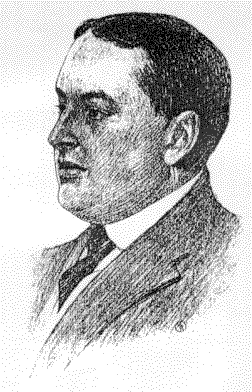
Lord Donoughmore
The Duke referred to was Henry Charles, the 8th Duke
of Beaufort, 1824-1899.(72) The fact that
this aristocratic patronage of homeopathy in the UK extended well into
the 1940’s, and beyond, can be easily demonstrated. In the Homeopathic
Medical Directories there are lists of patrons of the dispensaries and
hospitals. They read like an extract from Burke’s or Debrett’s.(73)
Some examples include: The Dukes of Beaufort, Dukes of Cambridge,
Marquesses of Anglesey, Earl of Essex, Lord Gray of Gray, Viscount
Malden, Earl of Donoughmore,
Lord Ernle, Earl of Kintore, Earl of Kinnaird, Duchess of Hamilton and
Brandon, Earl of Wemyss & March, the Lords Paget, Dukes of
Sutherland, Earls of Dudley, Lord Leconfield, Earl of Wilton, Earl of
Albermarle, Viscount Sydney, Lady Radstock, Duchess
of Teck, Duke of Northumberland, Earl of Scarborough,
Earl of Dysart, Marchioness of Exeter, Countess Waldegrave, Countess of
Crawford & Balcarres, Lord Headley, Earl of Plymouth, Lord
Calthorpe, Earls of Shrewsbury, Lord Horder, Lord Gainford, Lord
Moynihan, Lord Ernle, Lord Ampthill, Lord Home, Viscount Elibank and the
Earls of Lichfield. And to this list we can also add numerous knights,
barons, Army officers and clerics.(74)
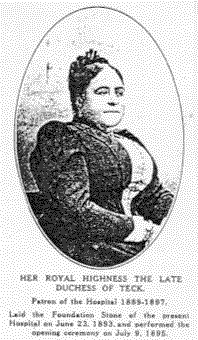
Duchess of Teck
Royal patronage of homeopathy also continues. From
King Edward VII through his son King George V (1865-1936), his sons
Edward VIII (1894-1972) and George VI (1895-1952)(75)
and so into today’s royals. The Queen Mother continues her work as
Patron of the BHA(76), while the
homeopathic pharmacy Ainsworth’s in New Cavendish Street, London, holds
all three Royal warrants as ‘Chemists Royal’ — ie. for Prince Charles,
the Queen Mother and the Queen(77).
And:
‘The principal supporters of the [homeopathic]
hospital, until Quin’s death in 1878, were members of the
aristocracy.’(78)
I think we can see from the above deliberations, that
these social networks were already complex and active and operated as
the normal channels through which ‘things got done’. And as Cannadine
makes clear, it was aristocrats who were very much in charge at that
time. They always socialised with and married, exclusively, others of
their own class. Thus their vastly interbred and interwoven families
served as an excellent matrix for passing along information and mutually
useful advice.
Contacts were made and recommendations were passed
around. These social networks undoubtedly served as an excellent means
of communication in a world much slower than ours today.
It is abundantly clear that we are right to draw a
connection between homeopathy and high class. The aristocratic Dr Quin
was ideally placed both to establish and to popularise homeopathy at the
very highest levels of English society. And also that once set rolling
that link paid off handsomely and repeatedly, for homeopaths in general,
down the years. But homeopaths seem to have been no more guilty of
cultivating and using aristocratic social networks than anyone else at
that time. Not to have used such networks, whatever one’s occupation,
would in fact, have amounted to professional suicide.
We have also seen how the decline of homeopathy in the
period from 1880 to 1940, can be very securely tied to the decline in
wealth and power of the aristocrats, who very largely formed its
client-base. From the same period we have also adduced some of the
events and criticisms made by others working in the same field about
this lamentable situation, eg. Dr Clarke and his homeopathic student, J
Ellis Barker (a doctor’s son from Cologne, whose original name was Otto
Julius Eltzbacher(79).
To focus exclusively upon one particular town, might
give a distorted picture, because the self-same process of
excommunicating homeopaths was in fact repeated, 1850-70, in practically
every town and city in Britain.(80)
Homeopaths were soundly deviantised by regular practitioners. In my view
it was chiefly competition in an overcrowded market that brought them
into such sharp conflict with regulars, not because of differences in
ideology or medical qualification.(81) It
is true (82) that ‘competitive expulsion’
was applied towards medical sectarians by regular physicians so as to
keep them out of the medical debates, out of the medical press and out
of the medical institutions. But this was mainly devised in order to
keep them out of the medical marketplace, where they were doing so much
damage to the profession — hitting them in their most precious place of
all, their wallets.
The exclusion of medical sectarians enforced by
regular physicians, also meant that the sectarians were left with no
alternative ‘survival strategy’ but to form themselves into ‘organised
deviant groups’(83) which served and
developed their own interests. Thus ‘social networks’ were in one sense
a product not a cause of their exclusion by the regulars. Sectarians
published their own journals, papers, tracts and books, held their own
conferences, and formed their own associations — all of which resided
beyond the ‘boundary’ created and imposed by the regulars. None of those
things happened spontaneously from their own side, but as a reflex
reaction to their exclusion by the regulars — and for no other apparent
reason.(84)
Through pursuing a policy of strict isolationism,
there is no doubt that regulars demonised homeopaths as quacks and
medical heretics; excluded them from debate or interaction with their
regular colleagues, who were, afterall, fellow doctors, and so created
the ‘crucial boundary’ Weatherall refers to(85).
This boundary was not based on empiricism or rationalism, science or
philosophy, but was erected primarily for social and economic reasons.
The reasons at the time for the conflict were clear
enough:
‘…a need to restrict entry to what was seen as
an overcrowded profession… medical practitioners were concerned both
to control the number of qualified practitioners entering the
profession and to reduce the competition from practitioners who were
not qualified.’(86)
‘…of the 10,220 practitioners listed in
Churchill’s Medical Directory of 18 56, 1524 possessed only the
diploma of the Royal College of Surgeons, and 879 possessed only the
licentiateship of the Society of Apothecaries.’ (87)
‘In 1851 there were an estimated 6000 unlicensed
medical practitioners operating in the UK but only 5000 regular
doctors, apothecaries & surgeons.’(88)
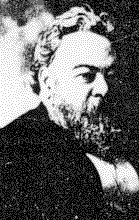
James Compton Burnett
It is easy to uncritically reiterate various
nineteenth-century myths about homeopaths. For example, it is unsafe to
make the nineteenth century suggestion that homeopaths were all
unqualified quacks. Two of the most highly-qualified physicians of the
last century were homeopaths: Dr James
Burnett (1840-1901), a Glasgow Gold Medal anatomist who
had also graduated from Vienna:
“Passing through a brilliant examination in
anatomy, lasting one hour and a half, the professor shook hands with
him, saying that he had never examined a student with so brilliant and
thorough a knowledge of anatomy.”(89)

Thomas Cooper
and Dr Robert Thomas
Cooper (1844-1903), a triple graduate of Trinity College
Dublin [AB 1864, LM 1864, MCh MB 1865, MD 1871 and MA 1882(90)].
Other examples abound. The argument therefore appears both feeble and
desperate, as it is so easily disproved. It was clearly a ‘smear tactic’
to accuse homeopaths of being medically unqualified quacks, and was, of
course, originally contrived quite specifically to deviantise and
ridicule them. Thus to repeat it today is to cheapen and devalue, by
contamination, any serious argument being proposed.
There seems to be abundant evidence that the rejection
of homeopathy stems much more from social and economic forces, than from
ideological ones. It was not chiefly based upon rationality or on
‘making medicine scientific’(91), but
mostly upon pure prejudice and ‘contempt without investigation’(92).
Homeopathy was demonised and deviantised by establishment science as an
heretical system of ideas and techniques, by doctors who were quite
simply afraid and jealous of its power, success and popularity with
wealthy clientele — clients they wanted for themselves. It was seen and
treated as a threat, chiefly due to competition in an overcrowded
medical marketplace.(93) A good example
of how contemptuously homeopaths were regarded is seen in a letter of
Nov 1834, from the President of the Royal College of Physicians, Sir
Henry Halford, in which he despairs at Queen
Adelaide‘s ‘absurd’ devotion to homeopathy. It is
printed in full in Leary et al’s article.(94)
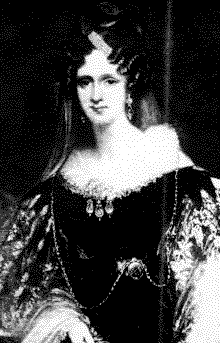
Queen Adelaide, in 1835
If homeopathy was the unmitigated nonsense regulars
believed it to be, then it would surely have died out of its own accord
as an outmoded ‘medical delusion’. That quite simply did not happen. And
rather than having no influence on regular medicine, or being consigned
to exist beyond the boundary of accepted medical knowledge,(95)
it does seem immensely curious that regular medicine, by the end of the
19th century, came to be using mostly single drugs and small doses
compared with the mixed drugs and high doses in use in 1800. Almost as
if they had, in fact, ‘stolen the clothes’ of the homeopaths by the
century’s end.(96) And by doing so had
they not in effect capitulated to two of Hahnemann’s most ferocious
criticisms of Old Physic?(97)
By contrast, homeopathy in 1900 had barely changed at
all since 1800. It had certainly not diluted any of its core dogmas,
relinquished a single technique or a particle of its ideology. It
emerged into the twentieth century still ideologically fully intact and
unaltered. Unscarred, in fact, from all its bitter fights with
orthodoxy. As it still is today.(98) In
this sense it is clear that, in spite of its numerical inferiority, the
reforming impact which it had upon regular medicine was far greater than
the reverse. To which we must add, that this would hardly have been the
case had it not won the wide support of the fashionable, the elite and
the titled.(99)

Dr. Margery Blackie and Sir John Weir
References
(1) Honorary Research
Associate in the History of Medicine, Dept of Sociology, Staffordshire
University, College Road, Stoke-on-Trent, ST4 2DE, UK
(2) Weatherall, M W, Making
Medicine Scientific: Empiricism, Rationality, and Quackery in
mid-Victorian Britain, Social History of Medicine, Vol 9: 2, August
1996, 175-194.
(4) Bonnard, Jean, Dr Quin,
Student Homeopath 25, Dec 1994, London, 32; this article is very closely
based upon the Quin biography in the Dictionary of National Biography;
see also Blackie, Margery,
The Patient Not The Cure, The Challenge of Homeopathy, 1976, MacDonald
and Jane’s, London, 25; Dr Blackie was 1969-81 the Queen’s Physician;
see also F Bodman, The Life and Times of Dr Quin, British Homeopathic
Journal 50:2, April 1961, 73-82.
(5) Cook, Trevor, Samuel
Hahnemann The Founder of Homeopathy, Thorsons,UK, 1981: 146; Hobhouse,
Rosa W, Life of Samuel Hahnemann, Harjeet, India, 1933: 248.
(6) Handley, Rima, A
Homeopathic Love Story, N Atlantic Books, Berkeley, USA, 1990: 47, 99
and 109; see also Blackie, op cit, 29.
(8) Bonnard, op cit, 33;
see also Blackie, op cit, 29
(9) Haehl, Richard, Samuel
Hahnemann His Life and Works, 2 Volumes, Jain India, 1922, Vol 1, 429;
see also Blackie, op cit, 26-29
(10) Haehl, Vol 1, op
cit, 233.
(11) See Nicholls, 1988,
111; Leary, B, Lorentzon M and Bosanquet, A, It Won’t Do Any Harm:
Practice & People at the London Homeopathic Hospital, 1889-1923, In
Juette, Risse and Woodward, Culture, Knowledge and Healing, Sheffield
Univ Press, UK, 1998: 252-3; see also Leary, B, Dr Quin, Homeopathy, Vol
41:1, Feb 1991 p.19, BHA London; see also G Rankin, Professional
Organisation and Medical Knowlege: Two Views of Homeopathy, in R.
Cooter, Studies in the History of Alternative Medicine, St Martin’s NY
USA, 1988.
(12) see biography in
Dictionary of National Biography.
(15) Leary et al, 1998,
op cit, 252-3.
(16) Inglis, Brian,
Fringe Medicine, Faber, London,1964, 85; see also Griggs, Barbara, Green
Pharmacy A History of Herbal Medicine, Jill Norman & Hobhouse,
London, 1981, 203
(17) Morrell, Peter,
A Brief History of British Lay Homeopathy, The Homeopath 59, Oct
1995, London; see also Morrell, Peter, A
Condensed History of British Homeopathy, Student Homeopath 72, Oct
1998, London; Leary et al, 1998, op cit, 252-4; Inglis, op cit, 85.
(18) Morrell, Peter,
1998a, British Homeopathy During Two Centuries, MPhil Thesis, Dept of
Sociology, Staffordshire University, UK, April 1998; Nicholls, Phillip
A, The Social Construction and Organisation of Medical Marginality —
the Case of Homeopathy in mid-Nineteenth Century Britain, Paper given to
Conference on the History of Unconventional Medicine, Univ of Linkping,
Sweden, 10-12 Sept 1998, 6-7.
(19) Leary et al, 1998,
253; Nicholls, Phillip A, Homeopathy and the Medical Profession, Croom
Helm, London., 1988, 144-5; Inglis, op cit, 80; see also Ivan
Waddington, The Medical Profession in the Industrial Revolution, Gill
& MacMillan Press, Dublin, 1984
(21) see Nicholls, 1988op
cit ; see also Rankin, op cit, 52-57
(22) Barrow, Logie,
Independent Spirits, RKP, London, 1986, 174-6; see also Porter, Roy, For
the Greater Good of Mankind, A History of Medicine,WWNorton NY &
London, 1997, 389-96; see also R Cooter, Studies in the History of
Alternative Medicine, St Martin’s NY USA, 1988; see also J F C Harrison,
Early Victorian Britain 1832-51, Fontana, London, 1988, 167-9; see also
J F C Harrison, Early Victorian Radicals and the Medical Fringe,
198-215, in W F Bynum and R Porter, (eds) Medical Fringe and Medical
Orthodoxy 1750-1850, Croom Helm, London, 1987
(23) see A Desmond and J
Moore,Darwin, Michael Joseph, London, 1991, 364 and 392; see also
Porter, op cit, 392.
(25) Barrow, op cit; see
also Rankin, op cit; see also entries for Epps,
Curie and Wilkinson in DNB and CDNB; see also Obituary for Hall in
Manchester Guardian, April 1885
(26) Barrow, op cit,
161-9; also Barrow, JJGarth Wilkinson- An Imponderable Liberator, in R
Cooter, op cit, especially 92-93
(28) Compiled from data
in Homeopathic Medical Directories 1867, 1874, 1895; see also data in
Nicholls, 1988, op cit, and Nicholls, 1998, op cit; see also Morrell, op
cit 1995 and Morrell, 1998 op cit; see also J Ellis Barker, The Worst
Enemies of Homeopathy, The HomeopathicWorld, May 1932,:160-175, which
also contains a lot of data.
(29) see also Nicholls,
1998, 4-7.
(30) Blackie,op
cit,27-8; Hobhouse, op cit, 248.
(33) Haehl, op cit, vol
2, 507; see also Griggs, op cit, 228.
(35) Hobhouse, op cit,
248; and Bonnard, op cit, 33.
(36) Leary, B, Dr Quin,
Founder of the Hospital, British Homeopathic Journal 78:4, Oct 1989,
204-9, 204; see also Rankin, op cit, 47, 59
(39) Trevelyan, G M,
British History in the Nineteenth Century and After, 1782-1919, Penguin,
London, 1965, 233; Cook, op cit, 144.
(40) Leary, 1989, op
cit, 209.
(41) Inglis, op cit, 79;
Hobhouse, op cit, 248.
(43) Inglis, op cit, 81;
Blackie, op cit, 34; Hobhouse, op cit, 248; see also figures given in
Nicholls, 1988 and in Nicholls, 1998, 4-7; see also Waddington, op cit,
148-152, for comparative figures for non-homeopaths.
(45) see Dr J H Clarke’s
Obituary, British Homeopathic Journal 10, 1, 1932; Dr Clarke –
Appreciation & Biographical Sketch, British Homeopathic Journal 79,
1990, 52; see also An Appreciation of Dr Clarke, by Dr Edgar Whittaker,
The Homeopathic World, Jan 1932.
(46) Leary, 1989, op
cit, 208.
(48) See Cannadine,
David, The Decline and Fall of the British Aristocracy, Routledge,
London, 1996, especially 88-181 and 236-386
(49) Letter, The
Homeopathic World, June 1932, 224
(50) see letters quoted
below from TheHomeopathicWorld, 1932; see also J Ellis Barker, Why This
Ridiculous Secrecy?, The Homeopathic World, May 1932: 177-82
(51) see letters in The
Homeopathic World, June 1932, 226-33.
(52) See Morrell, Peter,
Regarding Dr John Henry Clarke, Student Homeopath, April 1998, London,
and Homeopathic Links, 01/99, Jan 1999 (forthcoming); see Dr J H
Clarke’s Obituary, British Homeopathic Journal 10, 1, 1932, in which Sir
John Weir, the King’s physician, admits being
instrumental, during the 1920’s, in trying to woo Dr Clarke ‘back into
the BHS fold’, but without success; Dr Clarke – Appreciation &
Biographical Sketch, British Homeopathic Journal 79, 1990, 52; see also
An Appreciation of Dr Clarke, by Dr Edgar Whittaker, The Homeopathic
World, Jan 1932.
(53) he taught Canon
Roland Upcher (1849-1929), J Ellis Barker and Noel Puddephatt
(1899-c1971); see Morrell, 1995, op cit, Brief History of British Lay
Homeopathy
(54) see Nicholls,
Phillip A, 1998 op cit; Morrell, Peter, A Condensed History of British
Homeopathy, Student Homeopath 72, Oct 1998, London
(55) Barker, J Ellis, My
Testament Of Healing, John Murray, London, 1939, 73; see also Who’s Who,
1948, 144; see Barker’s Obituary, Heal Thyself, sept 1948, 235-8
(56) Morrell, op cit,
Regarding Dr John Henry Clarke
(57) See Barker’s entry
in DNB and Obituary, Homeopathy, BHA, 1948; also Morrell, 1998, thesis;
see also ‘Who Was Who, 1941-50’, 60
(58) Morrell, 1998,
thesis; the pagelength of this journal peaked in 1937.
(59) Letter, Edward
Barnett, Essex, The Homeopathic World, June 1932, 223
(60)Letter in The
Homeopathic World, June 1932, 224
(61) Letter, The
HomeopathicWorld, June 1932, 224
(63) JEB in The
Homeopathic World, June 1932, 226
(64) ibid, The
Homeopathic World, June 1932, 231-2
(65) see The Homeopathic
World, July 1932 267-8, 279, 290; September 1932, 367, 371-2, 394-8;
June 223 & 221-234
(66) Morrell, 1995,
Stuttgart Paper, op cit and Brief History, op cit.
(68) Nicholls, 1988, op
cit, 114-116, and 135
(69) Forbes, John,
Homeopathy, Allopathy and Young Physic, Radde, NY, USA, 1846, 17; quoted
in Nicholls, 1988, 121; Sir John Forbes (1787-1861) was physician to
Queen Victoria’s household from 1840 [CDNB, 1041]
(70) Close, Stuart, The
Genius of Homeopathy – Lectures & Essays on Homeopathic Philosophy,
New York,USA, 1924, 28-9
(71) Leary et al, 1998,
op cit, 253
(72) Burke’s, 1940, op
cit, 260
(73) See Nicholls 1998,
op cit, 6-7; Morrell, 1998, op cit, thesis
(74) this data extracted
from the Homeopathic Medical Directories 1867, 1874, 1895, 1909, 1931;
see also Morrell, 1998 thesis; see also Nicholls, 1988 and 1998 op cit;
see also LHH, Sixty Five Years Work: A History of the London Homeopathic
Hospital, London, 1915; for Earls of Shrewsbury see also Hobhouse, op
cit, 247; re Lord Donoughmore,
see his Obituary, Health Through Homeopathy, BHA, 7:11, Nov 1948, 250;
also his Obituary, Daily Telegraph, London, 19 Oct 1948; re Lords Ernle,
Gainford and Ampthill, and Viscount Elibank, see Heal Thyself 1935; re
Lord Home see Heal Thyself 1931-2; re Pagets see Heal Thyself 1938; re
Lord Horder Heal Thyself 1937; re Duchess of Hamilton and Brandon see
Heal Thyself 1932, 1933 and 1938.
(76) see BHA, Birthday
Greetings to our Patron, HRH Queen Mother, Homeopathy 40:4, July 1990,
97, and BHA, The Physicians Royal, Homeopathy 40:4, July 1990, 98
(77) Ainsworth’s
Pharmacy Advertisement, The Homeopath 71, October 1998, UK, 45.
(78) Leary, et al, 1998,
op cit, 254; see also Pickstone, John, V, 1992, Establishment and
Dissent in Nineteenth Century Medicine: an Exploration of Some
Correspondence and Connections Between Religious and Medical
Belief-Systems in Early Industrial England, Studies in Church History,
19, pp.165-89, Oxford, Ed W Shiels, in which are described similar
conflicts in Rochdale and Manchester, between regular and homeopathic
practitioners, 178.
(79) source British
Library Catalogue; I am grateful to Francis Treuherz MA FSHom, London,
and Julian Winston, New Zealand for this information.
(80) Nicholls, 1988, op
cit, 125-8; see also Pickstone, op cit, 177-9 and 181-3
(81) ibid; see also
Pickstone, op cit, 178-9, and 183, re Rochdale and Manchester.
(83) Becker, Howard, S,
Outsiders, The Sociology of Deviance, Free Press, NY, 1963, p.8
(84) see Nicholls, op
cit, 1998
(86) Waddington, Ivan,
1984, The Medical Profession In The Industrial Revolution, Gill &
Macmillan Humanities Press, Dublin, 139
(87) Holloway, S W F,
1964, Medical Education in England, 1830-1858: A Sociological Analysis,
History, XLIX, pp.299-324, 312
(88) Griggs, Barbara,
1981, Green Pharmacy A History Of Herbal Medicine, Jill Norman and
Hobhouse, London, 224
(89) from Clarke, The
Life and Times of Dr Burnett, Homeopathic Publishing Co, London, 1901
(90) Homeopathic Medical
Directory 1895, London; Registrar of Alumni,Trinity College Dublin, in
an e-mail April 1998.
(91) Weatherall in title
of his paper
(92) Herbert Spencer,
quoted in Barker, op cit, 1
(93) see Waddington, op
cit, 135-152, and especially 138-9
(94) Leary, et al, 1998,
op cit, 253
(96) see Nicholls, 1988,
op cit, 125-8
(97) see Morrell, Peter,
The Proving, Potentisation and The Law of Similars, Some Historical
Perspectives, Resonance, Vol 20:3, USA, May-June 1998; and Morrell,
Peter, The Character of Hahnemann and the Nature of Homeopathy, The
Homeopath 68, Oct 1997; see also Morrell, Peter, ‘From Poisonings and
Provings to Holism’, Simile, Australia, Jan 1999, forthcoming.
(98) Although various
techniques have evolved within homeopathy, and it is by no means a
homeogeneous entity, nevertheless all forms of it are still rooted
firmly in its four original and fundamental Hahnenanian dogmas:
similars, single drugs, small doses and provings.