American Homeopathy in the World War
by Frederick M. Dearborn, A.B.,
M.D.
Presented
by Sylvain Cazalet
The Battle of Pougues-les-Eaux
A History of U. S. Army Base Hospital No. 44Organized by the Massachusetts Homeopathic Hospital, Boston, Mass.
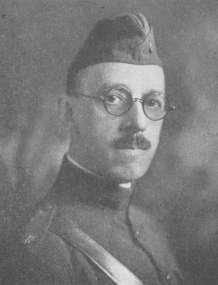
By Wesley T. Lee
Wesley T. Lee
Commissioned Captain August
27, 1917. Promoted to Major February 17, 1919. Base Hospital No. 44 U.S.
and A.E.F. Pougues-les-Eaux and Mesves Hospital Center. Overseas France,
nine months. Discharged April 30, 1919.
Foreword
THE purpose of this story is
to furnish a briefly comprehensive account of the wanderings and work of
United States Army Base Hospital Forty-Four. No attempt is made to
describe in detail the activities of the Unit, or to give a complete
statistical statement of its accomplishments. To those who were
participants in “The Battle of Pougues” memory will supply an
endless succession of interesting, exciting, amusing, and trying
additions: they will “read between the lines” a vast number of
incidents and experiences which space and wisdom make it inadvisable to
publish. To any “non-combatants” perusing these pages,
imagination must produce the coloring necessary to render the picture
sufficiently vivid.
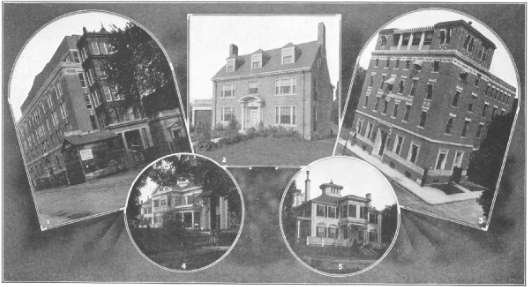
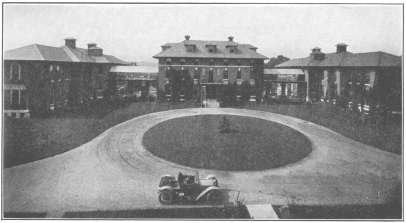
Massachusetts
Homeopathic Hospital.
1. Maternity and Out-Patient
Department. 2. Superintendent’s Home. 3. Evans Memorial.
4. Nash Home for Convalescent Men. 5. Sunnybrook Home for Convalescent
Women.
Attention !
ONE of the most important
lessons which have been learned from the wars of the past is that the
proper care of the sick and wounded and careful attention to the sanitary,
hygienic, dietetic and other measures which are employed to prevent the
development of disease largely determine the efficiency of the army.
Within a comparatively few years the most elaborate practical scientific
methods have been evolved and perfected for the prevention of disease and
the care of disabled men in the service. To the hospital corps has been
delegated the task of caring for the sick and wounded, and the functions
of the various units comprising this essential branch of the service have
been thoroughly worked out. Not the least in importance of these several
departments constituting the hospital corps is the base hospital, which
functionates as a clearing house between the field and evacuation
hospitals, situated comparatively near the area of combat, and the
general, special, rest and recreation institutions located at long
distances from the firing lines.
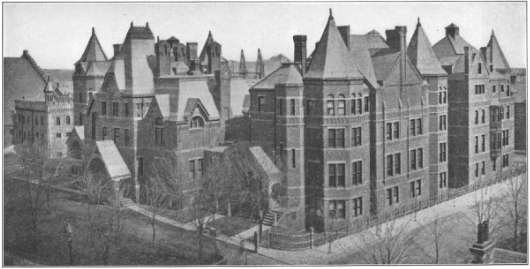
Haynes Memorial
Hospital for Contagious Diseases.
Massachusetts Homeopathic
Hospital.In peace times the maintenance
of a small, well organized, and efficient hospital corps is sufficient to
care for the incapacitated members of the standing army; but, immediately
upon the declaration of war, it is necessary to enlarge tremendously this
branch of the service. To be prepared to meet war conditions, base
hospital units representing civic interests and enrolled under the
American Red Cross are organized for military emergency. Such hospitals
have no connection with the army until accepted by the United States
Government, when they automatically pass from the control of the Red Cross
to that of the War Department. These hospitals are developed in connection
with large medical institutions, the professional personnels being chosen
from the staffs of the hospitals, and the necessary supplies being
provided by the institutions. In this way complete base hospitals with
entire personnels and full equipment are organized under the authorization
and control of the American Red Cross ready for transfer to the Government
in case of emergency. When mobilized for active duty, each base hospital
is supplied with executive officers by the War Department, consisting of a
commanding officer, an adjutant and a quartermaster.Such a unit possesses many
advantages. It is organized and equipped without expense to the Government
; its staff is composed of men who have worked together and who are
familiar with each other’s abilities and methods; its activities have the
moral and financial backing of a large and interested clientele; and its
personnel is stimulated to its best efforts by a desire to do credit to
the mother institution.
Massachusetts
Homeopathic Hospital, Boston, Mass.Taps
The following facts briefly summarize the work of Base
Hospital Forty-Four:Date of mobilization: March 10, 1918
Date of leaving America: July 6, 1918
Date of arrival in Liverpool: July 17, 1918
Date of arrival in Pougues-les-Eaux: July 26, 1918
Date of transfer to Mesves: Dec. 15, 1918
Date of departure from Brest: April 7, 1919
Date of arrival in America: April 20, 1919
Date of mustering out: May 2, 1919Number of days of home service: 129
Number of days of foreign service: 289
Total number of days of service: 418Number of commissioned
officers:
Original: 37
Attached for temporary duty: 6
Total: 43
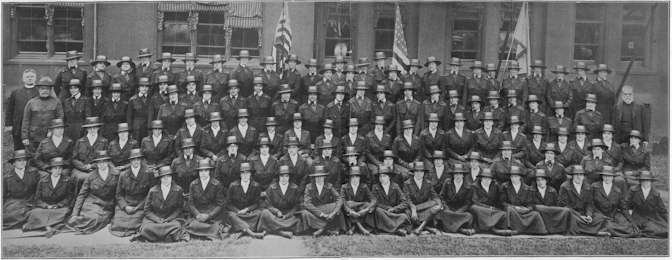
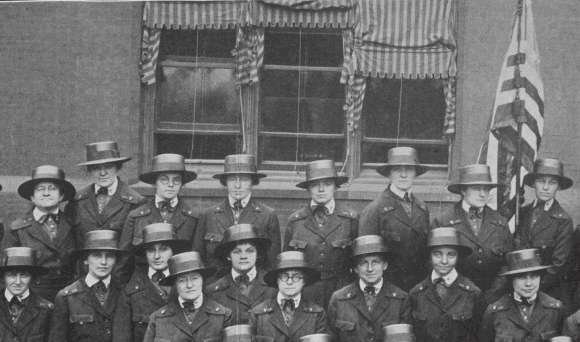
Nurse Corps, Base Hospital
No. 44. (Full Size 220 Ko)
Number of nurses: 100
Number of nurses serving with Base Hospital Forty-Four: 38
Number of non-enlisted personnel: 6Number of enlisted personnel:
Original overseas organization: 200
Temporarily attached, and transferred before Unit left for France: 27
Attached to Unit in France: 15
Total: 242Total number in personnels: 391
Deaths:
Nurse corps: 1
Non-enlisted personnel: 1
Enlisted personnel: 3
Total 5Number of days of actual hospital work: 161
Normal capacity of hospital: 1200
Emergency capacity of hospital: 1750
Total number of patients treated: 3681
Highest daily census of patients: 1712
Number of dental treatments . 2267
Number of eye, ear, nose and throat treatments: 4641
Number of X-ray examinations: 623
Number of surgical operations
– Result of battle casualties: 116
– Due to other causes 82
Total 198Number of laboratory examinations: 2677
Number of deaths of patients: 33
Number of autopsies: 26
Nurse Corps, Base
Hospital No. 44.
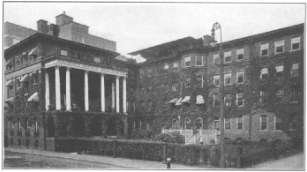
Nurses’ Home.
Massachusetts Homeopathic
Hospital.