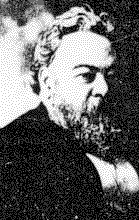
by Peter Morrell

JOHN HENRY CLARKE [1853-1931]
John
Henry ClarkeClarke graduated in
Edinburgh in 1877 and then studied homeopathy in Liverpool under
Berridge. Burnett had also settled and practised near to Liverpool
before moving to London in 1881. Liverpool at that time rivalled London
as an important centre of homeopathic teaching. It was also the major
west coast port and linked to the USA by ship.Burnett and Clarke
stand out as the two most important members of the Cooper Club. They
were at once the most heretical, the most interesting and the most
deeply critical and experimental homeopath of their generation and the
finest figures in British homeopathy at the turn of the century, not
only in their own opinion but also in that of their immediate successors
like Wheeler, Blackie, Tyler and Weir. They were traditional
Hahnemannians, but who somehow managed to retain a critical and
open-minded attitude about all new developments taking place in the
wider field of medicine in general.
Dr
BurnettBurnett and Clarke
revolutionised British homeopathy by importing and integrating into it
every new development, such as isopathy, as well as weaving back into
the fabric older heresies like Rademacher and Paracelsus along with new
ideas like high potencies and miasm-based ‘nosodopathy’. They produced a
rich blend of the old and the new; of tradition and of experiment. In
this sense they developed for UK homeopathy a unique ‘broad church’
tradition to pass on to their successors. But in many respects the
strength and value of this heritage has been ignored, and misunderstood.
It is a very tangled tale historically and in the development of ideas
within homeopathy.Cooper, Hughes,
Schuessler and Burnett all tended to use the lower potencies and the
tinctures of the remedies. It might be tempting to think that they
believed in materialistic notions, except Cooper and Burnett, and
followed an organopathic or physiological version of homeopathy. Their
views may appear dominated by the grosser and more physical aspects of
disease, of anatomy, pathology and morbid symptoms. Certainly this was
true of Hughes and Dudgeon, who were very like modern allopaths in their
thinking. In the case of Schuessler, his ‘Tissue Salts’ were based upon
the 12 salts commonly found in normal body cells and he tended to stress
the mineral and structural aspect of the body, rather than any type of
metaphysical orientation. It is not true of the others. Yet low
potencies like 3x were the norm for most of the 1800s.By contrast, Skinner
and Clarke tended to use the higher potencies and many of the new
nosodes. Skinner, Burnett and Clarke introduced many new nosodes into
homeopathy, especially cancer ones. Examples include Melitagrinum,
Morbillinum, Nectrianinum, Scarlatininum, Bacillinum testium,
Coqueluchinum, Carcinosinum, Epihysterinum, Ergotinum, Hippozaeninum and
Schirrhinum of Clarke [see Allen, 1909, pp.559-576] and the Bacillinum
of Burnett [‘a maceration of a typical Tuberculous lung introduced by
Dr. Burnett’, Boericke, 1927, p.101].Some early homeopath
became distinguished for their inventiveness as allopaths before their
conversion, a fact which is rarely mentioned today and not widely known.
That applies both to Burnett and Dudgeon, but especially to Skinner, who
designed the ‘Skinner Mask’ for the administration of chloroform,
and alter the ‘Skinner Potentising Machines’ [see Winston, 1989].Clarke later described
the other leading members of the Cooper Club as ‘the three most
potent influences on the evolution of British Homeopathy today’, and
wrote in 1901 after Burnett’s death: ‘It is not too much to say that
during the last twenty years, Burnett has been the most powerful, the
most fruitful, the most original force in homeopathy.’ Clarke was
himself a physician to be reckoned with, and in time the author of a
medical encyclopaedia which rivalled that of Hughes, his old enemy, and
the man who had kicked him out of the British Homeopathic Society. And
the same Hughes who Kent called ‘that skunk I will fight to the end
of my days’. What wonderful respect for each other some homeopaths
had.
Clarke’s Use of Potency
Clarke used a diverse
range of potency, as we can see by sampling references made to potencies
given in his The Prescriber [1924]. I have used a sample of 12
randomly selected pages in Clarke’s book. Thes results show that Clarke’s
commonest, amounting to 184 out of 469, is for potency 3c; that is 39%.
His next commonest is 6c 120 or 25.6%. 39 are for 30 which is 8%. 27
entries are for 1c which is 5.8%. Compared with most of his
contemporaries, who were mainly using 3x, Clarke was quite clearly a ‘high
potency man’. The highest potency recorded is 100c.
The Central Importance of Dr. Clarke
Two people in
particular formed the important bridge linking nineteenth-century
homeopathy with the homeopathy of the new century. These were Drs John
Henry Clarke in Britain and James Tyler Kent in the USA. We shall look
at both in some depth. They are both important as they were to influence
very profoundly the type of homeopathy practised, its quality and
popularity.Clarke soon became a
very important UK homeopath, publishing many influential works, many
aimed, like The Prescriber, at the amateur practitioner.
Embittered by the hostile reaction of his orthodox brethren to
homeopathy and by its sinking into further decline, Clarke left the British
Homeopathic Society [BHS] in disgust in 1907 and never returned to
the fold despite repeated attempts to woo him back [e.g. Sir John Weir].
Meanwhile he taught many laypersons the rudiments of homeopathy, some of
whom later became important in their own right. Three such were Canon
Roland Upcher, Noel Puddephatt and J Ellis Barker. Other members of the Cooper
Club might also have taught laypersons.While Dr. Clarke had
established himself as a very successful and highly influential London
homeopath in the 1870s, he fell out with figures like Hughes and
Dudgeon, who controlled the movement, to such an extent that all offices
became closed to him, except the editorship of The Homeopathic World,
which he retained to the end. He left the BHS in disgust in 1908, never
to ‘return to the fold’ [see Bodman, 1970, pp.190-91]. He thus became a
powerful ‘loose cannon’ and effectively divided the movement. This was
so for two main reasons.Firstly, he was wholly
disenchanted with the direction English homeopathy had taken. He
disliked the way it eventually failed to continue challenging allopathy
or winning many new converts to its dwindling ranks, especially after
1900. It simply ‘gave up’ in his view and came to occupy an all-too-cosy
niche within Victorian society, devoting itself mainly to serving rich
upper-class clientele. He started to teach laypersons all about
homeopathy [e.g. Upcher, Puddephatt and Barker], and towards whom many
of his books were directed, and he became increasingly convinced that
its future lay with them rather than with servile doctors who had ‘sold
out’ to allopathy. This very radical viewpoint turned out to be an
accurate premonition, really, as subsequent history has shown.Single-handedly, by the
1920s, Clarke had created a completely divided movement, composed of
doctors on the one hand, and lay practitioners on the other. And it was
mainly the latter who carried British homeopathy forward throughout the
dismal 1930s, 40s and 50s, their light never dimming. Yet the two
strands had little contact with, and only contempt for, each other. Even
in the 1960s, homeopathy was still very much a ridiculed medical
minority and in decline. Not until the late-70s did it start taking off
again, due mainly due to the lay revival, rather than any action on the
part of the doctors who, in fact, did very little to promote homeopathy
[see section on Ellis Barker].It is quite true that
Clarke was a typical early-century right-wing fascist and an
anti-Semite, which does not endear him to anyone today. How strange,
therefore, that he formed such a fruitful allegiance with J Ellis
Barker, who was probably a ‘left-winger’. All that united them, I
imagine, was homeopathy and a desire to ‘do something with it’ and ‘put
it back on the map’. Barker was handed the editorship of The
Homeopathic World in the spring of 1932, just after Clarke died, and
this rather stage-managed event must have caused considerable
embarrassment within UK homeopathy; a pervasive horror, really, that
this prestigious position hadn’t been passed, as expected, to another
doctor, but to a lay practitioner and a German immigrant to boot!
Clarke’s revenge must have been sweet, even from the grave.With some
justification, Clarke regarded his fellow doctors as traitors of
homeopathy, who had succeeded only in turning themselves into the easily
manipulated and servile puppets of their rich aristocratic clientele. He
regarded them with considerable contempt. Thus Dr. Clarke was probably
the single most important English homeopath of this century. In terms of
bold and experimental ideas and methods; for his writings; for his
fierce independence; his great energy, which he poured into homeopathy
with abandon; as a political force within the movement; and finally for
his deep radicalism re lay practice, he towers over all the rest. From
him flows nearly every tradition or strand within the fabric of modern
British homeopathy, other than Kentianism.
Dr Charles Edwin WHEELERYet it is surely rather
ironic, that a right-wing fascist hould come to be the one who turned
his back on the stuffy omeopathic establishment, accusing them of humbug
in their failure to give homeopathy to the masses! Ironic also that it
took his alliance with the Marxist, Barker, to establish a new lineage
of British homeopathy, wholly devoid of any roots within the class
system, and thus to truly transform it into a ‘tool of liberation’ Ivan
Illich-style. [Ivan Illich, 1977, Limits to Medicine, Penguin,
London]The ‘Cooper Club’
continued to meet even after the deaths of Skinner, Burnett and Cooper,
and up to the 1920s, mainly with Clarke, Wheeler, Tyler and Weir.
SOME STUDENTS OF DR. CLARKE
Clarke taught several
important lay prescribers, most notably Noel Puddephatt [1899-1971] and
J Ellis Barker [1869-1948]. He was also a close friend of the aristocrat
Canon Roland Upcher [1849-1929] who was a member of the Landed Gentry
and whose family owned Sheringham Hall in Norfolk. Clarke was also a
member of the Cooper Club with his friends Cooper, Burnett and Skinner.