Main
Pathogénésies
de l’an 1900
New, Old And
Forgotten Remedies
By Edward
Pollock Anshutz
Presented
by Dr Robert Séror
Blatta
Orientalis
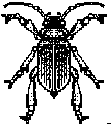 Synonym
: Indian cockroach,
Class
: Insecta.
Order
: Orthoptera.
Common Name
:
Indian, Talapoka.
Preparation
:
Triturate in the usual way.
(These two papers are by Dr. D. N.
Ray,
of Calcutta, India, and were originally published in the Homeopathic
Recorder in the years 1890 and 1891. A number of papers from American
physicians could be added confirming what Dr. Ray
says of the drug)
The
Blatta
Orientalis is a
common insect in India, where it is found abundantly in the dwelling
houses. it has rather a flat body, from an inch to a couple of inches in
length ; deep brown color.
It can fly a short distance.
The wings reach beyond the body and cover it completely ; the feet have
several segments and are provided with prickless.
I
Preparation
: The
live animal is crushed and triturated as under Class IX of American
Homeopathic Pharmacopoeia, a tincture can be prepared as under Class IV of
the same Pharmacopoeia.
This new unknown remedy has a curious anecdote connected with it.
I call it new because it has not been mentioned in any of our medical
works, although the use of
Blatta
Americana (American
cockroach) as a remedy for dropsy has been mentioned in journals.
The Indian cockroach is use not in cases of dropsy but in cases of
Asthma,
a most obstinate
disease to deal with. In asthma it acts almost specifically.
Before I further proceed to give an account of this new, invaluable
drug I shall narrate here a short story how it came into use.
Some years ago an elderly gentleman bad long been suffering from
asthma, for over twenty years.
He took all measures and tried different methods of both recognized and
unrecognized medical treatments, but unfortunately all proved in vain. At
last he gave up all treatment and was getting fits daily.
He was brought to such a deplorable condition that he was left to
suffer. He was in the habit of taking tea.
One afternoon as usual be drank his cup of tea-afterwards he noticed
that his oppression in the chest was much less and that he was feeling
unusually better, so much so that he felt himself a different being.
This led him and his friends to inquire into the cause of it. He
immediately inferred that the relief was due to the drinking of the
tea,
although he
habitually drank the same tea but never before had experienced any such
changes.
So this change he attributed to something in the tea. The servant who
prepared the tea was sent for and questioned. His reply was that he made
the tea as usual and there was nothing new in it.
The residue of the teacup was carefully examined, nothing was found
there, but on examining the tea-pot a dead cockroach was discovered.
So it was concluded that this
infusion
of cockroach did
the gentleman a world of good.
The very day he drank that
cup
of tea he
had hardly any fit of asthma at night, and in a few days he got
entirely well to his and his friends’ surprise.
The accounts of his providential recovery were communicated to some of
his friends-one of them, not a medical man, but quite an enterprising
gentleman, took this into his head and resolved to try whether cockroach
does any good to other asthmatic patients.
For this purpose he got a lot of cockroaches, put them alive into a
quantity of boiling water and mixed it after filtering the water when cool
with almost the same quantity of the rectified spirit of wine, so that it
might last for some time without getting soured. This new mixture (or
tincture) he began to try in each and every case of asthma that he came
across.
The dose was a drop each time, 3 or 4 doses daily, and more frequently
during the fits of asthma. Within a short time he made some such wonderful
cures that people began to flock from different parts of the country to
his door.
Soon the number of attendants was so great that he had to manufacture
the medicine by pounds and all this medicine he distributed to patients
without any charge. He has records of some of the cases.
Some two years ago a patient of mine asked me whether we make any use
of
Talapoka
(cockroach) in our
Pharmacopoeia. My reply was that we use many loathsome insects as our
remedial agents.
I told him also that
Blatta
Americana (American
cockroach), I had heard, had been used in cases of dropsy, but I had no
practical experience with it. He then said the Indian cockroach is used in
cases of asthma and he knew several cases had been cured with it.
This struck me and I deter mined to try this in cases of asthma
whenever next opportunity occurred.
For this purpose I got a lot of live cockroaches, killed them and
pounded to a Re pulp and triturated according to Class IX of American
Homeopathic Pharmacopoeia, that is, two parts by weight of the substance
and nine parts by weight of sugar of milk, giving IX trituration.
Thus I prepare up to 3x trituration and I also make an alcoholic
solution – a few live cockroaches were crushed and five parts by weight of
alcohol poured over them – It was allowed to remain eight days in a dark,
cool place, being shaken twice daily.
After the expiration of that period the alcoholic solution was poured
off, strained and filtered, when it was ready for use.
I began to try both the preparations-drop doses of the tincture and
grain doses of IX, 2x and sometimes 3x, 3 or 4 times daily when there was
no fit and almost every fifteen minutes or half hour during the severity
of a fit.
Both preparations began to answer well and I was getting daily more and
more encouraged about the efficacy of this new drug.
I had the opportunity of trying quite a number of cases of asthma
within this short time, the reports of which I wish to publish in the
future, but for the present I am glad to say in many cases it acted almost
specifically, that is, the whole trouble cleared away within a fortnight
or so without recurrence.
In some cases the severity of the paroxysm was lessened and the
recurrence of the fits took place at a longer interval ; in others again
only temporary benefit was observed. This failure to benefit all cases
alike I attribute to many circumstances.
Some people did not, rather could not, take the medicine regularly
according to my directions owing to their untoward circumstances ; some
persons were suffering from other complications along with asthma ; some
again got temporary relief and in the meantime discontinued the medicine
and came back again when there was a recurrence of the fits, that is, they
did not continue the drug for sufficient length of time.
Some cases again, not having derived immediate benefit, got impatient
and discontinued the medicine without proper trial. Besides all these, I
think individual idiosyncrasy has a great deal to do.
The season of the year has some influence. It is usually observed in
this country that those who are subject to periodical attacks of asthmatic
fits are more prone to an attack either during the full or the new moon,
or at both the times.
I believe if it is properly watched this fact will be evident all over
the world. Same is true of some other diseases, as chronic cough, chronic
fevers, rheumatism, either acute or chronic, gout, elephantiasis, other
glandular enlargements, etc., get aggravated or are prone to aggravation
during such changes of the moon.
Then some people get more severe and frequent fits during the winter
than, the summer and the others more during the summer than the winter.
Let me here tell you that the Indian summer is very different from either
the English or the American.
Some part of the Indian summer season is quite rainy and the atmosphere
is saturated with moisture and other irritating ingredients, consequently
a class of asthmatic people suffer more during this season.
I noticed to this class of cases
Blatta
Orientalis will
prove most efficacious.
I have used it in bronchial and nervous asthma with better success than
the stomachae.
Second Paper
I have of late tried
Blatta
Orientalis indiscriminately
in almost all cases of asthma that have come under my treatment, and I am
glad to say I have received good results in most cases, as the reports of
some of the clinical cases will show.
I have not come to any definite use of this drug yet, but I shall only
mention a few facts that I have observed during its use.
It acts better in low potency and repeated doses during an attack of
asthma ; when the spasm subsides, the terminal asthmatic cough, with
wheezing and slight dyspnea, etc., is better relieved with higher
potencies ; the low potency if continued after the spasmodic period is
over, will make the cough more troublesome and harassing to the patient
and the expectoration tenacious, thick and very difficult to raise, but
this will not be the case if the potency is changed.
I had this difficulty in a few cases when I was less acquainted with
the action of the drug, but now I manage my cases better.
In four patients who continued the drug for some time in the low
potency, during the paroxysm and after it was over, the cough became dry
and hacking with little or no expectoration, then streaks of blood
appeared in the sputa, which the patients had never observed in the course
of their long illness.
This appearance of blood in their sputa was the cause of a great
anxiety to them and made them hurry over to my office.
On inquiry I learned from two of the one a lady and the other a young
man, that while taking this remedy they felt a sensation all over the
body, for four or five days previous to the appearance of the blood, as if
heat were radiating from the ears, eyes, nose, top of the head, palms of
the hands and soles of the feet.
They attributed this sensation of heat all over the body and the
appearance of the blood in the expectoration to the drug.
I directed. them to stop the medicine at once ; this they did, and with
the discontinuance of it the blood disappeared from the sputa as well as
the sensation of heat, but to me it was an open question whether this
appearance of blood in the expectoration was due to over drugging,
although I must say that the presence of the streaks of blood in the sputa
of asthmatic patients is not an uncommon phenomenon.
I resolve to give the same potency to the same patients after the lapse
of some days. I did so, and to my surprise the. blood-streaked sputa again
appeared after they had taken the remedy I X, one grain, four times daily.
From this the patients understood it was the same medicine that had
been given to them on the last occasion and begged me not to give it
again, as the appearance of blood in the sputum frightened them, in spite
of all my assurance.
No more strong doses of the drug were given to them and they did not
notice any more blood in the sputum.
I have heard other patients complain of this peculiar sensation of heat
whenever strong doses were given to them for some time.
It acts better on stout and corpulent than on thin and emaciated
persons.
The asthmatic patients subject to repeated attacks of malaria derive
less permanent benefit from the use of the drug.
So, it seems to me, that in hemic asthma, which is due to the abnormal
condition of the blood, it is efficacious.
I have also used this drug in troublesome cough with dyspnea of
phtisical patients with good result.
Clinical
Cases
Case I
Baln R. M., aged
fifty-five, thin, emaciated and irritable temperament, has been suffering
from hereditary asthma for the last twenty-five years.
For the last six or seven
years he suffered from asthmatic fits almost nightly and a troublesome
cough with a good deal of frothy expectoration.
He said he had not known
what sleep was for the last six or seven years, in fact, he could not lie
down in bed, as that would immediately bring on a violent fit of coughing
which would not cease, until he sat up, so the recumbent posture for him
was almost impracticable, and he used to sit up during the night and doze
on a pile of pillows.
He passed his days
comparatively better, but the approach of the night was a horror to him,
his struggle, commencing at 9 or 10 P.m., would last till the morning.
He was the father of many
children and was well taken care of, but his suffering was so great that
he had no ambition to live any longer. He tried almost all systems of
medicine without much good.
For the last ten years he
took opium, which afforded him slight relief at the beginning, using as
high as forty eight grains of opium in twenty-four hours.
Owing to the constant
sitting posture he became stooped, and the back of his neck stiff and
painful.
In April, 1889, he was
suddenly taken ill with fever.
The fever became
protracted. After an illness of over a month his condition became so bad
that all hope of his recovery was given up.
During this illness he was
treated by an old school physician of some repute, but his condition daily
grew worse, the asthmatic attacks became very violent and almost
incessant, and the difficulty of breathing very great.
He became so feeble that he
had not strength enough to enable him to bring up the expectoration ; his
chest was full of it ; fever was less ; there was general anasarca.
He was sitting with head
bent forward, almost touching the bed, as that was the only position
possible to him day and night.
He had become almost
speechless, when I was sent for, at about 3 P- M. on the 23rd of May,
1889.
When I was entering the
patient’s room a medical man came out and hinted that there was no use of
my going in as the patient was just expiring.
I found the patient
breathing hard ; unconscious ; jaws were locked and saliva dribbling from
the corners of his mouth; body cold ; cold, clammy perspiration on
forehead ; eyes partially opened ; in fact, to all appearance, be looked
as if he were dead, except for the respiratory movements.
I felt his pulse and found
it was not so bad as the patient was looking.
I examined the back of his
chest, as that was the only portion easily accessible, and noticed that
the bronchial spasms were going on with loud mucous rale.
From the character of his
pulse I thought that the present state of the patient was probably
due to the continued violent struggle and not deep coma, and that he
bad become so exhausted that he was motionless, speechless and completely
unconscious.
His bed was surrounded by
many friends and relations, who had come to bid him a last farewell ; and
it was with surprise that they all looked at me when I proposed to
administer medicine to a patient whose death was expected every minute and
for whose cremation preparations were being made.
I got a big phial full of
water and put in it Blatta Orientalis IX
trit. a few grains and tried two or three times to give him a spoonful
of it, but in vain ; the jaws were locked and I could not make him swallow
any of that medicine ; then I put some powder dry in the hollow of his
lips and asked the attendants to try to give him the medicine. I left in
the bottle.
I was asked whether there
was any hope. of his recovery, of course my answer was “no”, and
I also said he could only live a few hours.
I left the patient’s house
with the idea of not visiting it again, but at 9 P. m. a messenger came
with the report that the patient was slightly better, he could swallow
medicine and two doses of it had been given. I was asked to see the
patient again.
I could hardly believe what
lie said, however, I went to see the patient again.
I noticed there was a
slight change for the better, the pulse was steady, the jaws were
unlocked, there was mobility of the limbs, he could swallow liquid with
ease and was expectorating freely, the breathing still difficult was
slightly improved.
There was the winking of
the eyelids. On the whole he was looking less lifeless, but still I
entertained no hope of his recovery.
I left instructions to
repeat the same medicine once or twice during the night, if required, at
the same time to give milk repeatedly, one or two spoonfuls at a time, and
to inform me next morning if he had survived the night.
Next morning I really grew
anxious to know what had become of my patient who had shown symptoms
slightly better with this new remedy.
A messenger came with the
report that the patient paved a good night. I was requested to see him
again. When I arrived at his place at 8 A. m.
I was surprised to see him
so much better, he had not only regained his consciousness, but was
sitting quietly in his bed, could speak slowly, the difficulty of
breathing was completely gone, but the cough occasionally troubled him and
a good deal of expectoration of frothy white or sometimes of big yellowish
lumps of mucus came up.
He was given three doses of
the same medicine 2x trit. during the day.
He passed a fair day, but
at night his difficulty of breathing again appeared in somewhat milder
form. He bad to take two doses of the medicine. Thus the medicine was
continued for a week and his trouble daily became less and less until
after the expiration of a week he was able to sleep at night for the first
time in the last six or seven years.
I treated him over a month,
and his health improved so rapidly that he not only got rid of the
asthmatic trouble, but was soon able to go out and even attend his
business.
The stooped condition of
his neck with slight pain and slight chronic bronchitis did not leave him
altogether.
Besides Blatta
Orientalis, I also prescribed for him Arsenicum
alb. 6 and 12, Naja tri. 6,
Ipecac 3, and Antim. tart, 3, as they were indicated.
He continued well for over
a year, but in August, 1890 he had slight reappearance of the asthmatic
trouble. He again took Blatta Orientalis
and got well.
Case II
Mrs. Nundy, a thin lady, aged twenty-three, mother of three children,
came from a village for the treatment of asthma, from which she had been
suffering for the last eight years.
For the first two or three years she used to get two or three attacks
in the year, but gradually they were repeated more frequently, though the
character of the attack remained the same throughout.
It would last two days and two nights, whether any medicine was given
to her or not.
Nothing would alleviate her suffering during an attack – too much
interference would increase her sufferings and prolong the duration of the
attack, so, practically speaking, almost nothing was given to her during
an attack.
The great oppression of breathing, restlessness, profuse perspiration,
inability to move or lie down and loud wheezing would be the most
prominent symptoms in each attack.
These would remain almost with equal violence for nearly forty hours,
when the spasms would cease with slight cough and expectoration, and she
would be perfectly at ease as ever, and there would be no trace of disease
left, except slight wheezing sound on auscultation.
But latterly these attacks were very frequent, almost every week or ten
days.
In August, 1890, she was brought here for treatment.
It is worth while to mention that she took both allopathic and native
drugs during the interval of attacks to prevent their recurrence, but
without any effect.
I saw her first on the morning of the 5th of August, during an attack.
I prescribed
Blatta
Orientalis IX trit.,
one grain every two hours.
It was to their surprise that this attack subsided unlike all others by
the evening ; that is, it disappeared within twenty hours.
This encouraged the lady and her husband so much that she wanted to
have regular course of treatment under me.
I put her under tincture of Blatta orientalis IX, one drop per
dose, twice daily. She continued this medicine till the time of the
Y%011111next attack was over ; that is, for ten days.
After the expiration of this period she began to complain of a
sensation of heat all over her body, so I changed it to 3x, one drop
morning an evening.
She kept and after a month she went home thinking she got well.
A month after her going home she had an attack of asthma at night and
took
Blatta
Orientalis IX, as
before, and by the next morning she was well.
This was in October, and after two months of the last attack.
She had another attack in winter and none since.
Case III
A young man, aged thirty-four, had been suffering from asthma for some
years.
He was invariably worse during the rains and the winter, and a chronic
bronchitis was almost a constant accompaniment.
He tried allopathic and lots of patent drugs, with only temporary
amelioration of the trouble.
At last, in November, 1888, he came to my office.
On examination of his chest I found there was a chronic bronchitis.
He said that slight difficulty of breathing with backing cough used to
trouble him every night, besides a cold would be followed by a severe
attack of asthma, so its periodicity of recurrence was irregular.
I treated him with
Ipecac,
Arsenicum alb., etc.
The first-named medicine did him the most good, but he never got
entirely well.
So in July, 1889 I put him under tincture
Blatta
Orientalis 3x, drop
doses, three or four times daily.
Under its use he began to improve steadily, and had only two or three
attacks of asthmatic fits since he used this drug, which were promptly
relieved by the same drug in IX, potency.
Euphrasia off
. was
prescribed for his cold whenever he had it.
He is free from all trouble for the last year and a half.
His general condition is so much changed that there is no apprehension
of the recurrence of his former illness.
Case IV
Balai Bose, an old, corpulent gentleman, aged sixty-two, has been
suffering from asthmatic attacks for some years.
He never took any allopathic medicine, but had always been under
treatment of native kabiraj (medical men), under whose treatment he was
sometimes better and worse at others.
Latterly he became very bad and passed several sleepless nights.
He used to pass his days comparatively better, and it was at night and
in the morning he used to be worse.
On the 24th of July, 1890 at 9 A.M. I saw him first – there was a
slight touch of asthma even then.
I made him try to lie down in bed ; this he could not do, owing to the
coughing fit it excited while in that posture.
On examination the chest revealed chronic bronchial catarrh, and there
was also a harassing cough, with very little expectoration after repeated
exertion.
I prescribed
Blatta
Orientalis IX, trit.,
one grain every two hours.
He passed the night without an attack, and the next morning when I saw
him he complained that only the cough was troublesome last night and no
fit of asthma.
The cough was somewhat troublesome even when I saw him in the morning.
I gave him tincture
Blatta
ori, 3x, one
drop dose every two hours.
He passed the day and night well. He continued the treatment for a
fortnight and then went home, where he has been keeping good health, with
the exception of an occasional bronchial catarrh.
Case V
A shoemaker, aged forty-two, robust constitution, has been suffering
with asthma for three or four years.
He came to my office on the 6th of November, 1890. He had been getting
asthmatic fits almost every night since October last.
During the day troublesome cough, with slight expectoration and hurried
breathing, made him unable to attend his business.
Tincture
Blatta
Orientalis IX, one
drop doses, six times daily, was given.
The very first day he perceived the good effect of the medicine and
continued the same for a month, when he got well and discontinued the
medicine. He has been keeping well ever since.
Case VI
Mr. G., aged forty, healthy constitution, had an asthmatic fit on the
4th of August, 1890, preceded by a violent attack of cold, from which he
frequently used to suffer.
He had this severe cold in the morning, and in the afternoon he began
to experience a great difficulty of breathing and slight oppression and
lightness of the chest – this, developed into a regular fit of asthma.
I was sent for. On my arrival, at 10 P.m., I found he was sitting
before a pile of pillows with elbows supported on them, and struggling for
breath.
There was also a great tightness in the chest, occasional cough, and
inability to speak.
I at once put him under
Blatta
Orientalis IX, trit.,
one grain every fifteen minutes, and less frequently afterwards if he felt
better.
On my visit next morning I found him much better, but he said this
trouble at night continued, more or less, till 2 A.M., after which he go
some rest.
Now, there was a troublesome cough, slight oppression of the chest and
great apprehension of a second attack in the night.
The same medicine, 3x trit., was given to him during the day, and a few
powders of IX, were left with him in case he was to get an attack at
night.
There was a slight aggravation of those symptoms at night, and he had
occasion to take only two powders of IX,
The next morning he was every way better, except the cough, for which
four powders of 3x were given daily.
In four or five days he got entirely well and had no relapse.
Case VII
Mrs. D., aged twenty.. a healthy, stout lady, mother of one child, had
been always enjoying good health, was suddenly attacked with a violent fit
of asthma on the 8th of August, 1890.
This was the first occasion she had a fit of asthma, the result of a
severe cold.
At about 2 A.M. she was suddenly seized with difficulty of breathing
and a great oppression in the chest.
She could not lie down any longer in bed and had to sit up, being
supported on a pile of pillows. In the morning at 8 A. M. I saw her first.
I noticed she was in great agony and almost speechless. On examination
I could not detect much loud wheezing – the characteristic of an asthmatic
attack – though the rapid movements of the walls of the chest were even
quite visible to the bystanders.
The patient was feeling almost choked up, and could not express what
was going on. She only pointed out a point, a little over the pit of the
stomach, most painful.
There was no cough, perspiration was pouring over her body. I could not
at once make out whether it was a case of pure asthma, especially as she
never had it before.
However, I made up my mind to give her
Blatta
Orientalis IX trit.,
a grain dose every fifteen minutes, and watch the effect myself.
Three doses of it were given without much change for the better. I left
a few more doses to be repeated half hourly and promised to see her again
within a couple of hours.
On my return I found her in a much better condition, and she had taken
only one of these powders I had left, and they were not repeated, as she
felt better.
Now I thought it must have been an attack of asthma, and I continued
the medicine unhesitatingly.
There was no aggravation at night, but on the next morning she was
better, and the usual asthmatic cough began with slight expectoration.
There was pain in the chest and head with each coughing fit.
Blatta Orientalis
3x
trit., four to six
doses, was continued for a few days, when she got well.
Again in November she had a slight tendency to an asthmatic fit, took
two or three doses of the same medicine and got well. Since then she had
not been troubled again.
Case VIII
A gentleman, the keeper of a common shop, aged forty-four, belonging to
a village, had been suffering from asthma for the last eight years and had
always been under treatment of native kabiraj (medical men).
In June, he came to the city, and I was called to see him on the 14th
of June, to treat him for his asthma.
The day previous he had an attack, for which he took no medicine.
Each of his attacks usually lasted four or five days.
I gave him
Blatta
Orientalis IX,
trit., one grain every two hours, and left him six such powders to be
taken during the day.
He took them and felt better the next day.
He stayed here two or three days more, and when well he wanted to
proceed home, which was some couple of hundred miles.
He took with him two two-drachm phials of
Blatta
Orientalis, one
of IX, and the other of 3x trit.
He continued the 3x, one grain doses, two or three times daily,
for a month, and discontinued afterward.
He had no more asthmatic fits.
In January last, 1891, I had a letter from him, thanking me for his
recovery and asking for some of the same medicine for a friend of his, who
had been suffering from asthma.
The friend of his who used the same drug,
Blatta
Orientalis, was equally
benefited.
Case IX
Mrs. Datta, a thin lady, aged thirty-eight, mother of several children,
had been exposed to cold, which brought on an attack of bronchitis with
fever.
This, in the course of a fortnight, developed into a regular fit of
asthma.
She was all this time treated by an old school physician, but when the
husband of the lady saw that she was daily getting worse, and a new
disease crept in, he made up his mind to change the treatment.
I was called to see her in the morning of the 8th of June, 1890.
She became very much emaciated, could not take any food, had fever with
acute bronchitis, hurried respiration, difficulty of breathing ; this she
was complaining of bitterly, owing to which she could not lie down in bed,
but had to sit up day and night.
There was a prolonged fit of spasmodic cough at short intervals, with
slight expectoration, but these coughing fits would make her almost
breathless.
This was the first time, I prescribed
Blatta
Orientalis 1X
in a case of asthma with fever and acute bronchitis.
It answered my purpose well.
She had only ten powders during the day and passed a comparatively
better night.
Next morning when I saw her she was better, except the coughing fits,
which were continuing as before.
The same medicine was repeated.
On the 10th of June she had no asthmatic trouble at night, but there
was not much improvement in her cough –
Antim.
tart, and Bryonia were
needed to complete the cure.
Collected, arranged and edited by Edward Pollock Anshutz
: New, Old And Forgotten Remedies. Papers by many writers. Philadelphia,
january 2, 1900.
Numérisation, reconnaissance, vérification,
arrangement et publication : Dr Robert Séror (MD)