Main
Pioneers
of homeopathy
by Dr Thomas
Lindsey Bradford
Presented by Dr Robert SérorC. W.
Fickel
Photo
not available
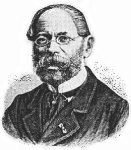
Dr.
FICKEL, C. W.
It may not be amiss to tell the story of one who, while pretending to
he a zealous Homoeopathist, yet really used every effort in his power to
bring the system into disrepute ; the strange tale of a brilliant but
thoroughly unprincipled man,Fickel.
He was a forger of provings arranged to appear to be the real result of
testing medicines upon healthy persons.For a time he succeeded in deceiving nearly the entire profession.
Rapou
says of this
brilliant rascal :
Dr Noack
In the year of
1831 the degree of Doctor of Medicine
was conferred by the University of Leipzig upon two young students, who were destined to exercise
upon our school very diverse influences.One was
Noack, who is among our most learned
writers : the other was Fickel.This last had conceived a plan to get himself received among the
practitioners
of the new art, and to publish for that right many experiences,
observations, imaginary pathogeneses, pseudonymous and false books, by
which he hoped to obtain the favor of his pretended colleagues.Thus it was that he proceeded to expose the fictitiousness, to
demonstrate the falsity of experiments accepted as tree : in a word, by
the power of an infamous management, to accuse of nullity all the
forthcoming work of the homoeopathic school and to acquire by this great
work of destruction an immense reputation. We know how it ended.A philologist of rare merit, of great erudition,
Fickel devoted himself and his talents with great
energy. Forthwith he left Leipzig
to go and develop his projects in the little Saxon village of Zwickau.The homoeopathist,
Haas, to whom we are indebted for a well
known repertory, lived here, and Fickel
sought to gain his friendship and to make himself familiar with his works
and ideas.Haas
communicated
all without reserve. Soon after Haas
received the following letter from Hahnemann ;” I send you in this a cutting libel against you and against the
little. book that you are publishing. It will appear in theGerman Indicator General.
The editor of that journal has sent it to me that I may know and
answer it in the following number. It will be easy for you to prepare a
refutation and to send it to me very soon that I may hasten its
publication in pamphlet form. I advise your answer to he calm and
tranquil, you will more surely gain public opinion.I count that best.”
Coethen, October 13, 1832.
Your devoted,
Hahnemann.This libel was signed,
Fickel.
This imposter, thus checkmated, withdraw his manuscript.A few days later there appeared at
Zwickau
a great number of copies of a caustic satire on Homoeopathy by Dr. Lekeif (anagram for Fickel).It was a beginning. This too transparent pseudonym was speedily –
changed to many other names unknown.He returned to
Leipzig with the intention of continuing
the projects so worthily commenced. He soon published a book entitled :” Practical Essays and Dissertations, upon many points in the
homoeopathic doctrines augmented by some new remedies for the use of the
whole world of physicians. By L.Heine, 1834.
At the same time he ingratiated himself with all the practicing
Homoeopathists, including his old classmate,Noack, assiduously cultivating his friendship.
One day thinking his plan sufficiently assured, and
Noack easy to convince, he invited him to pass the
evening in a wine shop, and spoke to him of an excellent speculation
consisting of publishing treatises on pathogenesy for which he knew the
booksellers would pay well, and for which they could easily prepare
schedules of symptoms.He insisted upon the advantages of arranging pathogenetic tables in a
manner to excite the curiosity of the professors.There was in medicine as illustrated by Homoeopathy, a large path open
to delusion and to deceit, that might be followed alike by conscientious
men and by charlatans, exact observers and enthusiastic spirits ; in the
search to discover the effects of remedies upon the healthy body.At the same time that a true disciple of the art devoted himself to
this laborious experimentation, writing at length the phenomena that he
observed, what should hinder the maker of dupes to lay upon paper a series
of symptoms, the fruits of his invention, and to publish them in a book as
the results of actual observation ?What other means, what manner more certain and easy to strike a fatal
blow to the new doctrine, and to spread confusion and error among the
knowledge needful for its practice ?Fickel
, repulsed
with indignation by Noack, commenced this work alone. He soon
published the one after the either, pathogeneses of the following remedies
: Aquilegia, Actea spicata, Triplex
olida, Cainca, Nigella, Bismuthum nitricum, Strontiana carbonica, Verbena
officinalis, Molybdena, and Osmium.He called this last the antipsoric above all others. These
publications, complete in all respects, and the appearance after1834, of many anonymous works, greatly attracted the
attention of the entire homoeopathic world.Some rejoiced to see homoeopathic literature so greatly enriched, and
thinking of this alone abstained from and praised complacently their
unknown author.Others, rendered suspicious by the pseudonym, subjected these
productions to a severe examination. The allopathic ideas modified to suit
theHahnemannian, the very complete pathogenetic
tables, the many successful experiments thus made, such as they had not
seen in practice, assisted in unravelling this tissue of lies.Stapf
and Arnold, without judging these works, praised their
tendency ; Gross had raised doubts regarding their
value, but Noack,
Trinks and Helbig, without consulting each other, reached the
bottom of the imposture.Trinks
distinctly
pointed out the authors to he knaves, who, under borrowed names,
contaminated and abused science. Helbig,
well read in the knowledge of the materia medica of the ancients,
recognized that the physiological effects attributed to Verbeca were to be found complete in an ancient
monograph on the Veronica ; that all the other pathogeneses
of this pseudo experimenter consisted in a collection of symptoms gleaned
like those ill studies formerly made upon other medicinal substances in
the manner of’ the eclectics, who borrow from every system to construct
their own.In
1835 he published, under the pseudonym
of Hofbauer, a book entitled : ” Homoeopathic Treatment of Surgical
Diseases,”
followed by the study of new and very important antipsoric (Osmium).The critics, good natured and inattentive, were disposed only to praise
this work that they regarded as homoeopathic, but those who were on their
guard appealed this time against these praises, against this foolish
criticism, that commended with closed eyes every production decorated with
the name of the new school.Everyone was aroused by these hard words. There was inquietude, a
general alarm.Noack now determined not to remain
inactive under the force of these perfidious attacks, but to discover
their source and to get at the root of this evil that thus threatened to
ruin our school.He carefully studied this book and recognized in it the results of the
insidious and impudent propositions thatFickel had made to him. He easily discovered in him the author
of these pathogeneses.Soon after he identified the pretended
Hein and Hofbauer as one and the same author.
Following these investigations he found out that the famous Real Lexicon, that great homoeopathic
encyclopaedia, edited by a society of physicians, was more the work of one
person, who alone composed the society mentioned, and with a fertility
marvellous, but very deplorable, had begun to change all the points of our
literature.Noack
sought to
induce the editor who had charge of the encyclopaedia sought confide in
known and conscientious physicians, and upon his refusal he denounced the
work as the production of an imposter. The editor, alarmed, hastened to
effect all agreement between Fickel
and Noack which resulted in a meeting.It was the intention to conceal near the place of meeting, and within
hearing, two persons, sent by a lawyer, to serve as witnesses in case the
affair should come before the courts.Fickel
avowed
himself a party to these maneuvres and renewed his old propositions. Noack resisted coldly and severely ; he insisted,
besought, and finally begged him not to divulge anything, and withdrew
with all expression of rage and menace.After this event
Fickel published two treatises upon the
allopathic practice, in which he exposed the falsity of our method with
such aplomb that he seemed to demonstrate his unshaken faith. Soon after
the appearance of these two volumes, under the pseudonym of Herting, followed a memoir of Hofbauer, in which he newly illustrated the logic of our
doctrines.It was impossible to remain longer a spectator of this work of darkness
; but what plan to follow ? To ruin completely a man of small fortune and
the father of a family ; to enter upon a scandalous suit ; thinking of all
thisNoack decided to write to him.
” You are entirely unmasked,” said he to him, ” but I
will, nevertheless, conceal all if you will promise me to renounce all
your projects.”Fickel
replied that
he would soon reveal the authorship of these works, that later all would
be explained, without Noack troubling himself ; that he understood the
spite with which he pursued him.He had, in effect, a good reason for dissimulating for some time
longer, andNoack, had also the mournful thought that
he could not as yet unmask him and that he would wait for a more favorable
occasion.Soon after there was to be a nomination for the post of
physician-in-chief in theHomoeopathic Hospital, left vacant by the departure of Schweikert.
After the bad management of this physician, and the disorder which he
had left in the institution, no one wished to occupy the position.Each one who had for a long time practiced in
Leipzig had gained a right in the direction of the hospital, but
no one presented himself as a candidate. Noack, who was holding himself back, found himself in a manner
carried to the front ranks in the suite of Fickel.Fickel
, to reveal
what lie knew of his character and of his works, was not possible at the
time. It was not expedient that he should accuse his rival.The intrigues of our knave overpowered the simple demand of
Noack. This viper entered the bosom of the new school,
the better to wound, penetrated this time to the heart.C. W. Fickel
was
nominated physician-in-chief to the Homoeopathic Hospital of Leipzig.From that time he had no farther wish for the management.
Noack prepared his work, presented before a justice
his accusation in due form, followed with the exposition of all these
facts, which he published in a little book under the title of “Olla” ` Podrida. “
(“Olla Podrida.” Ein Beitrag zur Literaturgeschichte der
Homoopathie. ist Heft : Lekciv, Ludwig Heine, Jul. Theod. Hofbauer, C. E.
Herting der Verein mehrer Homoopathiker als Verfasserschaft der homoopath.
Realencyklopadic oder Dr. Carl Wilhelm Fickel, Oberarzt an der homoop
Heilanstalt zu Leipzig. Dresden : Arnold. 1836. 80. )Fickel
did not long
remain in this situation, but was forced to go to hide his disgrace in
some unknown place. But the short time that he remained at the head of’
the clinic sufficed to accomplish his favorite project.In
1840 there appeared in the medical world
a book with this strange title : ” Proof Positiveness of the Nothingness of
Homoeopathy, by Fickel, Physician in Chief to the Homoeopathic Hospital at
Leipzig.”This announcement greatly excited all the practitioners of the new art
inGermany and the Allopaths triumphed for the
instant. The publishing the maneuvres of Fickel would have removed the influence of his last book, but
the “Olla Podrida,” prepared in secret, was seen
by almost no one, whilst the lively writing of the ex-physician of the
hospital of Leipzig extended to all quarters, attacking
at its base the structure of the young school. The truth came out slowly
day by day and ended by completely hiding this scientific scandal.Fickel’s ” Real Lexicon
” was published in five large Svo. volumes. The British Journal thus mentions it :
” We notice this publication for the purpose of warning our
readers against it, as it is the work of the notorious cheat and imposter,Fickel, and not, as is falsely stated in
the title, by a Society of Homoeopathists.Of course, when the character of
Fickel
was detected and exposed, and the authorship traced to him, the work lost
its value. ” (A
copy of this work may be found in the library of Hahnemann Medical College
of Philadelphia)
Dr. James Y.
Simpson quoted from Fickel’s “Nothingness of
Homoeopathy,” in
his ” Homoeopathy, its Tenets
and Tendencies,” and others have also used
this liar as au authority.Puhlman
, in his
“History of
Homoeopathy in Germany,”
says that Fickel managed the hospital for one year
before he was found out.Dudgeon
, in a
footnote to his ” Biography
of Hahnemann,”
thus notices this rascal :” The salary (at the hospital) excited the avarice of an
individual namedFickel, and he did his utmost to gain the
position.Among other expedients to gain his object he published a little book
purporting to contain symptoms of various medicines and cures effected by
them.He so ingratiated himself with the managers, by his apparent
zeal, that he at length got the situation ; but shortly afterwards the
fraudulent character of his pretended physiological provings was fully
exposed by the celebrated homoeopathic physician, Dr.A. Noack, and Master Fickel
was speedily ejected from his post.To revenge himself he published a book entitled, ‘
Direct proof of the Nullity of
Homoeopathy,’
respecting which it may be said that it is nearly on a par as to
truthfulness with his former would be homoeopathic work.The last thing known about him is that he was suffering imprisonment
for some swindling transaction.This respectable individual is a great authority with allopathic
writers against Homoeopathy in this country (England).
His career is too well known in
Germany
to allow him to be used there with equal effect.”
(Rapou, Vol. 2, P. 149. N. Am. Jour. Vol. 2, p. 157. Brit. Jour. Hom.
vol. 1, P. 406 ; Vol. 12, p. 137. World’s Hom. Con., 1876, vol. 2, p. 27.
Dudgeon’s Lectures on Homoeopathy. )
This biography is extracted from the book of Doctor Thomas Lindsley
Bradford (1847 – 1918) : ” The Pioneers of Homeopathy” 678 pages,
Boericke Tafel (Philadelphia, 1897).Pages 252 to 258.
Numérisation,
vérification, mise en page,