ART A PATH TO PERSONAL SALVATION?
Is Art a Path To Personal Salvation?
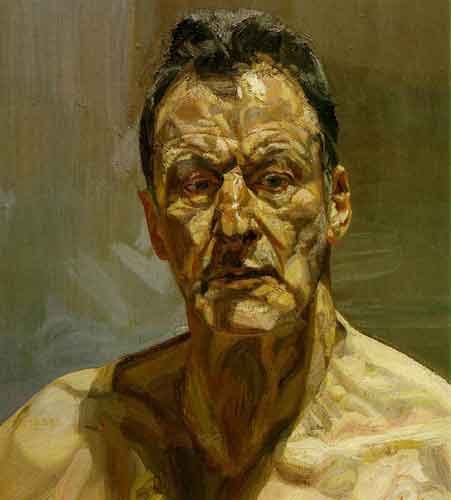
Lucian
Freud – Self portrait
Preamble
This essay addresses several key aspects about art in
the last two hundred years, and the underlying creative process by which
artists come to make pictures. Ancillary to the title theme is a range of
others which will also be explored. Repeatedly, the theme is explored that
the artist is sensitive to the outside world and is basically a collector
of sensations. It is these sensations which become stored to form a
growing bank of responses to the world, which comprise the artists
inner world of vision. The work of the artist then involves an ongoing
engagement with alluring forms in the outer world, in so far as they
resonate [or conflict] with the stored sensations within their inner realm
of artistic imagination.
A further theme is explored in that the artists work
displays a sense of the triumph of mind over matter, and that this
reflects their innate ambivalence towards material reality. The sense of
social alienation of the artist is also briefly explored in connection
with this theme. The point is also made that the elements of the artists
inner realm can be seen as obsessive elements which constantly recur
in their artistic output as underlying themes, images or unique aspects of
their own individualistic style or technique. It is suggested that these
recurring obsessive elements reflect all those forms which stimulate
and inspire the artist, for short or long periods.
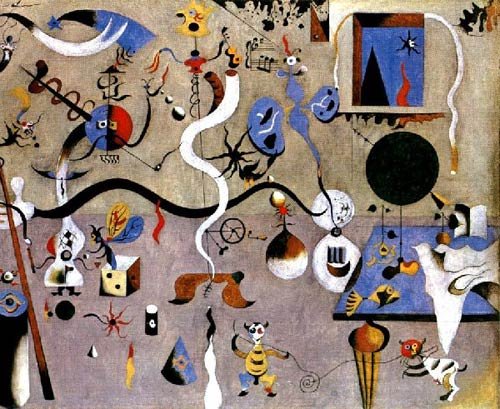
Miros Harlequin Carnival
1924
The point is also explored in depth, and supported with
numerous examples, that artists soon tend to subtly deviate from any
initial desire they may have to copy real forms. Especially in their
maturity, they mainly wish to use such forms to depict aspects of their
inner realm. In this process of depiction, the real forms become
increasingly deformed and distorted in shape and coloration to varying
degrees by different artists. This theme has increased significantly
during the progress of this century, such that reality-distortion
has in effect become the secret cause celebre which drives forward
the progression of modern art.
Finally, a point is explored involving areas of contact
between surrealists and Buddhists, who both seem to share a desire to
depict reality as essentially evanescent, disintegrating and illusory. In
this respect also, the point is made that all art to some degree can be
seen as a path of self-discovery for the artist, and in this sense
runs parallel to other spiritual paths found in world religions.
—————-***—————–
No matter how closely an artist attempts to copy
reality, they always incorporate into their art new elements which come
directly from their own inner world. Copying reality is not really their
main business anyway. The best art always seems to distort reality,
bending and shaping it at the artists will, while some art ignores
reality completely. In many ways, it is this distortion which can be
construed as a triumph of mind over matter. The greatness of an
artist relies not only upon their technical skill to compose images, with
whatever tools at their disposal, but also, quite radically, on their
ability to make their work a blend of images from their internal world of
vision and engaging elements drawn from the outer physical world. The best
artists seem always to create a logical or coherent blend of both, or at
least a consistent one.
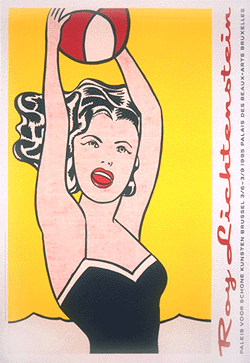
Roy Lichtensteins Girl With
Ball, 1961
The shapes and the colours in a painting are always
presented in a slightly modified form from what they had in reality.
However, this is not an error on the artists part. Like moths
extracting nectar from pretty flowers, artists merely take from the real
world what engages them while they discard the rest as an empty husk with
no value. The creative process means that what was at first real and
concrete, in the outer world, has been placed into the furnace of inner
vision, has been internalised, and transformed by the flames and fires
of the artists imagination. Thus the end product is always a spagyric,
an alchemically transmuted substance, spiritualised, set free by the fire,
set glowing by the inner fire of the artists vision. No wonder, then,
that it no longer conforms to the original or looks much like a perfect
copy! It has been transformed by the furnace into a form of
burnished gold! Its edges, shapes and colours have been softened, rounded,
transfigured by contact and internalisation, and become personalised into
something immediately new and more subjective.
You only have to look at the work of Turner, L S Lowry,
Lucian Freud, Giorgio de Chirico, William Blake and the modern pop-artist,
Peter Blake, to see the stunning and delightful way in which an artist can
indulge this margin of error a very long way and still create
excellent images, which are still very true to life. We can greatly extend
this list of examples to include artists like Watteau, Daumier, Seurat,
Millet, Degas and Klee. All of these artists distorted reality
considerably in their work, some by a wide margin. Some key examples from
this century include Chagalls I and My Village 1911, Modiglianis
Girl in Pink 1911, Matisses The Piano Lesson 1916,
Picassos The Three Musicians 1921, Miros Harlequin
Carnival 1924, De Koonings Woman 1, 1950, Pollocks
Blue Poles 1953, Roy Lichtensteins Girl With Ball, 1961 and
Boteros Santa Rosa De Lima 1966. In such works, the
artist, often by a wide margin, has altered the shapes and colours but in
each case, the essence of the subject still shines through, and great art
has, unquestionably, been produced.
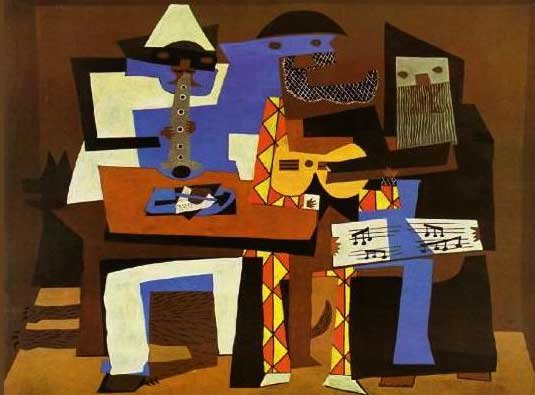
Picassos The Three Musicians 1921
It is hard to conceive of any artist painting something
they are not, at some level, quite deeply stimulated by. Some form of
excitement would seem to be a minimum requirement for it to even gain the
artists attention, let alone be placed in a painting. Thus, the fact
that certain themes keep on recurring in their work, shows the great charm
these themes have over the artist. It is such very enchanting things,
which are the obsession elements of the artists inner world.
There is always a form of excitement within the artist as a prerequisite
for making good work. The artist must intensely feel the emotion of the
object, whether it arises internally, or it is lifted from the outer
world. The feeling response is thus critical for the artistic
process. An artist who cannot feel is thus a contradiction in terms. The
excitement is often generated by the ‘electric contact’ between inner
‘obsession elements’ and alluring things viewed in the outer world with
which they resonate. It is also deeply intuitive, an involuntary process
of response to the world, which the artist fails, more than others,
to objectify, stand outside of, comprehend or rationalise as a distinct
process. The artist engages with alluring forms and an involuntary
internal process becomes triggered.
Predominant choice of colours can suggest the nature of
the artists inner world. The artist is strongly attracted to certain
colours and forms, certain views, certain objects, certain skies, certain
key elements of light and shade all of which unwittingly conspire to
allure and re-engage the deeply hidden vision derived from early childhood
or whatever other obsessive elements drive their art. At various
times the artist becomes opened up to these influences and so, in a sort
of reverie, the emotional engagement of inspiration moves them to
creativity. Such a process is precisely that subtle blend of inner vision
and objects lifted from external reality, mostly, transformed in some way
to blend them together.

Leonardo’s Ginevra dBenci
The paintings of Leonardo da Vinci and Constable, for
example, contain delightful scenes painted with great beauty. In the skies
of Constable and in the backgrounds of Leonardos pictures, also in
Caspar David Friedrich and Stanley Spencer, we see alluring mountains,
forests, animals or delightful skies. Leonardo’s St. John the Baptist,
his Virgin of the Rocks, sketches for his Last Supper, his Ginevra
dBenci, his Annunciation, his Virgin and Child with St
Anne, and his Mona Lisa all show tight, well-crafted
compositional structure, but adorned with wistful smiles and alluring
backgrounds highly suggestive of another sweet realm that exists beyond
the main subject. Such features are also found in many paintings of the
Italian school [e.g. Botticellis Venus, with her ecstatic
smile], and festoon religious paintings of all types. Although they can be
dismissed as valueless padding, serving no particular function,
other than to add compositional harmony, they do in fact suggest a form of
reality, which sits behind and beyond the main figures in the foreground.
Thus, such paintings clearly blend elements borrowed from reality with
those drawn from the inner realm of the artists imagination. Similar
compositional elements can be seen in the works of many artists of the
Dutch school, more especially Vermeer, Hals and Rembrandt, and in the last
portraits by Gericault.
Though excellent as a technician, and for his adorable
skies, Constable cannot really be regarded as a great artist, because he
failed to articulate anything, which we can call an inner vision, uniquely
his own. He presents a rather sentimental and romanticised image of the
English countryside, but disappoints us because of his dull and
predictable choice of subjects. Though technically impressive, he lacked
an internal vision worth articulating, and tried to copy reality too
closely. Striving to become a perfect camera [before its actual
invention], yet he seemingly failed to see that pure reality depiction is
ultimately rather boring. He had nothing new to say. For this very reason,
Constable’s oil sketches [e.g. Brighton Beach with Colliers] are
far more interesting with a lighter, less contrived feel to them than his
more formal six-footer compositions [such as Salisbury Cathedral
from the Bishops Gate, Haywain and Corn Field]. No
wonder then, that so many of the latter sat around unsold after his death!
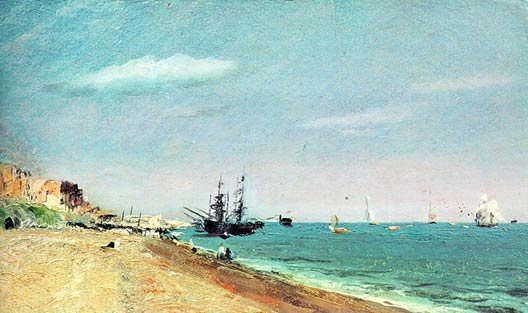
Constable’s oil sketches – Brighton
Beach with Colliers
Like the swarms of artists down the centuries who could
competently paint a bowl of fruit, some flowers, portraits, animals
[Reynolds, Stubbs, Landseer] or nice landscapes, Constable had
disappointingly little to say that was new or interesting. Essentially, he
failed to bend reality sufficiently to make it sit up and say something
new. He founded no new movement, even though some claim to detect elements
of Impressionism in his work. His contemporary, J M W Turner, was for the
same reasons far more interesting, as he pushed atmospheric images and
lighting effects considerably beyond the boundaries of normal physical
reality [for example his The Grand Canal Venice 1835, and Ship
In a Storm], and hence more surely foreshadowed Impressionism by fifty
or sixty years. Vermeer, likewise, was at his worst in trying to
‘photographically’ copy scenes, but at his very best where he sought to
suggest a golden realm lying just beyond the crumbling masonry of
his luminous Delft streets, and the delicate smiles of his young women.
Like Vermeer, Rembrandt and Boudin, Turner was far more intrigued,
stimulated and excited about light, and its illuminating effects, than
with the fussy technicalities of colour and form. It is this sense of
light which he explores in all his pictures, and which must have been for
him, his artistic touchstone. Above all other features, his paintings are
wholly dominated by light and a love of light; colour and form were
thoroughly subordinate factors in his art.
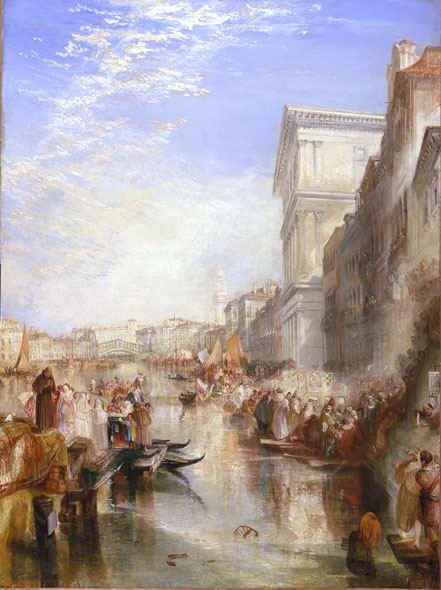
J M W Turner – The
Grand Canal Venice 1835
Impressionism, was a powerful and important revolution
in nineteenth century art – what was new and different about it – such as
the rejection of classical forms and techniques, the use of blurred edges,
dapple effects and brighter colours, and the depiction of ordinary scenes,
ordinary people and ordinary life – comprised at the time a massively
brave new mandate, eagerly embraced by all the young artists of the day,
and which shook the artistic establishment to its roots. It completely and
permanently fractured the old and fossilised, formal traditions of the
past, replacing them wholesale with an entirely modern perspective. Yet,
in spite of that, artists were still driven by their own innate vision and
techniques, blending them with the elements they saw and liked in the
outer world, which was luminously charged with emotive power. In addition,
arguably, they were still essentially striving to create a triumph of mind
over matter through their work. After about 1850, the artistic monopoly of
classicism disintegrated and no single type of art has since enjoyed such
a monopoly again. Fashions have shifted freely and naturally, ever since,
and artists have been entirely liberated in their work since the
Impressionist Revolution.
The elements included in pictures, which are suggestive
of the rich inner world of the artist, do not just include figures. Many
elements of technique can also be cited, such as the delicacy or roughness
of the strokes; the lightness or intensity of colour and the thickness of
the paint. For example, Augustus John, Vincent van Gogh and Jackson
Pollock all employed a vigorous use of paint compared with the subtleties
of Canaletto or Vermeer. These all reflect, and suggest, the relative
energy or subtlety of the artists personal vision and tastes, and which
they bring with them to their task. They are thus suggestive of his or her
preferred mode of working. They also reflect his/her inner vision. Much is
also reflected by the choice of subject, as mentioned before about
Constable. One can say much the same for Munch, Bosch and the Brueghels,
who all fail to manifest anything, which can be remotely described as an
uplifting life-affirmative vision. Quite the reverse, in fact.
Salvador Dali, like surprisingly few of the other
surrealists [Ernst, Magritte and Escher perhaps] manifests, to a high
degree, the process of reality distortion and having an inner vision. He
provides a very good example of an artist who successfully blended certain
carefully chosen elements of the outer world and those drawn from his
inner world of vision. He created vivid, hyper-real images, like some
dreamscape, but composed chiefly of elements of the physical landscape of
north-eastern Spain, blended intimately with images of his wife and images
drawn from his own childhood: Freud, masturbation, Voltaire,
psychoanalytical themes such as obsession, sexuality and excrement. His
later work concentrated more upon spheres, illusions, disintegrating
architectural forms, as well as metaphysical, scientific, political and
religious themes, and always suffused with his characteristically
luminous, mystical technique [the paranoiac-critical method]. For
anyone looking at his pictures one is hit first by the vivid brilliance of
the technique: the successful way he has used his skills as an artist to
create compositions; second, one is struck by the hyper-real images which
he has drawn from his unique inner world of vision, and which he uses to
populate his pictures. One may not even know that these images are
obsessions for him, but from considering the great regularity with which
they appear in nearly all his paintings, it soon becomes apparent that
they are such. In his early work, such obsession elements included ants,
soft melting forms, spheres, cherries, giraffes, excrement and crutches.
“His paintings employed a meticulous
academic technique that was contradicted by the unreal dream’
space he depicted and by the strangely hallucinatory character of
his imagery. He described his pictures as hand-painted dream
photographs’ and had certain favourite and recurring images, such as
the human figure with half-open drawers protruding from it, burning
giraffes and watches bent and flowing as if made of melting wax (The
Persistence of Memory, 1931).” [Oxford Dictionary of Art]
He forms an excellent example of an artist who
developed their inner world to an unusually high level of sophistication
and consistency, and who refined their technique to depict it
prolifically and with apparent ease. From childhood into adulthood, he
carried this inner world complete with all its emotional clarity, its
fears and tensions and the bizarre obsessions which were his
stock-in-trade and which seemingly formed the fount of all his art. All
he then had to do was to produce new pictures, each one illustrating
anew his various themes and mixing together all the main elements, the
browns and ochres of his arid landscapes of north-eastern Spain, the
childhood imagery, his wife and various sexual and religious symbols.
Each new painting Dali produced was in fact a new vista, containing the
forms that lived in his inner world; was a new window into Dali’s mind;
or a new way of re-working the same themes and images he consistently
articulated with supreme clarity. Arguably, the same can also be said
for all other great artists. The theme is that a blending occurs between
the elements of the artist’s inner world and certain key elements,
borrowed from the outer physical world they are familiar with or those
aspects of it, which are heavy with emotional significance for them.
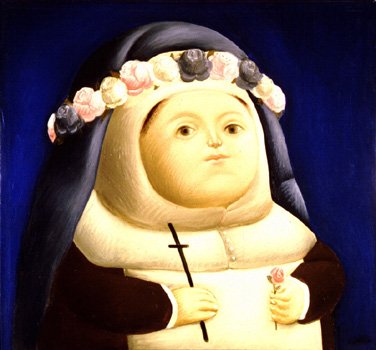
Boteros Santa Rosa
De Lima 1966
In the case of that other popular surrealist, Rene
Magritte, while technically competent, he seems somehow less satisfying
than Dali. His pictures seem more stiff, ambivalent and less natural
compositions, somewhat devoid of Dalis rich emotional detail. They
appear more bourgeois, more formulaic and heavily contrived by an
intellectual mind rather than by a sensual, natural intuition. He did
clearly articulate an inner vision, but perhaps it was too complex and
more intellectual than that of Dali. Much the same can be said of the
mathematically precise and contradictory images created by M C Escher.
Yet both retain the ability to shock, disturb and disorientate.
“From c.1944 his work took on a Surrealist
flavour as he made brilliant play with optical illusion to
represent, for example, staircases that appear to lead both up and
down in the same direction.” [Oxford Dictionary of Art]
Specifically regarding the surrealists, they manifest
several points of contact with the essential views of Buddhists, between
which there are some very striking parallels, particularly concerning
perception and illusion and the corpuscular and evanescent nature of
reality. Every artist knows that no two objects and no two moments in
time are the same.
“Constable thought that No two days are
alike, nor even two hours; neither were there ever two leaves of a
tree alike since the creation of the world.’ [Oxford Dictionary of
Art]
They know that our perception of the world is not what
it seems. That the world is not what it appears to be. That our perception
is not one-way traffic; it flows, not just inwards, but also outwards! As
well as taking information in, we also project onto the external world
various assumptions to fill the gaps that are there, and so create an
illusion of permanence which simply is not present of its own accord. We
project onto forms a permanence and a consistency which simply cannot be
found on closer scrutiny. In addition, it is precisely this bag of
tricks, which the artists employ in their work to create the light and
shade, which in turn generates 3-D effects in pictures. Artists largely
from their sustained observation of the external world have obtained this
body of very profound knowledge about the world. That it largely conforms
to the Buddhist view shows that a degree of fundamental agreement about
the nature of external reality exists between these two groups of people.
They also agree about the nature of our perception and how we project onto
forms qualities they do not have from their own side; that our perception
tends to project a permanence onto what are more truly fleeting and
impermanent forms.
“[Ernst] The irrational and whimsical imagery
seen here, in part inspired by childhood memories, occurs also in his
highly individual collages. In them he manipulated banal engravings so
that the contrast between the archaic appearance of the engraving and
the startling novelty he created from it made an impact of strangeness
and unreality.” [Oxford Dictionary of Art]
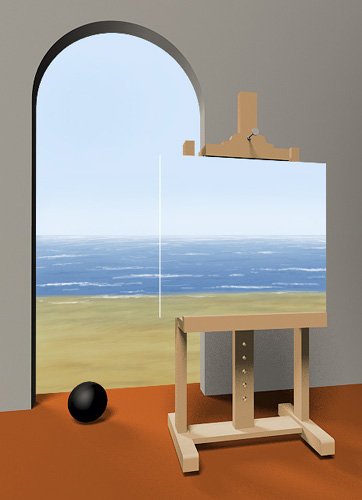
Magritte – La
Condition Humaine
In certain respects, the surrealists came astonishingly
close to the Buddhist view of an essentially impermanent, disintegrating
reality. The work of Dali, Magritte and Escher demonstrate this
phenomenal, almost cavalier attitude towards the accepted central pillars
of our rational understanding of physical reality. Several of Magrittes
paintings, for example, explore the theme of the view through a window
being in fact a picture, which is disintegrating. He also explores the
theme that the picture on the artists easel is not separate from, but
continuous with, the surrounding reality of the room. Several of his
pictures show the glass of a window breaking and falling onto the floor as
pieces of glass with sky and trees embedded [e.g. La Condition Humaine].
This suggests that the world seen through the window is in fact a part of
the room. These pictures show that the artist questions the accepted view
that reality is out there and an object with its own innate reality, and
driven from its own side or he asks whether it is projected by our minds,
as Buddhists tend to believe. The artist in such pictures is in fact
saying that reality can be whatever we choose to make of it and is thus
far more plastic and subjective than we believe it to be. In the work of
all surrealists, illusions are often presented as real, and reality is bent
to make impossible things sit together – like the reverse image of a man
standing before a mirror [La Reproduction Interdit, 1939] or a
steam train coming out of a fireplace [Time Transfixed, 1939]. In
each case, the hyper-real nature of the technique [as with Dali] combines
with the bland indifference of the characters to what is happening, to
greatly add to the shock impact of these images.
Likewise, Escher produced perfect drawings of water
flowing through the points of connecting towers, but flowing uphill, an
image our senses rebel against, as we know it cannot do so in real life,
and pictures which contain hands drawing themselves; lizards crawl into
and out of a chess board; animals and birds fly into and out of daytime
and night-time scenes or become reabsorbed into its background. All of
these pictures clearly present a challenge to the viewer in that they
disturb our normal, rational understanding of the world we think we
understand so well. Such artists challenge and question our normal
perception of reality at a very deep and fundamental level, and where
possible, deride and mock those minds which accept so easily such reality
as being real, when the artist knows that it is a fake or bogus viewpoint
All these pictures are therefore assaults upon our common-sense view of
the world, which inspire us to question the basis of our normal everyday
perception. The artist has become a clown who continually and disturbingly
juggles new illusions to deliberately challenge and upset our cosy view of
things, throw us off-balance and make us look afresh at the world around
us, with new and more critical eyes.
“[Friedrich] pursued with a rare and
instinctive single-mindedness his personal insight into the spiritual
significance of landscape. He was intensely introspective and often
melancholic and he relied on deep contemplation to summon up
mentally the images he was to put on canvas. ‘Close your bodily eye,
so that you may see your picture first with your spiritual eye’, he
wrote, ‘then bring to the light of day that which you have seen in the
darkness so that it may react on others from the outside
inwards.'” [Oxford Dictionary of Art]
The underlying philosophical objective of the
surrealists seems to have been to mount a sustained attack upon the
common-sense rationalism of ordinary people. They certainly adopted an
evangelical posture in relation to ordinary life as well as the rest of
art, publishing manifestos and philosophical tracts. They adopted a form
of zealous disregard for tradition and the formal rational structures of
the art establishment, wishing to tear them down. Here we can detect
here a Zen-like impulse to wake people up from their sleep and
open their eyes, forcibly if necessary, by frightening and shocking them
into seeing the world afresh. Forcing people to see the transient,
corpuscular, dream-like nature of reality, to watch the moment-by-moment
disintegration of the world and to see everything as transient, unreal,
the stuff of dreams, strange and disturbing. And thus on a philosophical
and political level they were regarded by others, and so regarded
themselves, as revolutionaries about to bring down all the citadels of
rational thought.
As previously mentioned, the Brueghel’s, Bosch,
Munch, Francis Bacon, and much of Ernst, disappoint chiefly because,
though they articulate an inner vision alright, yet it is not a very
attractive one. They depict gloomy worlds, in muted colours, peopled
with strangely contorted, deformed beings engaged in scenes of miserable
brutality, self-mutilation and wretchedness, which no life-loving person
can find very interesting. It is a deeply repellent vision, and is very
unedifying. Nevertheless, they conform to our definition of great art,
because they successfully depict the tensions and anxieties of the
artists inner world. In addition, their works have become intimately
associated with periods of tension, conflict and uncertainty in society.
Certain aspects of Cézannes art also illustrate
the same principle of ‘obsession elements’ and inner vision, most
notably his use of the same view in Provence for many of his pictures.
The same hill [Monte Ste-Victoire] in the background and the same trees
and cottages which recur in many of his paintings, viewed from different
angles and in different nuances of light. It seems he just could not
resist the joy of painting the same scenes over and over, so enchanting
and delightful did he find them. Why else would he have kept painting
the same scene so many times? It must have held for him great emotional
significance. Thus, the obsession element is that which
irresistibly and repeatedly charms and fascinates the artist and which
thus recurs in their work repeatedly. And from which they can presumably
extract inexhaustible artistic stimulation [what Dali somewhat lewdly
called an artistic erection].
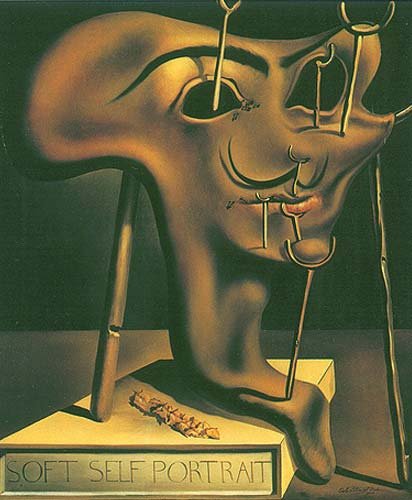
Dali – Soft self
portrait
The same repetition is also found in Vermeers
luminous domestic scenes. The essentials are repeated in most of his
pictures. The same windows, chairs, young women and rooms are used
repeatedly. Like Cézanne, he seems never to tire of repeating himself,
yet creating very new pictures each time from the old themes, but arranged
anew. In the case of van Gogh, much the same applies: similar themes and
images, and ways of depicting them recur endlessly.
For so many artists, the luminous power of childhood
memories, sensations and dreams, and their vivid, intense impact upon the
senses, is greatly enhanced compared to the duller perceptions of the
adult. The childs perception is generally clear, focused, and untainted
by the preconceptions or distractions, which the adult mind is so often
subject to. All of this tends to become grist to the mill of adult
creativity. However, the inner world is not confined to elements drawn
from childhood. The artist continually maintains and adds to their stock
of obsession elements, which comprise their inner world of vision. The
artist remains open to the outer world all their life. They are constantly
forming new emotional responses to the world and thus accumulating new
sensations to retain in their inner world. However, largely, it is true
that there is a sort of constancy in these obsessions and a thread of
similarity, which runs through them all.
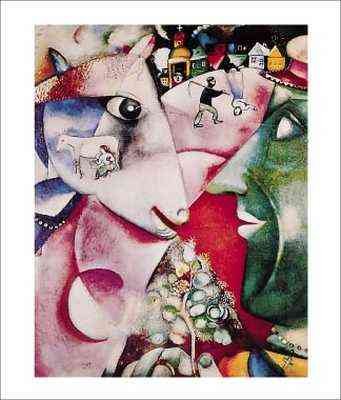
Chagalls I and My Village
1911
“Chagall’s work was dominated by two rich
sources of imagery: memories of the Jewish life and folklore of his
early years in Russia, and the Bible . [he] himself stated in his
autobiography Ma vie (1931) that however fantastic and
imaginative his pictures appeared, he painted only direct
reminiscences of his early years.” [Oxford Dictionary of Art]
Thus, it is little wonder that so many artists [and
also poets and writers] use images first gleaned in childhood first to
build their inner vision and later to build their art. The impact upon
the senses is clear: it creates deep grooves in the psyche, strong
preferences are established in terms of colour, technique, forms and
subjects. These preferences [obsessions?] are then carried forward, but
lie dormant until activated in adulthood, whereupon they may burst forth
into creative activity.
The process can be sketched out. Firstly, the artist
generates in his/her mind a stream of images and strong emotional
responses to the world, usually in childhood. These obsessive
elements never fail to charm and delight him/her in later life. For
example, Dalis watches, crutches, ants, cherries and Cadaques
landscapes all fall into this same category. Then they must develop the
key elements of their artistic technique, which will enable them to
depict these images from their inner world, placed alongside certain
elements lifted from physical reality. There is thus a matching-up
process whereby elements drawn from both worlds are placed together and
blended. The end-product has great meaning and satisfaction for the
artist and generates a form of inner contentment in a place where before
there was friction and conflict. This, I contend, is the process, the
very essence of most artistic activity.
Any interpretation of the significance of, and
relationships between, the various elements, which recur repeatedly in
an artist’s work, is bound to be a minefield of speculation. Moreover,
it is a vast and opaque subject. Nevertheless, they can nevertheless be
broadly reduced to the theme of accumulated emotional ‘responses to the
world’ and elements of an inner realm of vision. The charm of viewed
forms and a deep emotional engagement with them is always the driving
force behind the creative process. Expressing inner vision involves
either distortion of real forms or depiction of abstract or fantasy
realms; both risk being misunderstood, especially the latter. Distortion
is preferred possibly as the ‘lesser of the two evils’.
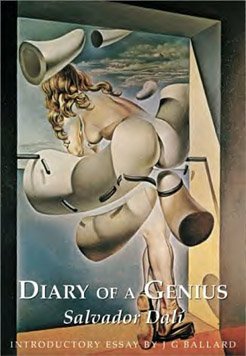 The
impulse to paint derives very largely from our internally stored
responses to the world we happen to have found ourselves in: the place,
the family, the events of childhood, the alluring aspects of landscape,
faces, forms or domestic scenes. We each of us carry within us a rich
world of vision, sensation and imagination combined with feelings and
memories. For the artist, the strongest images and memories, and the
strongest feelings, tend to comprise the obsession elements, which
they then later explore and endlessly re-work in their artistic output.
Essentially, the artist continues to feel the joys and fears, the
yearnings and disappointments of the child, or periodically
re-invigorates them deliberately or, by visitation of circumstance,
re-experiences them, to generate an ecstatic or magical vision of
external reality. Dali frequently referred to this masturbatory
nature of generating and rekindling artistic vision [see his Diary of
a Genius and The Secret Life of Salvador Dali]. Essentially,
the engagement of the artist with the world is based both on addiction
and dismissal, and is thus ultimately ambivalent. They are open to and
thus crave the pleasure of sensations, sensuality, but through
overdosing on it, they become destimulated by it. Thus they come to
acquire an attitude towards sensation similar to that of a prostitues
towards sex: occasional profound and uplifting enjoyment, with
intervening periods of profound disinterest.
Many artists and writers have also used a dissolute
lifestyle – drink, drugs or prostitutes [or all three] – for the same
purpose. Examples are legion, but include Baudelaire, Leonardo,
Coleridge, Wordsworth, Bacon, Behan, Dylan Thomas, Wilde and Toulouse
Lautrec. Arguably, these techniques were aimed to improve internal
vision and so resuscitate flagging inspiration. The principle seems to
be that altered mental states cause movement in the inner vision and so
engender new ideas. However, significantly, this also illustrates the
detachment and other-worldliness of the artist, cut off to some degree
from the rest of humanity, and burdened by their talents. The
other-worldliness is, perhaps, an aspect of their world of innate
vision. This outer world fascinates them ONLY to the degree that it
contacts and reflects their inner vision. All else about this world is
seen as bland, mundane and unstimulating and which they try to ignore
and keep at a distance. Artists feel alienated to some degree from the
rest of humanity; feel different or cut-off, both by their skills and by
their inner feeling responses to the world.
We each accumulate responses to the world about us,
what we can call feelings or feeling responses. Artists do seem to
be people who feel things more strongly than others do, and for whom
this accumulated mass of feeling responses take on much greater
significance in their life than for most people. This set of feeling
responses constitutes their inner realm of vision. The artist seeks to
reconcile inner vision with outer reality by blending elements of both
in their work. This represents a harmonisation effort on the part of the
artist to combine and reconcile elements from both worlds.
Being observers of the world, means that artists
minds primarily reach out into the world through their eyes, they are
visually-centred people who look at things, forms and objects all the
time. Caress with their eyes, might be a more accurate description. In
this sense, they come close to the habits of Buddhists who also gaze at
forms, checking to confirm their fundamentally illusory nature and the
fact that they are evanescent, changeable and disintegrating, rather
than having the permanence, which our minds project onto them. There is
thus a huge mass of experience that these two sets of people – artists
and Buddhists – have in common and share. For similar reasons,
therefore, both also realise ultimately that this world of forms is fake
and unsatisfying and that beyond it, or within us, there exists an inner
realm of mind, which is far more interesting. Both therefore tend to
reject the physical realm and prefer the realm of vision.
“[William] Blake might be called a mystical
realist
he believed that the visible world of the senses is an
unreal envelope behind which the spiritual reality is
”
[Oxford Dictionary of Art]
Artists are able to create, in their work, alluring
new forms and packages of sensation. In many respects, this is the
essential power of the artist. More fundamentally, art also consists in
endlessly exploring a theme of mind, thought or spirit, triumphing over
matter, just as Tantra insists. All great art basically illustrates this
point, as it transcends death or the individual and also the realm of
space and time, and it subtly changes the reality it depicts. Mind
triumphs over matter. Also, the images an artist creates either closely
approximate to external reality [perhaps disturbingly or hauntingly so]
or they suggest another realm, an alternative reality that flows
alongside this, but which only the artist is able to perceive, tap into,
depict and interpret. The two variously may or may not juxtapose,
connect or make contact. That realm clearly forms an alternative package
of sensation from that of the outer world.
“[De Chirico’s] pictures, which convey an
atmosphere of strangeness and uneasiness he developed a more
deliberate theory of meta-physical insight’ into a reality behind
ordinary things by neutralizing the things themselves of all their
usual associations and setting them in new and mysterious
relationships.” [Oxford Dictionary of Art]
In many cases, the great artist simply expresses their
own inner vision alone, unblended with forms drawn from the outer world
and which are available to us through our senses. Such applies in the case
of abstract, fantastic and conceptual art. Much symbolic and primitive art
also falls into this same category. This also applies very largely to the
work of Bosch, Yves Tanguy, Juan Miro, some Francis Bacon, some Blake,
much of Ernst and also some of Munch. Even the work of Cubists, like
Picasso, also falls into this category. It is centred upon a form of
representation so distorted that it verges into a realm of its own
abstraction. Yet this process of reality distortion goes back a long way
and is a centrally important theme in all art of the last two hundred
years. Other examples include work by De Kooning, Mondrian and even
Boudin, who, like Turner and Constable, started that abandonment of sharp
edges, and the adoption of blurred forms and general sketchiness, which
the Impressionists later embraced as their cause celebre.
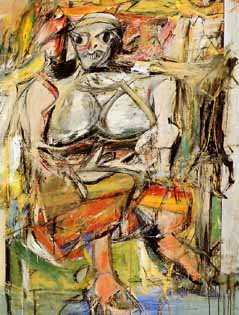
De Koonings Woman 1,
1950
“Boudin’s own paintings consisted mainly of
beach scenes and seascapes from the coast of northern France and were
distinguished by the prominence given to luminous skies.” [Oxford
Dictionary of Art]
Indeed, without this inner vision any artist appears
impotent, with little of interest to say, no matter how technically
competent they might be. In this sense, the artist is great almost to the
exact degree to which they are able to express and articulate their inner
vision. They are great if they succeed in doing that. They are not great
if they fail to do that. Mostly, great artists do both: they create an
alternative reality fully formed from their own inner realm of vision, and
they successfully blend it with certain elements drawn from the outer
physical realm. These outer elements they use in their art have totemic
power because they have deep emotive significance for the artist; they
have a fascination value or comprise obsession elements which
continually recur within their work. They may relate back to childhood
experiences, for example, or to family life. They are blended with other
internal elements. The outer forms which inspire the artist, once engaged,
resonate with the internal totemic elements or obsession elements,
fundamentally on an intuitive level, setting off chain reactions and
avalanches of emotional responses and a creative process. Arguably, it is
this, which initiates the process of creation. The inner realm of vision
is characterised by certain ‘obsession elements’ or recurrent themes in
terms of subjects depicted, colours used, and quirks of technique.
The work of great artists always seems to contain a
mismatch between reality as observed and the images they depict. It is
this mismatch, which stems from, and reflects, the frictions and tensions
of their inner world. In this very sense, it defines them as unique
individuals. The more delightful this mismatch is, the greater the artist
is considered to be. In addition, this mismatch suggests to us new ways we
might look at and see the world. Our initial shock at the artists
vision subsides and gives way to the realisation that, though new and
different, it is a possible, indeed a valid way of seeing the world. That
is eventually the impression one gets when viewing in detail the work of
Turner, Monet and Picasso, for example.
The greatness of an artist – as measured by the amount
of influence they wield over others – seems very largely to depend upon
their inner vision, its uniqueness and its power to distort reality in the
depictions the artist produces. Their greatness exists in direct
proportion to the amount of distortion of reality, which they incorporate
into their work. Turner probably constitutes the best example in the last
century, whose light-distorting influence had a massive and far-reaching
effect in nineteenth century art. Picasso and Monet probably form the two
most important examples of the same phenomenon in this century. The level
of reality-distortion they applied in their art was great and they were
both prolific and highly influential on all other artists of their
generation and subsequent generations. While some might choose to add
Dali, as a third important influence upon twentieth century art, in that
he was unique, reality-bending, prolific and influential, yet he
represents something of an artistic cul-de-sac. He became rather
predictable, and though technically impressive, he seemed closed to change
in his later years and thus failed to produce new and exciting work.
Surprisingly few artists, even amongst the
Impressionists, have chosen to depict, through their work, a boring
mundane world, yet those artists are legion who have glorified and
idealised their world or depicted an entirely subjective luminous realm
existing beyond physical sensation. This reflects not only the detachment
of the artist from this world, their sense of alienation from it and their
rejection of it, but also their desire to see it become more fully
integrated as part of their inner world of vision. Artists wish to express
their inner realm of vision, which often becomes their main pre-occupation
[path of self-discovery], and to achieve some measure of inner contentment
by so doing. Maybe this reduces their sense of alienation, and draws them
closer to humanity. As Berkeley might have said: the artist wishes to
absorb the world and internalise it, and to see the two blended together
indistinguishably as one. To my mind, that is what Blake attempted to do,
in his charming and simple way. In addition, it reveals a religious
dimension to art, which would sit neatly beside religions like Buddhism,
and make of them both pathways of self discovery.

Matisses The Piano Lesson
1916
The artist who can say something new, may well develop
an evangelical zeal in their desire to change things, to challenge
accepted views [norms], to ‘wake people up’ to the truth [as they now see
it]. There are clear parallels with religion and with paths of
self-discovery. It seems safe to assume, therefore, that on some deep
fundamental level, all art is a path of self-discovery for the artist, and
thus contains a spiritual component.
Art is a path of self-discovery for the artist. It is a
means of negotiating their inner world, their emotional responses to the
world, and of depicting the ongoing dialogue they feel occurs between
their inner world and the outer world of physical forms that charm and
fascinate them. Moreover, at a very fundamental level, it is what we all
do. We each of us develop a form of inner world, we internalise our
experiences and carry within us a rich cargo of memories and feelings,
which can be broadly and accurately categorised as responses to the
world. Arguably, the responses are more intense and the desire to
depict them more irresistible for artists. Artists are also more centred
in their feeling-responses than others are and ultimately more able to
express them than most people. Artists are either more affected by the
world than others are, or more desirous of depicting things upon the basis
of their feeling-responses, probably both. They develop a fine sensitivity
to aesthetics.
The artist relies, in their work, very much upon
his/her ability to distort reality, to deny its power, to let the mind
triumph over matter and to project onto the mundane world a vision all
his/her own, which can be allowed to run all over i.e. to wholly
tincture his/her perception of the world [e.g. van Gogh, Dali, Magritte,
Friedrich, Blake, Stanley Spencer]. This comes close to the techniques of
Tantra, in which the supreme power of images and imagination are
encouraged and in which so-called reality is mocked, and reduced to a mere
dream, a sham, a picture show.
In an artist’s work, a blending tends to occur of inner
elements and things borrowed from reality. This blending is very often the
source of the alluring strangeness and the greatness of their work. The
‘alluring strangeness’ of an artist’s work is largely dependent upon the
obsession elements, their mode of depiction, quirks of technique and the
blended elements, which have been borrowed from reality. The slavish
copying of real forms, no matter how technically impressive is never an
option for an artist. Becoming a ‘perfect camera’ is a suicidal path,
which represents ‘artistic failure’. The artist must distort real forms,
in some manner, if their work is to be regarded as attractive, original
and interesting.
Surrealists [like Buddhists] delight in making tricks
with reality to shock the viewer and challenge their ‘normal’ views about
perception and reality. Amongst many other things, Tantra depends upon
glorifying the inner realm and suppressing the power of the external
world. Artists are inclined in the same direction but artists are usually
reluctant, beyond a certain point, of going down the Tantric path or
‘losing themselves’ completely in their inner realm. Indeed, Tantra, like
Zen, eagerly tears down reality like so much shabby old stage scenery and
contemptuously tramples it all underfoot as a grand illusion. Thus, in a
sense somewhat aggressively, and comically, the alleged power and
supremacy of external reality over our lives is mocked, denounced and
vehemently denied, both in art and in Tantra. Surrealism, essentially,
attacks reality with the same sense of disbelief.
Briefly, Tantra declares that the external world is
inferior; second, that it is fake or not real; third, that mind is
superior; fourth, that thoughts and feelings are more profound and more
real than matter; fifth, that vision and imagination is the most powerful
force in the universe; far more powerful than material world. No more real
than a dream or vision, it holds reality in contempt; joyously and
defiantly so. The more deeply we contemplate this problem, the more
difficult it is to truly and fundamentally distinguish between a dream,
reality and inner vision. In essence, there is no difference; they are the
same. Though physical reality is seemingly more predictable and
consistent, all three consist of forms, sensations and emotions. Our
internal responses are similar in all three, and which we carry forwards
with us. All of this comes close to art as a personal path and the
dialogue between artist and the world. Every artist most surely treads
upon that path.
It is as if our internal world of vision and
imagination stands supreme over the external physical world; that death is
not real and that images have immense power; etc. Moreover, that reality
is nothing but ‘packages of sensation’. People are also packages of
sensation and likewise the inner world of mind and thoughts. Well, this
comes close to the artistic world too for various reasons. Primarily, most
artists do believe in the supremacy of mind, even though some might know
this only intuitively and without having given, it much thought.
Essentially, the point of contact here is that artists are primarily
visual people who look at things all the time. They gaze at faces, forms,
and views all the time, checking their contents, the light and shade, the
tones and colours. Without doing this, they would be utterly unable to
make copies of reality. Making copies of reality is how they start and is
initially their bread and butter, but very soon, they begin, in their
work, to distort it and add their own interpretation. That is where the
creative work, the real art, starts.
The artist is inclined to believe that ‘mind can
triumph over matter’ because they often feel that their inner realm is
certainly more important and often more real to them than the outer
physical world. All the best artists are those with inner vision, which
they strive to depict, often blended with elements, which they have drawn
from the physical world. All great art hinges about the essentially
spiritual theme of the triumph of mind over matter, their ability to blend
images and bend reality. Thus, the great artist is inspired by a divine
outrage in his/her attempt to let mind triumph over matter and so to
deny the supremacy of the latter at every opportunity. For, fundamentally,
that is the essence of all great art. Moreover, all lesser artists,
without such vision, are simply technicians, relegated to be variously
competent in somewhat slavishly copying aspects of the physical world.
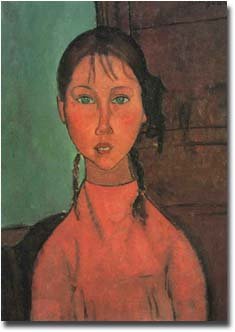
Modiglianis Girl in
Pink 1911