THE
HISTORY OF THE LONDON HOMOEOPATHIC HOSPITAL
Presented by Peter Morrell & Sylvain Cazalet
THE LONDON HOMŒOPATHIC HOSPITAL,
GREAT ORMOND STREET & QUEEN SQUARE,
BLOOMSBURY, W.C.
PERHAPS no
other district of the Metropolis has within living memory undergone a more complete
transformation than that of Holborn. Compared with what it was fifty or even twenty years
ago, it would appear to have been swept and garnished out of all recognition. Few traces,
indeed, yet remain of the old London that Dickens knew so well and that he immortalised in
his famous books. Lincoln’s Inn Fields in particular may be called the heart of
“Dickensland.” Within a stone’s throw of that stately square stands the “Old
Curiosity Shop,” wedged in amongst a little cluster of low-browed buildings that still
give a representation in miniature of this ” vanished London.”
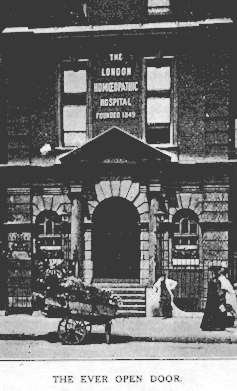
THE EVER OPEN DOOR.
In respect of area Holborn is the smallest
borough in London-smaller even than the City. It is a mile and a quarter long, and its
greatest breadth is seven-eighths of a mile. The greatest breadth of the City is the same,
but its length is a mile and three-quarters. Holborn, however, is not by any means the least
important of London boroughs. To begin with, its population is about 6o,ooo (equal to 147
persons per acre), as against a density of population over the whole of London of 61 persons
per acre. It has a ratable value of £ 1,122,607. The borough contains the British Museum
and Sir John Soane’s Museum, while the legal profession occupies a considerable area within
its boundaries. Gray’s Inn, Lincoln’s Inn, and part of Chancery Lane, John Street, Bedford
Row, Great James Street-household names in the legal world-all call Holborn mother and pay
her varying tribute. From the number of hospitals that it contains, Holdorn may be called
the great hospital borough; and of all these institutions, the LONDON HOMŒOPATHIC HOSPITAL,
founded SIXTY-FIVE YEARS ago, was the first to make its appearance.
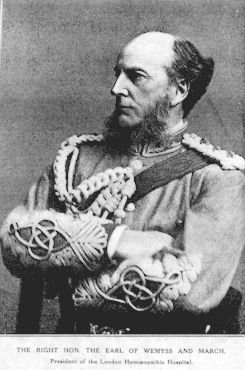
THE RIGHT HON. THE EARL OF WEMYSS AND
MARCH.
President of the London Homoeopathic Hospital.
His Lordship, who was 96 on his last
birthday wrote with his own hand, under date March 12, 1914 : “I wish all success to
Homoeopathy, to which I attach my physical well-being in a great measure. When I was 90 I
was asked to what I attributed my well-being at that late period of life. My answer was ‘To
parentage and moderation.’ I should have added ‘AND HOMOEOPATHY.’ with which I have been
treated since I was 20.”
Hospital literature, as such, does not, perhaps,
present many attractions to the general reader; and though the history of a hospital may
perchance figure as an item in the catalogue of a public library, the volume itself is more
than likely destined to repose undisturbed in a secluded nook or on an upper shelf.
Granting, however, that this may be true in the main, there are exceptions to this as to
every rule, and it is possible that the records even of a hospital may abound in details of
engrossing interest. This, indeed, we believe to be true of the history of the London Homœopathic
Hospital; and it is with a view to inspiring interest in the splendid work already
accomplished and still being done by that excellent institution that the following brief
record of its history has been penned.
Of 123 hospitals in London 84 are its juniors,
and of the 34 remaining, 11 were founded in the same decade, 14 were founded earlier in the
century, 11 date from the previous century, and 2 are the great historic hospitals-St.
Bartholomew’s and St. Thomas’s.
Homœopathy was first practised in England by Dr. Frederick Foster Hervey Quin, in 1828. Dr. Quin was
eminently qualified to be the pioneer of the new system. Endowed with great intellectual
powers, master of three or four modern languages, and one of the best raconteurs
of the day, he was admirably fitted to shine in the best society, to which, indeed, from his
position as physician to Prince Leopold, afterwards King of the Belgians, he obtained ready
admission. Soon after settling down to practice in London he was invited to dine at the
house of a nobleman, and having been detained by professional engagements he came in late.
Quietly slipping into his appointed place at the table, he was highly amused to find his two
neighbours, to whom he was personally unknown, engaged in animated conversation about
himself. “Have you heard ” said one, ” of this new-fangled system that has
been introduced by a Dr. Quin ? It is said to consist in giving medicines which produce, on
the healthy, diseases similar to the diseases to be cured, but in such very small doses as
to be absolutely ridiculous.”
” Why, the man must be a fool !”
exclaimed the guest on the other side of Dr. Quin.
” More knave than fool, I should imagine,” replied the
other.
” Pardon me, gentlemen, for interrupting you,” said Dr.
Quin, “but I think it right to inform you that I am Dr. Quin.”
His neighbours stammered out apologies for their
inadvertent rudeness, but Dr. Quin set them at their ease by saying, ” No offence,
gentlemen; and to show, you that I bear no ill will, I shall be happy to take a glass of
wine with both of you-with you, sir, in my character of fool, and with you, sir, in my
character of knave.”
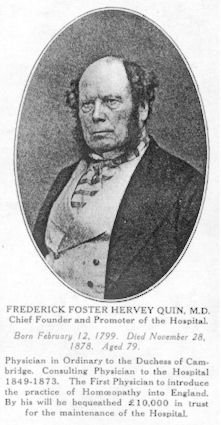
FREDERICK FOSTER HERVEY QUIN, M.D.
Chief founder and Promoter of the Hospital.
Born Fevruary 12, 1799. Died November 28, 1878. Aged 79.
Physician in Ordinary to the Duchess
of Cambridge. Consulting Physician to the Hospital 1849-1873. The First Physician to
introduce the practice of Homoeopathy into England. By his will be bequeathed £ 10,000 in
trust for the maintenance of the Hospital.
Relieved to find that Dr. Quin took the incident
so good – naturedly, his fellow guests soon found their prejudices melting away before the
charm of his conversation and their esteem so won that they became not only his friends, but
eventually his patients.
Dr. Frederick Foster Quin in 1828 stood alone in
England as the champion of the doctrine of Homœopathy, which he had received from Hahnemann
himself. A doctrine so scientific in character and so successful in practice could not long
remain without powerful adherents, and Dr. Quin speedily found himself surrounded by a body
of zealous practitioners, who were to share with him the honours of sustaining, in England,
the banner of homœopathy.
To-day, few charitable institutions are better
known than the London Homœopathic Hospital, and there are none where the professional
enquirer or benevolent visitor can receive a more cordial welcome. It was founded in 1849,
twenty-one years after Dr. Quin had established himself in practice, in order to
demonstrate, by the treatment of the sick poor, the truth and importance of this reformed
system of medicine. The story of its inception and development has a special interest, and
its remarkable progress, in the face of more or less active oposition in its earlier years,
affords cumulative proof of the value of the medical doctrine it was established to teach.
As in most famous enterprises, the beginnings were necessarily small. Progress has, however,
been unceasing, until at the present date it takes an undisputed position among the large
general hospitals of the Metropolis.
Hospital history is made rapidly. One can
scarcely realise that a humble house in Golden Square saw the beginning of the work of the
London Homœopathic Hospital, away back in the middle of the nineteenth century.
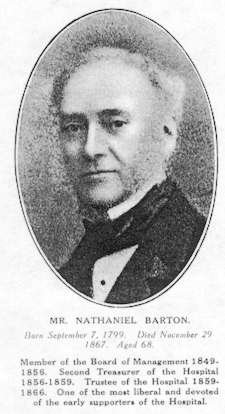
Mr. Nathaniel BARTON.
Born September 7, 1799. Died November 29, 1867. Aged 68.
Member of the Board of Management
1849-1856. Trustee of the Hospital 1859-1866. One of the most liberal and devoted of the
early supporters of the Hospital.
* * * * *