


by Peter Morrell

JAMES COMPTON BURNETT
Dr James Compton
BurnetDr. Burnett trained in Europe [3 years in
Vienna] and then in Glasgow where he graduated in 1876. He studied homeopathy in Liverpool
under Drs Drysdale and Berridge [see Nisbet, 1913, p.65], at first very secretively for fear
of reprisals from allopathic colleagues.Dr. John Drysdale [c.1816-c.1890] was then
in his late fifties, had qualified at Edinburgh and spent several years in the great
continental medical schools before settling in Liverpool, where his successes in the cholera
epidemic of 1849 had so ‘roused the envy of his allopathic colleagues’ that he was
forthwith ‘expelled from the Liverpool Medical Institute’ [Clarke’s Life of Burnett,
1902].Dr. Burnett was born July 20th 1840, near
Salisbury, Wiltshire. He qualified with honours from Vienna [orthodox medical school] 1869;
and then from Glasgow in 1876. He was awarded the Gold Medal in Anatomy upon graduation:
“Passing through a brilliant examination in anatomy, lasting one
hour and a half, the professor shook hands with him, saying that he had never examined a
student with so brilliant and thorough a knowledge of anatomy.” [from Clarke, 1902,
The Life and Times of Dr. Burnett.]
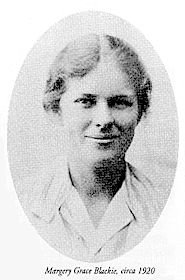
Dr Margery BlackieBurnett was a great-uncle of Dr. Margery Blackie, and a great stimulator
of interest in homeopathy, He was also an ‘Organ prescriber’ and supporter of
Rademacher.
“..James Compton Burnett died suddenly of heart failure at his
hotel in London during the night of Monday, April 1st 1901, two months before Ivy’s
seventeenth birthday…’ [Obituary, BJH, 1901]It was Dr. Richard Hughes’ book, A
Manual of Pharmacodynamics, the first authoritative homeopathic textbook published in
English, which had recruited Burnett himself and practically the whole of Burnett’s
generation of rising young homeopaths in Britain. But Hughes was severely puritanical by
temperament, a fundamentalist and a purist, resenting on the one hand all attempts to
tamper with his own interpretations of what he regarded as revealed truth laid down Samuel
Hahnemann, and detesting, on the other, an ad hoc, empirical or individual approach to
clinical symptoms.
“About 1888 [he] had deservedly made his way in medical circles as
a well-known London practitioner with the appointment as Physician to the London
Homeopathic Hospital . . . ” [Preface to “50 Reasons For Being a
Homeopath”]

Dr. Burnett ran two busy medical practices
in London. He introduced many nosodes: Bacillinum testium [Allen, 1909, p.559], Coqueluchinum
[ibid., p.559], Carcinosinum [ibid., p.560], Epihysterinum [ibid., p.560, Ergotinum
[ibid., p.561], Morbillinum [ibid., pp.565-6], and also Schirrinum [ibid.,
p.568, Allen, 1909] and possibly Influenzinum [ibid., p.565];
“James Compton Burnett died suddenly of heart failure at his hotel
in London during the night of Monday, April 1st 1901.” [Obituary, Homeopathic World,
May 1st 1901]
Burnett was a prolific writer and wrote
numerous books and small pamphlets about diverse aspects of homeopathy. These included:
26 books in all… from 1878-1901, the most famous being:
Natrum mur as a Test of the Doctrine of Drug Dynamization [1878]
Curability of Cataract by Medicines [1880]
Tumours of the Breast and their Cure [1888]
Fifty reasons for Being a Homeopath 1888
The New Cure of Consumption [1890]
Curability of Tumours with Medicine [1898, 1932],
“But it should be remembered that, if homeopathy in the ‘eighties
and ‘nineties was under constant fire from without, it was torn simultaneously by civil
war within. Dr. Burnett had to contend not simply with crypto-homeopaths like Joseph
Kidd, who had attended Disraeli in his last illness, publicly renounced his
homeopathic allegiance and became the object of a blistering, often libellous onslaught in
the Homeopathic World for eight months thereafter; or allopaths like Robert Koch
who, as the first to isolate the drug tuberculin which ultimately eradicated consumption,
won a renown in the early ‘nineties which Burnett [who claimed to have pioneered the same
methods five years before Koch] held to be rightfully his. Homeopathy itself was meanwhile
split into two warring factions, the one led by Burnett and a group of his friends [among
them his future biographer, John Clarke], the other by the immensely influential Richard
Hughes.” [ibid.]
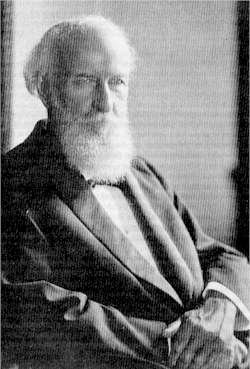
Dr Joseph Kidd
Regarding Dr Kidd, who was Disraeli’s
physician in his last illness, see Treuherz, 1995, and the Kidd Obituaries in The Times and
The Lancet [Kidd, 1918].
Burnett’s approach to homeopathy was richly
informed by reviving earlier heresies like Paracelsus, Rademacher and Fludd. He accepted
that a person could be treated through the organs [‘organopathy’] and on this basis he
mainly used the low potencies and tinctures. He also employed what came to be called ‘the
ladder of remedies’, zigzagging his way through the symptoms of a case taking out a
single symptom at a time. The ‘ladder’ consisted of:
‘…a series of different medicines prescribed at different potencies
and subtly adjusted to the needs of a particular case. The trickiest problems pleased him
most, and the quirkier the solution, the better it suited him…’ [Clarke, 1902]
Like most of his contemporaries, he also
made extensive use of the newly introduced nosodes, like his own Bacillinum, prepared
from tuberculous sputum [Allen, 1909, pp.559-576]. These were used in the 30, 200 and 1M
potencies, widely spaced. He swiftly became famous as a doctor who could cure tumours and
was reckoned to have, at his death in 1901, the largest consulting practice in London
[Obituary, Westminster Gazette, 1901]
His surprisingly ‘unclassical’ approach
also echoes the work of Hahnemann in his final years in Paris:
‘Hahnemann would then select his remedy on the basis of any important
or prominent symptoms… he had to be content to move through the case, eliminating
symptoms serially…as he removed each symptom, so he tuned each note until eventually the
whole instrument might be restored to harmony….there is extreme example of this in Mr
Robert Lyster’s case, where Hahnemann worked his way serially through all five
remedies…until some improvement was eventually achieved with the last one.’ [Handley,
1997, pp.65-6]
Burnett also resorted to old herbal Drugs
like Acorns, Bruisewort, Walnuts, Nettles, Couchgrass and Daisy [Clarke, 1902]. His whole
approach was remarkable for its very wide grasp of homeopathy as a system of natural healing
wholly without dogma and a wide eclecticism with regard to herbs and ‘organ remedies’.
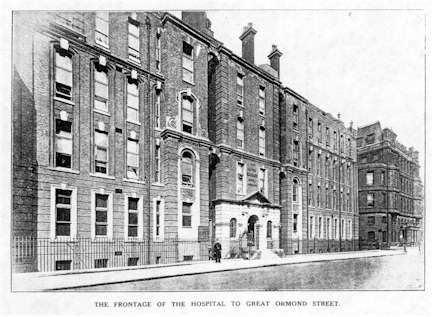
The London
Homeopathic Hospital
He seemed as happy with high potencies and
nosodes as he was with tinctures and herbal preparations derived from ‘old wives tales’.
This was in marked contrast to many of his contemporaries within the movement, who were
deeply dogmatic purists, strongly opposed to such experimentation [e.g. Drs Hughes and
Kent]. Burnett was so well-regarded that a Chair of Materia Medica was named after him
within the BHS, at the London Homeopathic Hospital, and often called the ‘Burnett
Professorship of Homeopathic Practice’.