Hahnemann
& Homeopathy – from Romanticism to Post-Modernism
by Peter Morrell
Dream of Egypt, 1995 – Peter Morrell
When Dr Samuel Hahnemann [1755-1843] died of
bronchitis in Paris in July 1843, few people were told of his death, and
the funeral, in driving rain at Montmartre, was only thinly attended.
His coffin was inscribed Non inutilis vixi – I have not lived in
vain.
The following short account hopes to clarify and
illuminate the changing nuances of attitude towards homeopathy, from its
humble origins in Saxony, and the intellectual milieu that created
Hahnemann, tracking shifting attitudes since the mid-19th century and so
through to the modern era of homeopathy’s dramatic revival on all
continents.
At his passing, many doctors must have heaved a sigh
of relief that a rather unedifying chapter of medical history was
finally drawing to a close. Yet, his homeopathic system of medicine
became the darling of the fashionable classes throughout Europe. Like
Mesmer before him, it was Paris, which had given him a thriving medical
practice, and made him, and his young second wife, rich and famous.
Hahnemann treated patients from all social classes, including the
virtuoso violinist Paganini, and some minor British aristocrats. Though
he occasionally went to the Opera with his fashionable, artist wife,
generally speaking he lived a quiet, unassuming life, oblivious of the
delights on offer in the capital of the ‘beau monde’.
Homeopathy had been taken up by doctors all over
Europe, was exported to Russia, India, south America and USA, where it
especially thrived, becoming the preferred medical system of royals and
aristocrats everywhere. Along with other complementary therapies,
homeopathy today is back on the medical map once more; having undergone
a resurgence in public interest, it now flies under a pluralist,
post-modern banner, which challenges the entrenched reductionist
orthodoxy of medical modernism.
Origins
In the origins of homeopathy, several diverse
currents and ideas can be seen to converge. A humble pottery painters
son from the porcelain town of Meissen, Hahnemann indulged a passion for
experimentation and chemistry, eventually rejecting the medicine in
which he had been trained, as bogus, ineffective and bereft of rational
principles. Being also a gifted linguist, he was fortunate in having
translation work to fall back on in the 1780s after the severe
disappointments of his first medical practice.
Abandoning medical practice and moving to Dresden in
1784, he became an official translator of medical and scientific texts
for the Dresden Economic Society. Between 1777 and 1805, he translated
into German over 20 large texts from the Italian, Latin, English and
French.
Hahnemann became bitterly disappointed with the
medicine of his day and resolved to elucidate the fundamental causes of
its errors. While translating texts, he studied case histories in the
literature and collected evidence in an effort to establish some sound
principles for the actions of drugs. He became famous for the copious
and highly learned footnotes and annotations he inserted into his
translations, making them more sought after than the originals.
Correcting numerous points of fact and interpretation, he clearly
relishing putting his extensive knowledge to good use in this task. That
they grew in length and disputatiousness as time went on, can be judged
from his translation of the Thesaurus Medicaminum in 1798, where
he exhorts the reader in a preface to kindly burn this useless book.
From Signatures to Poisons
Like other scientists of his day, he remained hopeful
that genuine medical principles would eventually be found. Fearlessly
iconoclastic, he rejected the ‘doctrine of signatures’ as forming any
kind of rational basis for the selection of drugs. Having held sway for
many centuries, this unquestioned dogma pretended that the shape and
colour of a plant could accurately reveal its general therapeutic
properties. It was to be the first medical icon that Hahnemann
fractured, ridiculing it as a preposterous folly. Further research
inspired him to attack two other favoured doctrines: mixed drugs and
high doses.
 Through
his reading, he soon became fascinated by poisonings, entertaining the
notion that the toxic action of a drug more surely reveals its
therapeutic properties. In this notion, he came close to a view
expressed by Shakespeare, in Romeo and Juliet, when Friar Lawrence chose
the plant from which to make Juliet’s sleeping potion: “Within the
infant rind of this small flower, Poison hath residence, and medicine
power”. Fastening hard to this principle, Hahnemann soon found
abundant evidence for it in the medical literature. A literature not
only of six north European languages, but being also fluent in Arabic,
Greek and Hebrew, he soon accessed previously untapped streams of
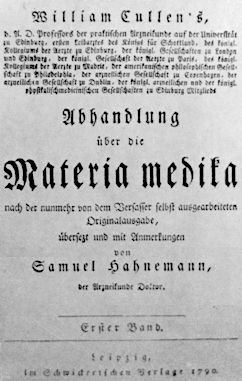
medical knowledge. While translating William Cullen’s ‘Materia Medica’
in 1790, Hahnemann was led to make experiments testing drugs on himself.
It was these mild self-poisonings of drugs [‘provings’] that spawned
homeopathy, which is embodied in the phrases: ‘law of similars’ or ‘like
cures like’.
Drug Experiments
From his iconoclastic attitude he was to reap a
bitter harvest of trouble, as much from apothecaries as from other
doctors. Hunted down wherever he went as a loathsome medical heretic,
his growing family were forced to endure a peripatetic existence for
many years. He settled for a time in Dresden and later in Leipzig,
obtaining a brief teaching post in the university medical faculty, until
his deviant views got him sacked for ‘corrupting the young’ – a similar
charge that had so abruptly terminated the teaching career of Paracelsus
three centuries earlier. The two lives carry many important
similarities.
The testing of drugs on the healthy, which might
almost be called the first ever drug trials, became a foundation stone
of homeopathy, from its inception. Certainly, this reflected Hahnemann’s
insistence that only through scientific experiments and mass trials can
the truth about the nature and actions of drugs in health and disease be
finally settled. Having deliberately laid to one side centuries of
entrenched dogma and superstition about drugs, in preference for
experimentally demonstrable facts, homeopathy can therefore claim to be
the first evidence-based system of medicine. It also reflects
Hahnemann’s upbringing, steeped as it was in the pervasive spirit of the
French Enlightenment.
In spite of all this rationalism, and empiricism, it
is not hard to find woven into the fabric of homeopathy several concepts
closer to Romanticism. These include the infinitesimal doses, a form of
vitalism [healing power of nature] and the idea that medical similars
[similia similibus] will always triumph over opposites [contraria
contrariis]. Thus, in Hahnemann we can discern a clear rejection of the
entrenched dogmas of Claudius Galen [2nd century founder of contraries]
in preference for the views of clinicians like Paracelsus [1493-1541,
doyen of similars]. By drawing equally upon the scientific and the
romantic traditions, Hahnemann assembled a very motley crew of concepts
and techniques that reflect the late 1790s obsession with conflicting
ideas – Enlightenment rationalism and the empiricism of experimental
science, both so beloved of the French, combined with ancient, almost
mystical ideas of the spirit of minute doses and the innate healing
power of the body. Such ‘nebulosities’ arguably reveal some influence by
German Romantic thinkers, like his contemporaries Goethe [1749-1832],
Kant [1724-1804] and Schiller [1759-1805].
Mixed Influences
Drawing heavily on no-one directly, he was clearly in
tune with the ‘zeitgeist’ or spirit of his times. Many European thinkers
were still obsessed with science and the concept, associated with Newton
and Descartes, that all phenomena can somehow be explained through
experimentation and the material concepts of the machine. Such a
reductionist impulse had already made a thoroughgoing rejection of
vitalism and organicism in preference for chemistry and mechanics. Yet,
with the rise of Romanticism – a Counter-Enlightenment – the
smouldering, intense, and mainly German, rejection of materialism and
industrialism, signalled a revival of such pastoral notions as the
sanctity of life, the pervasive presence of God in the world and a
precious regard for human life. These largely incompatible world views
lived side by side at that time and still endure in homeopathy.
As well as being dominated by pioneering experimental
scientists like Lavoisier, Priestley and Scheele, this was also the
great age of Wordsworth, Blake, Byron and Keats, not to mention
Beethoven, Constable and Turner. Blake eloquently encapsulated the
passionate Romantic rejection of machines and Newton when he wrote: ‘A
Robin redbreast in a cage, puts all Heaven in a rage’. The cage
being Newton’s ‘universe as machine’. Thus, in Hahnemann, we can see
opposing elements of late 1790s philosophy conjoined. He drew heavily on
both traditions, outrightly favouring neither, and thus rendered
homeopathy ambivalent towards each.
Hahnemann ignored virtually every tumultuous
contemporary development in philosophy, in economics and in politics.
Battles seemed to rage, conquerors came and went, whole philosophies
erupted and had their day, while he blinked not an eye. He steadfastly
focused upon his one chosen task, living through some of the most
exciting events of history, oblivious of and making no comment upon
Napoleon, the Battle of Leipzig [1813], the American Revolution [1776],
the French Revolutions [1792, 1830] and the philosophies of Kant and
Hegel.
Nineteenth Century
What probably made homeopathy so thrilling in the
19th century, is the way it was taken up by people who mattered – the
rich and influential. It is no exaggeration to say, that it went through
all the European royal and aristocratic families like a forest fire,
becoming a social phenomenon. It became the preferred medical system of
the Kings of Prussia and Saxony, and later of Wurttenburg. This
popularity soon spread to Austria [where it was later banned], Poland,
Russia and Italy, where it was popular among those rich Englishmen
embarking on the Grand Tour.
Its English origins can be traced to Naples via Dr
Frederick H F Quin [1798-1878] and the Earl of Shrewsbury, who
frequented Naples and brought homeopathy back with them to Britain in
the 1820s. Quin first encountered it through a Dr Neckar, an Austrian
army physician then resident in Naples. The causes of homeopathy’s
popularity with the rich are not hard to see. Compared to barbaric
conventional methods, like bleeding and purging, it was an extremely
benign and gentle system of therapy – water and sugar pills – and it had
gained a reputation for being efficacious against epidemics like
cholera, typhus and scarlet fever.
Homeopathy soon became a thorn in the side of
conventional medicine, which it attacked with unrelenting ferocity, and
which failed repeatedly to halt the spread of this ‘medical heresy’. It
also engendered a revolution in conventional medicine, which, unable to
justify its own methods, gradually began to reduce the doses of drugs in
use, to terminate the unpopular use of bleeding, purging and blistering,
and to employ simpler drugs rather than the complex mixtures in vogue in
1800. By 1900, the entire edifice of conventional medicine had been
radically transformed, partly through advances in science [mostly drug
chemistry] and partly driven forwards by the sustained and corrosive
critique alternative therapies were making of its ineffective and
dangerous Heroic methods.
The entire 19th century saw the battle-lines in
medicine drawn between ‘conventional’ and ‘alternative’. Only with the
political legitimation of scientific medicine by the 1858 Medical Act,
did the popular healing sects finally become legally pressured into
decline and seem outdated. Becoming a true profession after 1860,
medicine barred entry to the unqualified, and though it declined to
outlaw quackery entirely, it strongly suppressed deviance within its own
ranks.
Modern Times
That is not to say that sectarian healers all went
away and the story ended there; far from it. Homeopathy, herbalism,
osteopathy and nature cure trickled on as a ‘medical underground’
movement, occasionally emerging from the darkness of marginality, to
mount fierce attacks on orthodoxy, and continuing to attract the loyal
patronage of royals and aristocrats. Even though they were deviantised
by the orthodox, these marginal healers continued to play a minor part
in the medical scene through the 1930s and into the 1960s. Though
interest in them had certainly declined, they still succeeded in
attracting clientele; in England, homeopathy has enjoyed unbroken royal
patronage since about 1900. During the late 1960s, when ‘alternatives’
of all kinds became fashionable once again, with a renewed flowering of
Romanticism, their revival seemed assured. All these systems of healing
are now popular as never before, and so an age of medical pluralism,
reminiscent of the 1840s, is made manifest.
It seems that deviance performs a useful function in
all professions, holding up the mirror of caricature to the orthodox and
so, through friction, generating an impulse for change and innovation.
From contact with its opposite, orthodoxy is challenged, put on the
defensive, and hence has to garner inspiration for change and renewal.
That is just as true today as in the 19th century, and has, above all,
been a dominant theme of the 20th. The current revival of these diverse
healing systems is fundamentally post-modern in character – challenging
the right of any fundamentalist, monistic hegemony to assert a single
medical truth’ or to elevate itself in rank above any other medical
modality. Pluralism has become king and this inspires change. As
Aristotle insisted: Everybody has something to add to the truth.
Due to the sheer popularity of these healing methods,
modern medicine is being forced once more to scrutinise its own
principles and methods, not to say its social niche, and to decide how
this strangeling might become more comfortably accommodated. As in the
1840s, so at the start of the 21st century, history is repeating itself.
As we are now finding, the silver plate on Hahnemanns coffin still
seems apt, he did not live in vain.
Further Reading:
Howard Becker, 1963,
Outsiders, Free Press, New York
Rima Handley, 1990, A
Homeopathic Love Story, North Atlantic Books
Richard Haehl, 1922,
Samuel Hahnemann His Life and Works, 2 volumes, Jain, India
Martin Gumpert, 1945,
Hahnemann – The Adventurous Career of a Medical Rebel, Fischer, New York
Rosa Hobhouse, 1933,
Life of Hahnemann, Harjeet, India
Peter Morrell –
British Homeopathy During Two Centuries, thesis online at
http://homeopathyforce.com/morrell/british.html