
SAMUEL
AND MELANIE IN PARIS
by Peter Morrell
‘study of water’, 1975 – Peter Morrell
This short piece is mainly designed for the visitor to
Paris who may wish to lookup some of the places which were central to
the lives of Samuel and Melanie when they lived there over 150 years
ago.
Samuel Hahnemann and Melanie first met in October
1834, Melanie having travelled from France to Coethen to see him. In the
following January – 18th Jan 1835 – they were married. Melanie was not
happy in Coethen and wanted them both to move to Paris. Having rewritten
his Will on 2 June, they left Coethen (and Germany) for the last time on
7 June 1835, he thereby bidding adieu forever to his beloved Saxony.

(Courtesy H.I.)
Samuel HAHNEMANN (1755-1843)

(Courtesy Dr R. Séror)
Marie Mélanie dHervilly-Gohier
On 21 June they arrived in Paris and took an apartment
at 26 Rue des Saints Pères, right in the centre of old Paris, south of
the Seine opposite the Ecole des Beaux Arts, near the Hopital de la
Charité and the Medical Academy. One of the main bridges, the Pont du
Carrousel leads south from the front of The Louvre straight into the Rue
des Saints Pères. Some weeks later they moved to a house on the
southern outskirts of the city at 7 Rue de Madame, mile further south
and on the western side of the Jardin du Luxembourg. In a letter in Jan
1836 to his German friends he describes this house as ‘…free from
noisy streets, our large windows overlook a pretty garden…with
backdoor opening into the Park of Luxembourg…a large garden with
trees, which is an hour’s walk in extent.’ (see Haehl, Samuel Hahnemann
His Life and Works, 1922, Vol 2, p347 & Vol 1 pp221-237). In 1837
Hahnemann and Melanie moved house again, this time to  the
north of the city, to 1 Rue de Milan
in 9th District, halfway between the Boulevard Haussman and the Place de
Clichy. It is a short east-west street joining the Rue de Clichy with
the Rue d’Amsterdam, very close to the railway station Gare St Lazare
and to the north west of central Paris. House number 1 is at the eastern
or Rue de Clichy end of the street. It was a very noisy and bustling
area with fewer trees and less fresh air than they had enjoyed at their
former residence. It was at this house that he stayed until his death.
It was to this house that the many students, doctors and famous and
celebrated visitors came to seek him out for tuition, treatment and
advice, such as the virtuoso violinist Nicolai Paganini (1782-1840) and
the 2nd Marquess of Anglesey, Henry Paget (1797-1869). It was a house
well known to the main founders of English homoeopathy in the 1830’s: Dr
Quin, Rev Thomas Everest, William Leaf and
Dr Paul Curie. Everest, his brother George and Leaf had all been his
patients. Despite his great age, Hahnemann clearly had a whale of a time
in Paris, being as fluent in French as he was in Italian, English and
Spanish. He was feted by the Parisians as a great celebrity in the most
fashionable European city of the day. Hahnemann died there at 5am on 2
July 1843 and Melanie kept his body there before burial until the 11
July. He was buried in the Cimetiere de Montmartre to the north of Paris
in what is popularly called the ‘artists’ quarter’. He was buried in
grave number 8 and in 1878 Melanie was buried ingrave number 9. In the
early hours, the cortege moved grimly through the streets the short
distance to Montmartre in driving rain with only a handful of mourners-
Melanie had not informed anyone of his death. On the insistence of
wealthy American homoeopaths, in 1898 it was agreed that his grave
should be opened, so his remains could be moved to the more prestigious
Cimetière du Pere Lachaise. On May 24 1898 the two graves were opened
and theremains identified from a large lock of Melanie’s hair around his
neck and from his engraved wedding ring. The bodies were moved to a much
grander tomb in the Lachaise cemetery which can still be seen. It is a
‘celebrity’ grave along with many other Paris notables from the last
century and also from this.
The Paris College of Homoeopathy
The Paris College of Homoeopathy or `Institut de la
Medecine Homeopathique’ was located at 93 Rue de la Harpe. This is a
bow-shaped north-south street south of the Ile de la Cité, in the
centre of old Paris, just at the top end of the Boulevard Saint Michel.
It was opened in Oct 1839 by Dr Croserio with Dr Jahr teaching Materia
Medica Pura in German, Dr Mure teaching pharmacology and mnemonics and
Dr Croserio running the Homoeopathic Clinic (p400). In July 1840 Dr
Croserio says that another College and Clinic had been opened in Rue
Git-le-coeur on the south bank of the Seine; both are close to the
allopathic ‘Ecole de Médecine’ and opposite the Palais de Justice.
(Bradford, 1895, p401) The expressed objectives of the Paris College of
Homoeopathy were outlined by Dr Croserio in a letter to Dr Neidhard of
Philadelphia as follows:
- to teach students the theory and practice of
homoeopathy; - to spread the benefit of homoeopathy among the
lower classes of the capital, by giving consultations gratis to
those who will personally apply for them; - to give advice in writing to those patients in the
country and in the Provinces of France, who, having no homoeopathic
physicians near them, apply for it; - to prepare Homoeopathic medicines according to the
method of Dr Mure; - to translate into the French language practical
works on homoeopathy; - to publish, under the title of `le propagateur de
l’homoeopathie’ a monthly periodical, by which all new homoeopathic
works and periodicals will be reviewed; - to procure for those homoeopathic physicians and
other individuals in the Province, or in foreign countries, who
would apply for them, homoeopathic books, instruments, medicines and
practical advice in particular cases; - to open a `cabinet de lecture’ where students,
physicians, may read or borrow all homoeopathic books and
periodicals published in France or other countries; - to consult strangers who come to Paris, either for
studying homoeopathy, or for buying homoeopathic medicines, books
etc. - to serve as a central point for homoeopaths of all
nations and to nominate correspondents for that purpose in all
foreign countries.

(Courtesy Dr R. Séror)
Georges Henri Gottleib JAHR
(1800-1875)

Dr Benoît MURE
`Dr GHG Jahr will teach Materia Medica Pura, with
German as the homoeopathic language; Dr Mure pharmacology and menonics
applied to the Materia Medica; andI have accepted the homoeopathic
clinic.’ (Bradford, 1895, p400-1). It is not entirelyclear how long this
institution lasted and what number of homoeopaths it trained.
And what a shame it was for British homoeopathy that
those noble aims of the Paris Institute were not shared by its founders,
Dr Quin & Co, nor imported to the British Isles to create a
‘homoeopathy for the masses’ rather than a ‘homoeopathy for the rich
elite’, which is what they actually created. And how correspondingly
impoverished UK homeopathy has therefore been ever since. It would be of
great interest to determine to what extent the great popularity of
homoeopathy in France can be attributed to the above sentiments of Dr
Croserio and to Hahnemann’s great generosity of spirit. And by contrast,
how much its relatively dismal track record in England can be attributed
to the absence of the same attributes by the founders of English
homoeopathy.
Dr Croserio
Dr Felix Croserio is a little known yet very important
figure during Hahnemann’s final years in Paris. He was born in 1786 at
Condove in Savoy. He studied in Turin, and did military service in 1806
as a French Army Surgeon, following campaigns in Spain, Germany and
Russia until 1814. He went back to Turin for his MD in 1812, leaving the
Army as a Senior Physician after Napoleon’s downfall and settled in
Paris as a practitioner. He became acquainted with homoeopathy in 1833
through a Dr Petroz and studied eagerly, learning German at the same
time. He edited for some years, along with Dr Leon Simon (1798-1867) and
Dr Jahr (1800-1875), the `Annales de la Medecine Homoeopathique’. He
also wrote many essays, his influential `La Statistique de la Médecine
Homoeopathique’ and in 1850 `Manuel Homoeopathie d’Obstétrique’. He was
Physician for a time to the Embassy of the King of Sardinia in Paris and
was attached to several charities. He was trusted completely as an
intimate friend of Hahnemann – he and Dr Jahr being the only physicians
to attend Hahnemann at his last. He was also Melanie’s chief assistant
and constant companion after Samuels death, and helped her compile her
case for the Lawyers at her trial in 1847. He also corresponded with the
American homoeopaths. He died in Paris 69 years old on 13 April 1855,
ominously 3 days after the 100th anniversary of Samuel’s birth and thus
in what must have been a very bleak time for Melanie. (see Haehl, 1922,
vol 2, p506)
The grave of Hahnemann
1993 marked the 150th anniversary of Samuel
Hahnemann’s death. Rima Handley, in A Homoeopathic Love Story, records
his death in Paris in 1843. His grave is at the prestigious Cimetière
du Père Lachaise in the north east of the city. `It is easy to get to
the cemetery by bus or Metro. At the gate you can buy a plan which shows
the whereabouts of the 200 most famous people, out of more than a
million who have been buried there over the centuries. You will be glad
to know that Samuel figure among these 200. Others include Chopin, Edith
Piaf and Jim Morrison of The Doors! `It was a warm Sunday morning in
mid-March when we climbed the hill side, bright with crocuses and
daffodils, to find Hahnemann’s memorial beside a broad path. There is a
bust, surmounted by the words, ‘Hahnemann Fondateur de l’Homeopathie’
and beneath, the words he asked Melanie to put on his tomb, ‘Non
Inutilis Vixi, I did not live in vain. To the left is a list of his
major writings and to the right, ‘Similia Similibus Curantur. Traitez
les Malades par des remèdes produisant des symptômes semblables à
leurs maladies’. Let like be cured by like; treat illness with remedies
that produce symptoms similar to the illness. A rose and some other
flowers had been left on the memorial recently. We took a lot of photos
and watched the reaction of others to the impressive memorial.”
[The above section, written by Richard Palk, has been edited down from
an item in’ONEM, The College of Homoeopathy Student Magazine’, which
also appeared inthe Society of Homoeopaths Newsletter 39, in Sept 1993]
The baffling thing about Melanie’s destiny is that her grave is also
near Hahnemann’s, but is in an unmarked plot. Haehl has this to say
about it:

Melanie, circa 1875

Père Lachaise
“Madame Melanie Hahnemann died on the 27th of May
1878, almost forgotten. She was then 78 years of age, and succumbed to
catarrh of the lungs, from which she had sufered for several years. She
was laid to rest in Montmartre… she had left her husbands grave
without the inscriptions he desired and composed… her own resting
place she had chosen to the left of Hahnemann’s grave. The assumption
that as at first intended, she was to be united with her husband in the
grave, led in many cases to a mistaken idea that her grave was also
Hahnemanns last resting place. For two decades it was continually
described as Hahnemann’s Grave’, if it was at all remembered as such.
Not until 24th May 1898 was the complete and final truth revealed. On
this date the grave was opened and found to contain only one coffin with
the remains of the widow Hahnemann, Melanie nee d’Hervilly. All the
marks coincided with the number of the grave and the entries in the
register of the cemetery. In the grave next to it, however, Hahnemann’s
coffin was discovered containing his remains. These remains of
Hahnemann, together with what was left of Madame Melanie now entered
upon their very last journey. In the Père Lachaise cemetery the
Frenchwoman Melanie lies in a small coffin at the foot of the coffin
containing the German founder of Homeopathy. Stranger shave at last
carried out his dying wish: ‘bones to bones and ashes to ashes’. (From
Haehl, Samuel Hahnemann His Life and Works, 1922, vol 1, p354)
Finally, for the antique collector, try the flea
market of Montmartre in the north every Monday for old medicine bottles
and pillars. There are some beautiful old pharmacies in Paris, with
wood-panelled walls packed with those attractive old medicine jars and
bottles that could even be seen in Britain up to the early 70’s. These
old pharmacies are common around the Ile de la Cite and Ile de St Louis
near the Notre Dame. There are also a number of interesting second-hand
book stalls along the Seine and a large American Bookstore
(second-hand). The latter is bright yellow and close to the banks of the
Seine, though I can remember neither the the exact location nor its name
as I was travelling on a bus at the time I saw it.
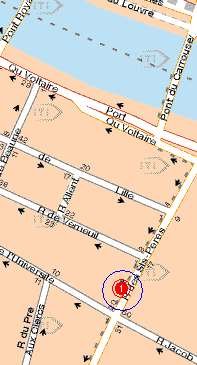
Rue des Saints pères (Paris)

Rue de Milan (Paris)
Sources:
Bradford, 1895, Life and Letters of
Hahnemann, Jain Indian Edition
Burke’s Peerage, 1940, London
Debrett’s Peerage 1920, London
Dinges, Martin (Ed), 1996, Weltgeschichte der Homoopathie: Lander,
Schulen,Heilkundige, CHBeck, Munchen
Editions Couterel, 1995, Paris par Arrondissement, for maps
Haehl, 1922, Samuel Hahnemann His Life and Work, 2 vols (for picture of
his tomb and for the death certificate)
Morrell, Peter, 1996, Sam & Mel in Paris, The Homeopath 62, London
Palk, Richard, 1993, The Grave of Hahnemann, in ONEM, and Society
ofHomeopaths Newsletter 39, Sept 1993, London
Extrait du plan de Paris avec l’aimable autorisation des pages jaunes
(internet).