
Triumph
of the Light Isopathy and
The Rise of Transcendental Homeopathy, 1830-1920
by Peter Morrell
Pencil Sketch of a rusty old boiler at a disused green
marble quarry on the southern tip of Iona in western Scotland, 1979 –
Peter Morrell
Triumph of the Light Isopathy and
The Rise of Transcendental Homeopathy, 1830-1920
“Long before the birth of bacteriotherapy homeopathic
physicians carried out investigation in their own way, and
discovered similar medicines, and effected numerous cures Hydrophobinum
was proved in 1833 50 years before Pasteur many others followed.”[1]
———–oOo———–
Abstract
Modern homeopathy dwells in a nebulous and
metaphysical realm into which few allopaths would fear to tread. It is
precisely this philosophical distinction that places the two medical
traditions in very different medical worlds and speaking languages
virtually incomprehensible to each other. The two seem fundamentally
incompatible medical systems whose respective and highly sophisticated
conceptions of ‘disease’ and ‘cure’ are sufficiently at variance to
prevent their peaceful co-existence without creating tensions,
division and dissent. And woe betide those who try to cross-breed
them. The problem today concerns what can be done to move things
forward. How can the best of modern scientific medicine be reconciled
with this ‘medical Lazarus’ so recently brought back from the dead?
How can previously closed doors be re-opened for creative dialogue to
proceed into a future broad church medicine of the whole person? This
article explores the development of modern homeopathic medical
conceptuality between 1830 and 1920, and charts the discourse within
homeopathy first set in motion in the 1830s with the increasing use of
higher potencies and disease products [nosodes]. It also attempts to
show that the gradual incorporation into the homeopathic mainstream of
disease products, both killed off and supplanted the earlier
allopathic version of homeopathy and, by encouraging the use of higher
potencies, also emphasised the adoption of a metaphysical medical
conceptuality within the movement.
Introduction
Developed in 1790s Saxony by Dr Samuel Hahnemann
[1755-1843], homeopathy is a medical system that gives drugs to the
sick on the basis that they can induce similar symptoms in the healthy
[similia similibus]. [2] Seeking through experimentation to
radically improve the ineffective medicine of his day, and partly
inspired by study of poisonings, he conducted ‘provings’ of single
drugs on healthy volunteers, after 1790, and compiled a brand new
materia medica thereby. Hahnemann had studied at Leipzig, Vienna and
Erlangen, where he graduated in 1779. He attracted great controversy
and many students, such that homeopathy spread rapidly throughout
Europe, Russia and the Americas. After 1800, and deriving from further
experiments, he introduced infinitesimal doses of drugs, devising
decimal and centesimal dilution scales, in which one part of the crude
drug [such as a plant tincture] was diluted with 9 or 99 parts of
dilute spirit and vigorously shaken [succussion]. For insoluble drugs
[e.g. Oyster shell, Silica and Lycopodium pollen] trituration with
milk-sugar was substituted for shaking in dilute spirit: “he
was probably the first to produce suspensoids by his process of
repeated trituration and dilution,” [3]
The main features of homeopathy are single drugs
and small doses, employed on the basis of similars and case totality
rather than named conditions. Then, in 1828, Hahnemann announced the
miasm theory of Chronic Diseases, which stirred up a great deal of
controversy and dissent. His main works were the Organon [1810,
but revised five times to 1842], the Chronic Diseases and the Materia
Medica Pura [1811], plus numerous essays and scientific papers,
and 21 translations into German of key medical texts from Italian,
English and French, including William Cullen’s pivotal Materia
Medica of 1790.
Homeopathy was brought to the UK in 1828 by Dr
Frederic Quin [1799-1878], who established a London practice July 1832
at 19 King St, St Jamess, [4] the British Homeopathic Society
[1844], the London Homeopathic Hospital [1849] and the British Journal
of Homeopathy. An Edinburgh graduate and aristocrat, he was physician
to the Belgian King Leopold [1790-1865] from 1827-29, [5] to Queen
Adelaide [1792-1849] and to the Duchess of Devonshire. Having
travelled extensively in Europe he was the only British homeopath who
had studied directly with Hahnemann [in Coethen, in July 1826, staying
until November], [6] including a visit to Moravia treating cholera[7]
and then in Paris in 1830. Quin “combined great charm and
close aristocratic connections,” [8] which meant that
homeopathy “got a firm hold of the highest grades of society
first of all.” [9]
Having all the right connections, Quin was a man of
tremendous personal charm and integrity, who moved completely with
ease in high society and was on friendly terms with everyone who
mattered “among his patients were Dickens, Landseer and
Thackeray“[10] – even being in later life a dining partner of
the Prince of Wales and future King Edward VII [1841-1910]. Quins
efforts obviously rendered homeopathy very palatable to the social
elite and ruling classes in London and the fashionable resorts, as it
also was with royals throughout Europe. He maintained close personal
links with Hahnemann in his last years [1835-43] in Paris.
While some physicians benignly regarded homeopathy
as “an innocent and harmless species of quackery,”
[11] others denounced it as “medical superstition and
pretension,” [12] and ridiculed the processes of trituration
and succussion as merely “magical ceremonies and the tricks of
conjurors.” [13] Quite apart from the vilification heaped
upon homeopaths by the mainstream, powerful divisions within the
movement soon became apparent [1830s] over some of Hahnemann’s more
contentious doctrines, especially the use of high dilutions of drugs
[30c, 200, and higher], and surrounding the miasm theory [1828] that
portrayed all chronic disease as deriving from ancient and
internalised dyscrasias, stemming originally from syphilis, gonorrhoea
and Psora [suppressed skin eruptions]. In the 1830s, those who
favoured such transcendental doctrines [especially in the USA], also
developed isopathic drugs [nosodes and sarcodes] derived from diseased
tissues, [14] and mechanical contrivances [fluxion machines] [15] for
more speedily preparing the higher centesimal potencies, upon which
their practice was chiefly based. It is the unfolding of this aspect
of homeopathy and its impact, that forms the main focus of this essay.
The development of homeopathy seems always to have
contained a struggle between the nebulous or spiritual and the
material. For example, Aphorism 9 of Hahnemanns Organon
speaks of the material organism being governed by a “spiritual
principle
that rules with unbounded sway.” [16] This
struggle largely derives from the dual nature – material and spiritual
– of medicine in general, but it also derives from the way homeopaths
were continually influenced, especially in the 19th
century, by developments taking place in conventional medicine. For
example, the Germ Theory emerging in the 1880s with Koch [1843-1910]
and Pasteur [1822-95], [17] which partly succeeded and paralleled the
nosode movement in homeopathy. “Burnetts Bacillinum was
prepared from
sputum whereas Kochs preparation was made from a
culture of the bacillus
by 1914 most homeopathic doctors used both
Bacillinum and Tuberculin,” [18] The therapeutics of such
preparations varied widely: “Tuberculinum has for years been
helpfully given in meningitis, hereditary and inveterate headaches,
hectic fever, night sweats, cough with tuberculous expectoration
”
[19] The conflict so spawned within the movement, might be
depicted as that between darkness and light, between the material and
the spiritual. Being generally sceptical of the Germ Theory,
homeopaths preferred to believe in susceptibility as a more
credible explanation of the facts about disease. [20] This
susceptibility was deemed to “exist in the vital force, and
not in the tissues,” [21] because if a man was “in
perfect health he would not be susceptible.” [22] As Burnett
says, the technique was grounded in 1870s experimentation with disease
products: “It must be over fifteen years since I first
[used]
the viruses of certain diseases against the diseases themselves;”
[23] “I beg publicly to thank Dr Skinner, of London, for
inducing me, sixteen years ago, to administer the virus of a disease
therapeutically.” [24] As he shows, the use was based upon
the idea of proving: “I took [Tuberculinum] myself in varying
doses at various times, the 30, C, CC [= 10M], in the form of
pillules.” [25]
A Romantic Outlook

Rudolf
Steiner (1861-1925)
Homeopaths drew some inspiration and ideas from
esoteric sources, religious and metaphysical traditions that all share a
vitalist outlook with regard to the organism. For example, Simpson
claims homeopathy is reliant upon “a spiritual medicinal power,”
[26] Homeopaths have generally, interpreted the phenomena of life,
disease and cure through essentialist eyes: “the outer
world is the world of results.” [27] The corpus of homeopathic
theory very much reflects this essentialist view such concepts as
potency energy, similars, resonance, layers, miasms and vital force.
Even the concept of constitution in homeopathy has become a
rather complex and nebulous construct. [28] Homeopaths have generally
been inclined towards vitalist and spiritual ideas, and to reach out to
concepts such as the soul or spirit, an afterlife, reincarnation,
pacifism, vegetarianism, Druidism, paganism, etc, which all have a
shared belief in spirit in all life forms and in the earth itself. In
some respects, it therefore comes close to Goethe, Steiner,
anthroposophy, organic gardening and biodynamic agriculture and a belief
in innate essences in nature, and the soil. [29] One movement might then
be said to have spawned the revival of the other.
Such views suggest that homeopathy might have been
repeatedly influenced by Romantic philosophy in Germany, in the early
days, and since then, just as the entire revival of alternative medicine
was influenced by those distant cultural grandchildren of those times,
hippies and the back-to-nature pacifists and political rebels of the
1960s and 70s, [30] who were inspired to “protest against
established society,” [31] and who celebrated a “truly
do-it-yourself participatory element,” [32] that was hostile to
the collective power of experts in any field, such as in medicine.
Therefore, a very similar root and branch revolution that hippies were
creating for music, sex, art, free expression, racial equality, travel,
and looser social morals, the ‘alternative health types’ wished to visit
upon what they regarded as an arrogant and non-plebeian allopathic
medical establishment. Suspicious of science, they both shared a range
of underlying beliefs, such as trust in nature, proletarian politics,
macrobiotics, and a rejection of plastic and chemicalised food,
fertilisers, synthetic drugs and a disposable culture. Such “nonconformist,
broadly counter-cultural types,” [33] all celebrated “the
creative individual,” [34] and had a “clear philosophy
condemnatory of capitalist and consumerist society.” [35]
Without exploring the details too much here, it is clear that the
parallels are great. They shared rejection of authority, admired the
rights of individuals as being transcendent over corporatism – attitudes
that were integral to late 1960s hippies, rebels, eco-activism and
alternative medicine. [36] The historical location of the alternative
medicine revival lies between 1975 and 1980, but is hard to locate more
precisely. A range of articles began to appear at that time, some
friendly and some hostile; they peaked after 1978-9. [37]
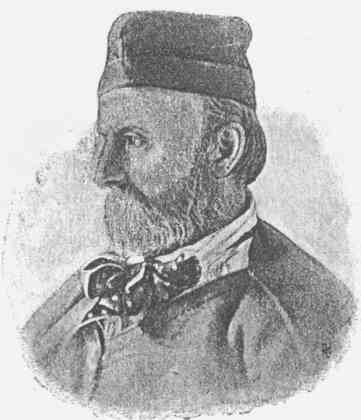
C.F.
Von Villers (1817-1890)
Such an impulse might also have served to reinforce a
basically pantheistic spiritual outlook that is as equally suspicious of
scientific rationalism as was Romance. Upon this point, it is likely
that for Hahnemann, as for Queen Victoria, “all the intellectual
and artistic developments of his age flowed by him unnoticed.”
[38] He may well have been as indifferent to the philosophical
developments of his day as he was to its political upheavals, [39] for “we
possess no definite references in his writings to a close intellectual
connection with any of the contemporary German poets or intellectual
giants. Not a word is mentioned of Goethe or Schiller.” [40] In
a letter to von Villers, Hahnemann mentions the “enormous effort
[required]
to understand even [Kants] Critique of Pure Reason,
as so many German-born scientists cannot fathom or understand Kant, let
alone translate him
I only value Plato when he is quite
comprehensible.” [41] This at least shows he struggled in his
attempts to study philosophy.
Being something of “an eclectic,”
[42] it is therefore doubtful that Hahnemann wholeheartedly embraced any
philosophical system of his day, all of which “offered him
little satisfaction.” [43] It is known that from his schooldays
he had followed Descartes, Spinoza and Leibniz, and then “proceeded
to vitalism and to the Naturalism of Schelling and Hegel. He advanced
beyond this into spiritualism, and for a time lost his way in occultism
he
was a strong opponent of materialism
he rejected materialism
as an
outlook on life and as a fundament of his new theory.” [44]
Yet, homeopathy bears unmistakeably essentialist and spiritual
hallmarks, such as “the conception of dynamisation, in
potentising, in giving medicines to smell, and in the long intervals
between the individual small doses
the purely spiritual [the dynamic]
came more and more into the foreground
[and] his outspoken tendency
towards Mesmerism.” [45] Even though Hahnemann criticised the
philosophers after Kant in that “they wrote even more mystically
than Kant,” [46] though some took the view that the
Naturphilosophie “of Hegel and Schelling
actually afforded
help to the rising of homeopathy,” [47] how this should
be so is not explored and hard evidence for this influence currently
remains elusive.
However, it is also true that Hahnemann frequently
condemned speculative metaphysics: astrology and theology, and their
medieval supernatural garb, with which he had limited patience: “…metaphysical,
mystical, and supernatural speculations, which idle and self-sufficient
visionaries have devised;” [48] “…now the influence
of the stars, now that of evil spirits and witchcraft…” [49]
In an especially contemptuous blast, Hahnemann even questions how “old
astrology was to explain what puzzled modern natural philosophy.”
[50] And, “…we were fooled by the natural
philosophers….their whole conception – so unintelligible, so hollow
and unmeaning, that no clear sense could be drawn from it.”
[51] We can therefore see in the man and in the movement he spawned the
conflicting influences of Enlightenment-inspired science and experiment
on one side, and medieval metaphysics on the other. Homeopathy as a
movement is undoubtedly imprinted with both influences, and to an almost
equal degree signalling considerable ambivalence within Hahnemann
himself. Arguably, this reflects something of the schizoid nature of
intellectual life in Germany at that time.
It seems that in the 1780s and 1790s, Hahnemann was
not only living through a time of medical uncertainty, but also one of
general ‘intellectual directionlessness’, which pervaded the heart and
soul of Germany at that time: “This faith in the powers of
reason and science was by no means universally held, even in the
mid-eighteenth century in western Europe…the first formidable attack
upon it, uncompromising, violent and fraught with lasting consequences,
came from Germany..” [52] At this time there emerged a
great divide between Enlightenment and Romantic philosophers [53] and in
its origins and general tone, homeopathy seems imbued with strong
elements of both movements, while being neither entirely one nor the
other. It accurately mirrors the underlying ambivalence and uncertainty,
and the ‘cultural schizophrenia’ of his fellow countrymen in the latter
half of the 18th century.
“For Schelling and other German philosophers,
inspired by Kantian idealism, evolved in their minds that
Naturphilosophie
which exerted so potent an influence upon scientific
work in Germany between 1810 and 1840. These thinkers prepared another
grand systematization, not simply of medicine but of other natural
sciences as a whole. Ultimate reality was found in the universal Mind,
and all natural phenomena were fitted into this metaphysical pattern;”
[54] The keen feeling of cultural and intellectual inferiority to
France, and the emergence of “an idealistic synthesis which
appealed to the romantic mood of the German people,” [55] meant
that “for nearly a generation, German physicians remained
philosophically aloof from the achievements of the French School,”
[56] and deeply ambivalent regarding rationalism in all its then
emerging forms.
Isopathists
A very good measure of the attitude among homeopaths
can be gained by considering their view of isopathy, higher potencies,
nosodes and the miasm theory, because these topics have tended to
clearly demarcate those of a more spiritual disposition from the
materialists, and therefore also reveals the “intraprofessional
tensions over what constitutes proper homeopathic practice.”
[57] Isopathy, or “the cure of diseases by their own morbid
products or the supposed exciting causes, are, far from being a novelty,
on the contrary of very ancient date.” [58] Dudgeon [1820-1904]
is in no doubt that “the honour of having introduced isopathic
heresies into the homeopathic school
[falls upon] our transatlantic
friend Dr Constantine Hering,” [59] who, according to Dudgeon,
simply raked isopathy “up from the dust and rubbish of antiquity
much
encouraged by Gross and systematised by Lux.” [60] Yet, other
homeopaths took a far more generous view: “the indispensable
curative service of the products of disease
safely administered in
sickness.” [61] “for the past five years I have
regularly used the bacillus virus as part of my daily practice
with
great satisfaction;” [62] “I think very highly of
Koch’s remedy
I use it in high potency
” [63] In
particular, it was claimed, nosodes could be used to neutralise old
internalised illness states [dyscrasias] or remove invisible ‘taints’
that prevent ordinary remedies from working: “the nosode has
removed the miasmatic block,” [64]. Then “the remedy
will work again after the block is removed with a nosode,”
[65]. This much at least is the empirical observation of those who use
them in clinical practice: nosodes were not so well proven as “well-known
polychrests
but have been so successful;” [66] their use “depends
more on clinical experience
[which has] accumulated for many years and
has been checked by the experience of so many practitioners that it is
considered trustworthy.” [67]
Yet, Dudgeon denounces isopathists outright as “homeopathic
heretics distinguished for the eccentricity of their aberrations.” [68]
By not exactly mincing his words on such people, which reveals his
abhorrence for that type of person, this exposes him as a ‘non-believer’
in miasms, who poured nothing but scorn on the entire theory. Leading
British homeopaths, Robert Dudgeon and Richard Hughes [1836-1902],
“were pathological prescribers, their ideas contrasting with
those of Frederic Quin,” [69] who mostly used the 30c potency,
like Hahnemann. [70] The low-potency pathological approach dominated
early British homeopathy, c.1830-1870. As a Hughesian homeopath, a 3x
man, Dudgeon also poured scorn on any potency above 6x. Dudgeons
colourful and emotive language arguably show that he was almost an
allopath, unable to conceive of anything beyond the rather rigid ideas
at the core of homeopathy – single drug, similars, and small doses,
provings. One of Hahnemann’s star pupils [Clemens von Boenninghausen],
who had little patience for low-potency types like Dudgeon, called them “amphibians
neither
homeopaths nor allopaths
giving low dilutions in frequent repetition.”
[71] Such a quote echoes Hahnemann himself when he said: “the
converted are only hybrids, amphibians.” [72]Such tensions
between the “genuine homeopaths and the pretenders,”
[73] were soon to grow.
Detesting signatures, woolly or vaguely spiritual
concepts, Dudgeon’s protestations reveal a desire to cling doggedly on
to a tidy image of homeopathy of the weaker allopathic type. Threatened
by the challenge to his beliefs that the high potencies and nosodes
represented, most of all he simply did not want them to hold any truth.
The key to the whole matter probably rested in some undisclosed claim to
professional credibility and prestige that such amphibians had
conceived for themselves as respected practitioners to blend in within
medicine as a whole, and their equal desire to influence its future
direction. For such low-dosage, eclectic homeopaths as Hughes and
Dudgeon, the dangerous views of high potency homeopaths “were
hopelessly unscientific, metaphysical, and a recipe for the permanent
closure of doors to professional credibility.” [74] Thus, their
real problem was tied in with prestige and a desire to tie their
version of homeopathy more firmly to the allopathic mainstream. They
knew that transcendental methods and ideas would seriously compromise
such a cosy arrangement.

C.
Hering (1800-1880)
Portraying Dr Hering [1800-1880] as “the
original suggester of the heresy,” [75] isopathy is, he
contends, “stretching the principles of homeopathy too far. [76]
It is “a mere clumsy attempt to revive the doctrine of
signatures under a most irrational and repulsive form.” [77] He
depicts so much of it as “ineffable trash. [78] While
isopathy does indeed stretch the principles of homeopathy, but at its
core, there sits an empirical database of some real cures. Attempts to
lightly dismiss the doctrine do not comprise robust or measured
intellectual invalidations, but more acts of disbelief and prejudice.
Some prominent and respected homeopaths, such as Boenninghausen,
repeatedly testified to the power of these high potencies: “the
great curative power
of high potencies
since I almost exclusively
employ these,” [79] “the efficiency of high potencies
[is]
beyond all doubt;” [80] “since 1844
I have used high
potencies almost exclusively.” [81] He mostly used the 200 and
lower M potencies. Undoubtedly, Dudgeon and others closed their eyes to
these claims and just wished they would go away.
Dudgeon also mixes isopathy up with much absurd
material from antiquity, telling us that “Galen says that the
brains of a camel are a cure for epilepsy,” [82] and that “the
organs of foxes, wolves, dogs, sheep and swine are arbitrarily selected
for supplying the remedial agent.” [83] This seems like a
pretty desperate attempt to smear isopathy with any dirt he can find,
including ancient and discredited, half-baked material on signatures,
claiming that much of it is “the offspring of a prurient
imagination or a most perverted pathological creed.” [84] Yet,
by seeking to denounce and demonise isopathists as extreme deviants
within homeopathy, a sect within a sect, and opponents of true
homeopathy – enemies within – he calls for them to be expelled from the
mother church and all ties severed. He condemns them as having no proven
therapeutic value and of being an embarrassment that invites nothing but
ridicule on homeopathy as a whole, and which threatens his undeclared
desire to see homeopathy pulled closer to the allopathic mainstream.
Even when he claims that the use of isopathic
remedies “has never extended beyond a few whimsical and
fantastic individuals,” [85] which is not actually true, this
exposes his attempts to deviantise isopathists, without successfully
discrediting them at the intellectual level. It is an act of disbelief,
that attempts to socially exclude, stigmatise and expel them from within
the movement as unwanted heretics. This is also apparent when he refers
to what he calls the “extravagances of the isopathists,”
[86] their only extravagance being their use of nosodes and the higher
potencies, accepted in the light of the miasm theory. [87]
This point is made abundantly clear when he says “the
isopathic heresy, with its innumerable divergences and extravagances,
has brought no small amount of ridicule upon homeopathy, and has been
eagerly seized on by some of our opponents as a proper mark for their
wit and satire. [88] Being unable to expel them by sound
intellectual invalidation based upon actual homeopathic principles
culled from the Organon, for example, the last resort is to have
them deviantised as just ‘too weird’. Dudgeon always answers his own
rhetorical question, “can we admit the truth of the isopathic
principle as a rule of cure?” [89], with a resounding ‘no’.
He also accuses isopathy of being saddled with
logical inconsistencies, and tries to show that many nosodes have no
rational basis because they are not real remedies: “to give the
morbid products of non-contagious diseases and the morbid matters
excreted by some contagious diseases, which do not, however, contain the
contagious principle of the disease
these matters are not capable of
producing the disease in healthy individuals.” [90] He then
elaborates this theme further, claiming: “the infecting
principle of measles is contained in the blood
the matter of
ophthalmia neonatorum contains undoubtedly a contagious principle
therefore,
it is with respect to these and similar matters only that the isopathic
principle can be applied, for they alone are capable of inducing in the
healthy the disease to which they owe their origin.” [91] This
was a dangerous strategy is open to criticism, because it is a deviation
from the mainstream homeopathic principles.
By implying that only toxic, infectious or contagious
materials can yield nosodes [remedies], this clearly denotes an
abandonment of the usual homeopathic essentialism in his thinking, a
bacterial thread almost, bearing in mind it was written some 40 years
before the true Germ Theory itself had appeared in the modern form.
Though many nosodes were not proven, yet their empirical use as useful
adjuncts and intercurrent remedies, conferred upon them some credibility
and validity, to reinforce their regular use by growing numbers of
respected homeopaths. To transcendental homeopaths, nosodes like Carcinosin
and Tuberculinum, for example, are valid remedies, not
because they contain any poison, virus or contagious matter of a
chemical nature, as Dudgeon demands, but because they are imbued with
the secret essence of cancer and TB, being made from diseased
tissue. Similarly with remedies like Sol, Luna or X-ray,
because the lactose has been exposed to and captured the essence of
sunshine, moonlight or X-rays: “imponderabilia [like]
electricity and the X-ray are both capable of potentisation;”
[92] “A drachm vial filled with absolute alcohol was exposed to
a Crook’s tube in operation for half an hour, and then brought up to the
sixth centesimal potency;” [93] “Lyssin, or
Hydrophobinum; saliva of a rabid dog
introduced and proved by Hering
in 1833, fifty years before the crude experiments of Pasteur with the
serum;” [94] “Electricitas
the potencies were
prepared from milk sugar which has been saturated with the
current.” [95] The point is that diseased tissue contains the
essence of that disease, its fundamental but invisible
disease-creating force.
This is an essentialist point of view inherent to
homeopathy, and has nothing to do with any alleged contagious
principle of Dudgeon. The use of nosodes was not based upon belief,
supposition or superstition, even though Dudgeon suggests that “these
isopathic preparations seem to accommodate themselves remarkably to the
pathological views of those who administer them,” [96] which
seems an astonishing claim for a homeopath to make. Their use was always
supported by and grounded in clinical experience. [97]
What he also seems to be saying, when viewed at the
deeper level, is that since no symptoms can theoretically derive from
non-contagious material, therefore no cures can devolve from them
either. In other words, all provings [and implicitly, all cures] must
involve the use of ‘toxic’ [symptom-producing] material. In this sense,
he denies any natural sympathy that might pertain between a drug and its
effects, which is today seen as essential, innate, or spiritual, and
which Dudgeon insists must be solely actual, physical, chemically
detectable and pathogenic. Like Simpson saying that “no poison
in the billionth or decillionth
would in the least degree affect a man
or harm a fly.” [98] Such reads like the outright demolition of
a core homeopathic principle and its replacement with a very material
and literal reading of a fundamentally allopathic principle. He
therefore also denies any mere phenomenological resonance that might
adhere between a remedy and its symptoms: “the artificial
illness that proving initiates
alters inner states which are
apprehended initially through changed sensations, images, feelings,
dreams and the production of outer symptoms,” [99]
A more modern example, “In February 1998 we
initiated a proving of positronium…made at the particle accelerator
ethanol
in a vial was exposed to the radiation of decaying positronium –
approximately 1,000,000,000 annihilation events being captured over a 24
hour period. This was run up to the thirtieth
[which] was the proving
potency.” [100] In contrast to Dudgeon’s claims, such
matters prove that symptoms can be induced by higher potencies. He
implicitly seems to deny the spiritual [essentialist] aspect inherent to
the homeopathy of Hahnemann himself: “the homeopath
evokes by
triturations, succussion, etc, his spiritual powers, principles,
or influences, out of material bodies, as house-salt, charcoal, oyster
shells, etc.” [101] Dudgeon conveniently ignores Hahnemann’s
basic finding that many otherwise medicinally inert substances can be
converted into remedies by potentisation.
Following, in his creation of homeopathy, the maxim
of “everything that can hurt is something that can heal,”
[102] though Hahnemann was mindful of the nature of poisonings,
[103] for the same reason Shakespeare once observed: “in the
infant rind of this small flower, poison hath residence and medicine
power,” [104] and although it is self-evident that “drugs,
in crude form
[do] have the power to make even well people sick,”
[105] yet this line of argument ignores the more subtle dimension of
sickness, and those “agents, material or immaterial, which
modify disease.” [106] For example, what really in modern
parlance, is a dream proving [107] or a 10M potency? Or, what is the
vital force? Because such nebulosities cannot be expressed in the
familiar materialist language of modern science, they seem somewhat
ineffable, in the last analysis, being taken on trust, as “idealised
entities,” [108]; so the idea of contagion becomes in truth a
complex subject “he caught the disease and catches the cure.”
[109] We do not see “disease itself any more than we see life,
mind or thought.” [110] Conveniently sidestepping such deeper,
and genuinely substantial issues, Dudgeon merely denounces nosodes on
reflex as unproven, and therefore as illegitimate, additions to the
materia medica, which, as an argument, is a curates egg only good
in parts. Lord knows what he would have made of modern remedies like Berlin
Wall, [111] Luna [112] or Venus! [113] Can such
remedies be presumed to contain any infecting principle as his
view demands? Presumably not. More enlightened homeopaths realised what
Dudgeon had blinded himself to: “the homeopath does not consider
it essential that its bacilli be seen in the atom of diseased material
which he prepares for medicinal use.” [114] As a modern master
practitioner also puts it: “the material of the nosodes is much
more than the micro-organisms involved.” [115]
A Luminous and Pivotal Example
When Dudgeon states that “there cannot
theoretically be a more appropriate stimulant than the very agent
capable of producing the same state, given in regulated doses,”
[116] then this could be the nosode, or it could be the most similar
drug [similimum], depending upon the case in hand. Dudgeon is right in
saying that the basis of Similia involves “the curative process
in admitting the possibility of cure by an agent capable of producing
the same disease.” [117] He therefore does admit some uses for
nosodes. For example, “I find a good many cases of measles which
apparently recovered very quickly under the use of morbilline,”
[118]; “varioline in
cases of smallpox
[having a] decidedly
beneficial influence exerted by the remedy on the course of the
disease,” [119]; but he insists that “isopathic
agents should, in my opinion, be strictly limited to really infectious
morbid products.” [120] His views on contagion seem peculiar to
modern ears – “contagion by means of clothes
and often by the
mere emanations from the patient.” [121] The entire concept of
contagion is philosophically both more ancient and more complex and more
subtle than Dudgeon pretends. Right down to the time of Sydenham
[1624-89], it was always rooted in a form of spiritual invasion
[Pagel, Temkin]. It is probably his deceivingly literal and allopathic
interpretation of homeopathy, which blinded Dudgeon to these deeper
subtleties.
Having difficulty in his attempts to find any valid
intellectual means to denounce transcendentalism, and being unable to
state why he would impose limits upon the use of remedies or miasms, his
condemnations lack focus and failed to attract any followers; he failed
to supply a coherent rationale to justify his prejudices. He clutches
desperately at rules and certainties that turn out to be only ‘castles
made of smoke’. Dudgeon only permits entry into the realm of ‘the real’
and ‘the approved’, those provings and cures obtained by using
contagious or toxic material. This would logically invoke a corollary
that only material doses can induce symptoms in the healthy and
that only material and sub-material doses can elicit cures: “the
dynamic potentised drug is the chief factor in both proving and healing;”
[122]
As a 3xer, one can see where he is fixated, but since
the 1850s homeopathy has moved forward a great deal. The reality of the
high potencies [higher than 6x] is not just the reality of cures
obtained with fantastically high potencies [30c to CM], but also
includes the reality of symptoms being induced in people with high
potencies, [123] – “the dynamic potentised drug is the chief
factor in both proving and healing” [124] – not to mention more
recent things like dream provings. [125] When Close [1860-1929] mildly
suggests that “the whole scale of potencies from the lowest to
the highest is open to the homeopathic physician,” [126] such
would seem an outrageously heretical suggestion to the likes of Dudgeon,
who is impatient to dismiss any spiritual link between remedy and
patient and most unwilling to adopt higher potencies, purely on the
basis of disbelief and trepidation. He clearly felt that this would
disastrously lead homeopathy over some disreputable Niagara Falls
straight into some airy-fairy ‘anything goes’ policy, much to the
delight and furious applause of allopaths everywhere.
It is clear, that there exists a real province within
homeopathy that embraces the nebulous, but it is a province lying
entirely beyond the conceptual grasp of someone like Dudgeon; a realm he
dare not enter lest “the wheel be broken at the well.”
[127] Yet, another desire to negotiate and retain a prestigious
relationship with orthodoxy, spawned a polarisation of the movement into
those who were attracted by the nebulous in homeopathy and those others
who were repelled by nebulosities. Yet, in terms both of ideas and
technique, this polarity already existed even in the Organon and,
as we shall see, even in Hahnemann himself. It certainly existed in
German homeopathy, with its many rebels and dissenters from the official
doctrine.
For all the reasons thusfar explored, Dudgeon is
clearly a quite luminous and pivotal example of an articulate but
conservative homeopathic “old guard“[128], who at best
could only grasp Hahnemann’s teachings in a crudely allopathic fashion;
an ‘old guard’ who controlled UK homeopathy at that time and were
manifestly sceptical of high potencies and nosodes, and very resistant
to change. [129] Like Hughes, Dudgeon wished to root homeopathy solely
within the framework of an allopathic patter, in terms of familiar and
more trusted concepts like ‘diseases’ and ‘remedies’. Much later, in the
1890s, homeopathy in the UK then took a sharp turn towards American
transcendentalism. [130] This inspired an expansion of homeopathy both
at the theoretical and practical levels, to embrace the full reality of
miasms, higher potencies, spiritual ideas about remedies, and, more
recently, dream provings, essences, mentality and disposition as the
dominant factors or ‘core concepts’ and more miasms, not only the
original three, but also tubercular and cancer miasms, as new offshoots
of Psora. [131] Homeopathy today has expanded when compared to the
rather narrow, rigid, and limited view of early Hahnemannian homeopathy.
Yet, both lineages in modern homeopathy can be traced back to Hahnemann,
not just the more conservative or allopathic version preferred by
Dudgeon. It has expanded beyond all rules and limits, which any
‘insiders’ have sought to impose upon it, so great has been its growth.

Robert E. Dudgeon
(1820-1904)
According to Dudgeon, the whole isopathic “affair
finds but little favour in Hahnemann’s eyes,” [132] and
therefore, by implication, it is safe to condemn it both as
un-homeopathic and as nonsense! He depicts it as a medical darkness, a
crooked path to be avoided. Yet, Dudgeon is wrong. As usual, Hahnemann
was not disapproving, as Dudgeon claims, he was ambivalent. He saw some
uses for nosodes and miasms, but also some problems. Likewise with the
higher potencies. He went so far with these concepts and methods, but
only so far; he stopped short of some of the others in embracing them.
He did not fully embrace isopathy; he partially embraced it. His was a
mixed response. The ‘highs vs. lows struggle’ dominated not only
American [133] and British homeopathy in the last quarter of the 19th
century; it was a widespread division much before that. Having seeds in
the Organon; it is inherent to early homeopathy in Germany, and
indeed had roots in Hahnemann himself.
This radical new isopathic and transcendental
homeopathic conception, or agent of change, which originated about
the time of the publication of Chronic Diseases in 1828, [134]
soon spawned a new movement within homeopathy, a dangerous and
frightening sub-sect [to people like Dudgeon], gathering to its cause a
motley but energetic crew of rebels, dissenters and freethinkers. It
immediately gained support from those who indulged a taste for the
higher potencies, like Korsakoff [1788-1853],
Boenninghausen [1785-1864], Stapf [1788-1860], and Griesselich
[1804-48],. Such pioneers were then followed up by Hering, Allen
[1830-1909], Skinner [1825-1906], Berridge [1844-1920], Burnett
[1840-1901], Clarke [1853-1931], Kent [1849-1916], and Weir [1879-1971].
[135]
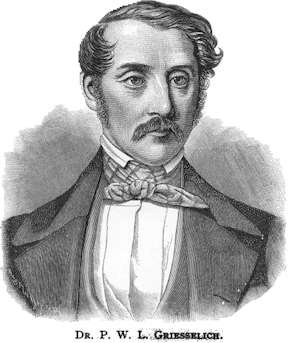
P. W. L.
Griesslich (1804-1948)
This transcendental ‘virus’ spread insidiously
throughout American homeopathy, with its strongly metaphysical
inclinations, and then began to infect small groups in British
homeopathy by about 1870. “Kent [placed great]
emphasis upon
mental symptoms and the use of high potencies. They first appeared [in
Britain] when Dr Octavia Lewin presented a paper
in 1903
Dudgeon,
who was present at the meeting, raged against the whole idea.” [136]
The cases were treated with 1M, 81M and CM potencies and “Dr
Clarke congratulated Lewin on the courage she had manifested in treating
them with single doses.,” [137]
At the meeting Dr Dudgeon, clearly outraged, “spoke out against
the use of high dilutions and quoted
quod fieri potest per pauca,
non debet fieri per pauca
if we can get by with few dilutions, we
ought not to employ many.” [138]
In fact, to correct Leary, the Kentian influence had twice visited
Britain before, via Drs Skinner and Berridge in 1870s Liverpool, and via
Gibson Miller in 1880s Glasgow.
[139] In any case, Dudgeon was ejected from the meeting.
[140]
Dudgeon and Close On Disease
and Cure
When we come to compare Dudgeon [1853] to Close
[1924], for example, then the differences between them become very
pronounced and we can measure what progress had been made. After 1900,
we behold an expansive and unstoppable movement of transcendentalism,
shamelessly declaring the power of high potencies and the use of nosodes
in even the most serious conditions, and sweeping all before it. While
for most of the 19th century, conservative British homeopaths
prescribed remedies “in low potency, usually 1x or 3x, but
mother tinctures were used regularly,” [141] yet “by
1910 there was a complete change from the prescription of 90% material
doses to 70% or more of high potencies.” [142] Therefore,
Dudgeon was wrong when he claimed isopathy to be neither “consistent
with theoretic probability,” [143] nor “borne out by
experience.” [144] His claim that there were “no
arguments having the slightest claim to validity brought forward in its
support,” [145] and no facts to substantiate it, seems
like a very blinkered view. In fact, by the 1870s an abundance of
evidence was in existence to underpin this burgeoning movement, and a
significant rationale was supplied by Hahnemann’s acute and chronic
miasms. [146]
On a theoretical level, the use of high potencies and
nosodes certainly acts to confirm and underscore the essentialist ideas
of transcendental homeopathy and therefore became important emblems of
its sense of identity, which are strongly preferred to the materialist,
bacterial and physiological constructs of allopathy. Homeopathy has
always had to struggle to demarcate and police its own borders, and to
retain a distinctive sense of medical and philosophical identity that
separates it from the politically dominant and more powerful allopathic
medicine. Even though the movement was now in decline, and entering what
was to be a seventy year period of stagnation, nevertheless, it was
henceforth to be pure homeopathy or nothing.
When Dudgeon also complains that “the
disgusting character of many of the preparations introduced into our
materia medica by the isopathists has been particularly held up to
public condemnation by our adversaries,” [147] such a view
seems only relevant to those stuck in the past and terrified of
progress. They were only disgusting in their origin, before
potentisation had rendered them as safe as babys milk. Indeed, it
ethically behoves any physician to explore any means of curative
treatment: “the homeopaths
have not hesitated to explore
filth, decay, and disease for morbific products or nosodes. Diseased
material from animals and plants, and the poisonous secretions of
reptiles, fishes, and insects, are found to be indispensably curative in
desperate or obscure diseases.” [148] Dudgeon can again be seen
evading his real problems concerning the prestige and social standing of
homeopaths. As Dr Burnett himself once bitterly put it: “the
social value of [surgery] is a baronetcy. The social value of
[homeopathic remedies] is slander and contempt.” [149]
Compared to Dudgeon’s view, Close states that “the
gross, tangible, lesions and products in which disease ultimates are not
the primary object of the homeopathic prescription.” [150]
Close goes right to the heart of the matter in stating that it is not
symptoms that need correction, but function. “Function creates
the organs
function reveals the condition of the organs,”
[151] and he further reveals that “the totality of the
functional symptoms of the patient is the disease.” [152] This
somewhat flies in the face of the Hughes/Dudgeon claim that disease is a
localised affair, a material affair that must be treated with material
doses – tinctures, 1x and 3x. But, seizing his quarry firmly, Close
deepens the real focus of homeopathy not upon the tissues, but into “the
realm of pure dynamics;” [153] what he calls the “sphere
of homeopathy is limited primarily to the functional changes from which
the phenomena of disease arise.” [154]
Manifestly, after 1880 or so, homeopathy had become
increasingly concerned with ‘essence’ or the deeper and invisible
‘genotype’ of disease, rather than with phenotype [the visible]; with
causes rather than with effects. Such a shift clearly reflects the
transcendental focus and essentialist nature of this later form of
homeopathy – a far subtler and more sophisticated system than its
crudely allopathic predecessor, so beloved of the ‘amphibians’. When
Close speaks of “the morbid vital processes,” [155] and
that any pathological changes and “physical effects of
mechanical causes, are not primarily within the domain of Similia, and
therefore are not the object of homeopathic treatment,” [156]
he means to emphasise to all homeopaths that true homeopathy aims not to
directly remove Dudgeons external ‘phenotype’ of disease, in the
tissues, but to remove its root cause, its internal ‘genotype’ the
fount from which all symptoms spring. “In faithful treatment, it
is sought to accomplish an end far more subtle than the mechanical
removal of bacilli
” [157] Symptoms were not seen by
homeopaths as the disease, but as the results, the end-products, of
deeper dynamic disease processes: “tissue changes
are but the
results of disease;” [158] “a cure is not a cure unless
it destroys the internal or dynamic cause of disease.” [159]
When Close states that the “real cure
takes
place solely in the functional and dynamical sphere,” [160] we
can see that his emphasis has shifted away from any visible pathology
resident in the organs, tissues and cells, to the underlying vital and
dynamic processes that underpin and derange the cells and tissues. It
has moved away from the physical body per se to the vital force, the
mind and spirit, disposition, modalities and peculiar symptoms of the
patient; from the visible realm of germ and cell, to the hidden,
archetypal and miasmic realm; from effects to causes; from matter to
spirit [essence]; from phenotype to genotype. The focus has shifted to
those dynamic forces that lie behind and direct tissue processes and
tissue changes.
Even in the perception of remedies and diseases, the
whole focus and emphasis has subtly shifted from the gross and physical
to the mental, emotional, and dispositional factors of the proving, of
the remedy and of the patient [disease]. This becomes even more clearly
visible in the work of modern figures like Sankaran, Scholten,
Vithoulkas, Eizayaga and Candegabe. [161] The “homoeopathic gaze,”
[162] no longer falls so much upon the ‘disease’, the symptoms or the
condition, but much more upon the mentality and disposition,
constitution, layers, essence, which distinguish the remedy or case in
its uniqueness. Uniqueness and individuality being the true realm of
Similia: “homeopathy considers the single patient as indivisible
and unique,” [163] recognising “health as a dynamic
equilibrium,” [164] of invisible forces ultimately under the
control of the vital force. Previous talk of conditions and diseases,
henceforth becomes muted by that in favour of the highly individualised
nature of cases and patients and the mental symptoms of the case and the
remedy – what Vithoulkas and Sankaran would call the ‘essence states’,
and what Eizayaga calls the genotype. [165]

S. M. Close
(1860-1929)
Close validates this view by tracing it back to its
true source when he maintains that “Hahnemann introduces us into
the realm of dynamics, the science
of motion. In medicine dynamical
commonly refers to functional as opposed to organic disease.” [166]
Power, Close insists, does not reside in the body, in the tissues or the
cells themselves, it “resides at the centre;” [167]
disease “is the suffering of the dynamis.” [168] Close
devotes considerable energy to clearly defining disease; an effort which
repays close study. For example, he says that “homeopathy does
not treat disease; it treats patients.” [169] Disease, he
claims, is “an abnormal vital process;” [170] “a
dynamic aberration of our spirit-like life;” [171] “a
perverted vital action;” [172] it is “not a thing, but
only the condition of a thing;” [173] that in the last analysis
disease is “primarily only an altered state of life and mind.”
[174] This is akin to Kent’s likening of cure to a qualitative re-tuning
of a piano, [175] and is all a very far cry from using remedies in
material doses [1x or 3x] for named conditions.
Close lays bare its deeper nature when he says
disease is “primarily a morbid disturbance or disorderly action
of the vital powers and functions,” [176] or “purely
a dynamical disturbance of the vital principle.” [177]
Furthermore, he logically pronounces that because “disease is
always primarily a morbid dynamical or functional disturbance of the
vital principle,” [178] so in turn it is clear that “functional
or dynamic change always precedes tissue changes,” [179] and
that cure has been established only “when every perceptible sign
of suffering of the dynamis has been removed.” [180] For Close,
it is precisely upon such reasons and definitions that “the
entire edifice of therapeutic medication governed by the law of Similia,”
[181] has been conceived and constructed. All these insightful
statements elaborated by Close might be said to derive from Kent, but,
as he insists, they also flow naturally from Hahnemann’s own sentiments
in the Organon: [182] “let it be granted now…that no
disease…is caused by any material substance, but that every one is
only and always a peculiar, virtual, dynamic derangement of the health.”
[183]
Close very emphatically places his bets not upon a
condition or disease label, or in Dudgeons beloved cells and tissues,
or material doses of drugs, but firmly in the invisible sphere of causes
– the vital force and the potentised drug. When he says, “the
tumor is not the disease, but only the ‘end product’ of the
disease,” [184] he means to show that disease is a process of
change within the organism, directed, not by itself, not under its own
power in the cells, but by the power of a deranged vital force that
impinges upon and coordinates the cellular processes. Such is certainly
a view of disease as a “dynamic derangement of the life
force,” [185] more as derangement of process, rather than
derangement of structure. The remedy for these sickness processes is
equally dynamic and nebulous the potentised drug which gives
rise to the comment by Kent: “lower potency
less fine and less
interior than the higher,” [186] meaning the higher the
potency, the deeper it penetrates into the hidden realm of disease
causes.
For Close, then, ipso facto, homeopathy sees
as its mission to un-derange the vital force, which is precisely what he
claims its remedies do. All of this is expressed in words that Kent
would also have chosen. Close, one might say, treads perfectly within
the verbal footprints of Kent himself, who in turn we might say
follows closely Allen, Hering, and Boenninghausen. They all speak with
one voice, even though their voices span ten decades.
“That which we call disease, is but a change in the Vital
Force expressed by the totality of the symptoms.”
“We do not take disease through our bodies but through the
Vital Force.”
“The liver is not the cause of itself. It is under the
control of the Vital Force, and it is what the Vital Force makes
it.”
“The Vital Force dominates, rules and co-ordinates the human
body.”
“The Vital Force holds all in harmony, keeps everything in order
when in health.”
“Man cannot be made sick or be cured except by some substance as
ethereal in quality as the Vital Force.” [187]
Suppression of disease by palliating its symptoms, is
another practice strongly condemned by the transcendentalists and upon
which much ink has been spilled. They have always regarded drug-induced
changes in cases as fundamentally uncurative acts: any “removal
of the tangible products of disease
does not cure the disease, but
does the patient a positive injury.” [188] As Close then adds, “the
suppressed case always goes bad,” [189] to which Kent adds: “all
prescriptions that change the image of a case cause suppression.”
[190] The construction and strengthening of these ideological positions,
soon became hardened into massive therapeutic barriers standing between
homeopathy and allopathy. Clearly, once this later, more sophisticated,
spiritualised, and transcendental form of homeopathy had reached
maturity, and transformed the entire movement, after 1920 or so, there
could be no going back; a great gulf had indeed deepened and widened
between the two systems that was now too wide to bridge; no
reconciliation was henceforth possible. When Kent said “truth
looks as black as smoke and false philosophy as bright as the sun,”
[191] he meant that the physical, physiological and bacteriological
realms, which wholly dominate modern allopathy, do not and can never be
viewed by homeopaths as the true realm of disease cause: such is viewed
as a false and uncurative medical philosophy that actually extends
disease and harms patients.
It is regarded as both a corrupt and a corrupting
medical creed, opposing the one light and only truth, the truly curative
medical system, the realm of true causes and cure – pure Hahnemannian
homeopathy, a higher and transcendental homeopathy. It was precisely
when homeopathy reached such a metaphysical Niagara Falls that Dudgeon
had prophesied and so sorely lamented. Such was his personal nightmare
vision. Dudgeon did not really accept that “all substances in
nature, even those regarded as inert, possess the power of acting on the
vital dynamism, because all contain a spiritual principle
every atom
of matter has a soul,” [192] because he knew such views smacked
of a form of spirituality unacceptable to the allopathic establishment,
whose patronage he sought to retain at all cost.
German Origins
Although Hahnemann himself experimented continuously
with the question of potency and kept an open mind about the whole
issue, yet he also wished to discourage and place limits on the free
experimentation of others. Though he knew very well that Boenninghausen
[1785-1864] , Korsakoff, Jenichen [1787-1849] and others, for example,
had developed and were freely indulging an enthusiasm for using the
higher potencies, yet he stuck to his assertion that 30 was high enough
for any homeopath. “With the demand for higher and higher
dilutions, the attacks of opponents grew
the year 1825 showed the most
violent attacks.” [193] But “there existed a small body
of overzealous students, anxious to outstep the Master in
potentising…they produced a 60th, 90th, a 200th and finally even a
1500th potency. Amongst these enthusiasts the principal part was played
by Dr Gross of Jüterbogk, Dr Schréter of Lemberg and General Korsakoff
in Russia. They became the real founders of the theory of high
potencies, which later on found an industrious and zealous protagonist
in Stapf.” [194]
How anxious Hahnemann was at that time to set a limit
to the over-enthusiasm of his students, is best shown by the following
letter to Dr Schréter [1803-64], of Lemberg, of the 12 Sept 1829:
“I do not approve of your potentising medicines higher than to
XII and XXII – there must be a limit to the matter, it cannot go on
indefinitely. But by definitely deciding that homoeopathic medicines
should be diluted and potentised up to X (= 30c) a homogeneous process
arises in the cures of all homoeopaths and if they describe a cure, we
are able to work after them in the same degree, since they are operating
with the same tools as we are. Then our enemies cannot reproach us with
all having nothing definite, no fixed standard.” [195]

Korsakoff
(1788-1853)
Hahnemann despatched a similar reply to the Russian,
General Korsakoff, who wished to potentise unmedicated globules by
mixing them with one or several granules soaked in the medicine. The
General had gone so far as to say that he had succeeded in transmitting
all the properties of Sulphur to 13,500 unmedicated lactose
granules from one single globule of Sulphur 30. Hahnemann himself
felt, in 1829, an urgent necessity of a limit in potentisation. He had
settled “upon the strange idea of setting up a kind of standard
dose for all curative remedies used in homoeopathy. This was to be the
30th centesimal,” [196] but all these efforts Hahnemann
made to place strict limits upon the question of potency were doomed to
fail, because the movement had now moved beyond his control. He had
already exceeded this limit in 1825, when he recommended Thuja
for gonorrhoea; in the 60th potency. This trait has not gone unnoticed
by others: “I have been fascinated to discover the amount of
experimentation and ad hoc solutions to which Hahnemann resorted…[and]
to see how often he broke his own rules, as do all creative people.”
[197] By trying to impose such limits, it might be said he was trying to
bale out a sinking ship, or, like Dudgeon, he was fighting a losing
battle. Such ‘limits’ as he wished to impose will always be
inapplicable. Homeopathy has repeatedly proved itself to grow with an
uncontainable force that refuses to be tied down by anybody’s
constrictions, preconceptions or limits.
The origin of the transcendental form of homeopathy
can be traced back to people like Korsakoff, Hering and Boenninghausen,
who all preferred to use the higher potencies [200c and higher] and the
nosodes, and who favoured the miasm theory in spite of pushing Hahnemann
himself beyond the limits of his approval. Doubtless, the “high
potencies have produced a division, especially among German homeopaths
a
war in our own camp.” [198] They strongly favoured the
nebulous, subtle and metaphysical in Hahnemann’s teachings. This also
includes Gross [1794-1847], [199] Stapf and Griesselich. [200] Trinks
[1800-68] was one of the few who opposed the miasm theory[201] and the
higher potencies. “Gross was attacked by Hahnemann himself
because of his leanings towards isopathy.” [202] Isopathy,
he taught, “is only an extension and perfection of
homeopathy.” [203] There was “great strife and
dissension within German homeopathy from the beginning of the 1830s
onwards.” [204] This much is also acknowledged by Hahnemann
himself in a letter to Dr Franz [1768-1835] dated 12 Feb 1834: “here
there are eternal dissensions among the local homeopaths.” [205]
This again reveals the tensions amongst Hahnemanns immediate students
in Germany, mostly about potency and miasms, from which arguably sprang
the tensions rending the rest of the movement as a whole: “the
doctrinal split in homeopathy first made itself felt in Germany in 1822
”
[206]

Moritz W.
Mueller (1784-1849)
Of Hahnemanns closest associates, Dr Gross, who
was “distinguished by a marked propensity for novelty-hunting,
seems to have become at once deeply enamoured of the isopathic theory.”
[207] Dr Rau, however, “regrets the introduction of this heresy
into homeopathy, because he fears
our materia medica will soon be
polluted with the most disgusting articles.” [208] Dr Moritz
Mueller [1784-1849]“attempted to incorporate isopathy with
homeopathy.” [209] There seems little doubt that at the deeper,
metaphysical level, these homeopaths had been repeatedly influenced by
German Romanticism and a thorough belief in essences, making them
instinctively opposed to scientific rationalism and materialism, either
overtly and by choice, or through subtle inclination. Either way, they
were clearly more predisposed towards the subtle and transcendental
aspects of homeopathy. [210] Such transcendental views found expression
in various other ways, such as when Cooper referred to “in
plant-remedies a force…a power in all respects similar to a
germinating power in the human body,” [211] “…a force
which, if applied…to disease, will arrest its progress and even cause
its dispersal.” [212]
Anglo-American Homeopathy
With a certain inevitability, the high-low split soon
spilled over into American homeopathy [213] and came to bear the same
hallmarks as that in Germany and England. “During the 1860s the
homeopathic profession began to fragment over the desire of some
practitioners to modify Hahnemanns practices and to rejoin their
allopathic colleagues.” [214] The remaining high potency fanatics
were termed Hahnemannians and their “extravagant claims
had always been an embarrassment to the
eclectics.” [215]
The Hahnemannians also criticised the homeopathic colleges for wasting “too
much time on anatomy, physiology, surgery
while neglecting the study
of materia medica.” [216] They considered themselves as the
only “legitimate voices of pure homeopathy, proclaiming most
homeopaths as mongrels.” [217] Though a minority in the USA and
in England until around 1900, they increasingly came to dominate the
movement thereafter.
Similar worrying divisions had broken out in UK
homeopathy in the 1870s and for much the same reasons. By 1870 “Drysdale
was admitting that Hahnemanns more extreme views had been a
perpetual source of embarrassment to nearly all of us.” [218]
These so-called extreme views merely consisted in the use of
higher potencies and case totality to select the remedy, rather than the
pathological, Hughesian approach of matching remedies to conditions.
In 1881,“Drs Skinner, Berridge, Lippe, Swan and Bayard attempted
to propagate high dilutionist doctrines through a journal called The
Organon.” [219] This led to considerable friction and acrimony
within the movement, but worse was to come. “The antagonism
between the two homeopathic camps began to assume the qualities of
earlier exchanges between the regular and new schools. Though The
Organon had been short-lived as a journal, the views it espoused did not
disappear. On the contrary, they gained in support. The struggle was
symbolised by the exchanges between Hughes and Clarke.” [220]
And it was Dr John Henry Clarke who “favoured the high dilutions.”
[221] Clarkes ideas “were very far from those of Hughes
[because]
he used the 30th and 200th potency.”
[222] It is therefore hardly surprising that Kent referred to Hughes as “that
skunk I shall fight to the end of my days.” [223]
Even while Hughes “staunchly defended low
dose pathological prescribing,” [224] the storm clouds were
gathering. After his death “in a Dublin street“[225] in
1902, the movement increasingly danced to the high potency tune of Dr
Clarke, and “by the end of the first world war the views of
people like Clarke were in the ascendancy.” [226] To this was
added the influence of James Tyler Kent and “a teaching
scholarship which enabled British doctors to go to study with Dr Kent in
Chicago.” [227] A brand of American homeopathy with a “Swedenborgian
philosophy, a fervent, religious and metaphysical reinterpretation of
Hahnemann appeared, the psoric doctrine was reactivated, vitalism
re-emphasised, the importance of psychological and spiritual
symptoms in remedy selection, and the use of the very high potencies
advocated.” [228] The reverberations it visited upon the
conservative bastions of UK homeopathy placed it firmly at the upper end
of the Richter scale. There is absolutely no doubt that the highs “were
attracted by the spiritual and metaphysical element in Hahnemanns
work,” [229] and owing to “the dramatic decline of
homeopathy after the turn of the century, high dilutionist views
increasingly predominated.” [230] Such changes permanently
demolished all previous friction within the movement eradicating also
any possibility of reconciliation with allopaths as feebly envisaged by
Dudgeon and Hughes, whose pathological prescribing was thereby consigned
to the history books as an allopathic version of homeopathy utterly
vanquished by transcendental developments.
In England and America, the “purists railed
against the corruption of Hahnemannian doctrine by half-homeopaths
[leading]
to an institutional split, with the formation by the fundamentalists of
the IHA in 1880, and the appearance of high-dilutionist medical schools,
such as those formed in Chicago in 1892 and 1895.” [231]
Once again, there was no mood for reconciliation between two strongly
polarised camps. “In 1880
the AIH split, as the purists left
to form their own IHA,” [232] and as before, the purists “held
to Hahnemanns faith in extreme dilutions of drugs.” [233]
Discussion
In attempting to find reasons for the changes we have
described, one might decide, for example, that some transition towards a
modern dominance by individual mental, dispositional and lifestyle
factors in disease has occurred across the entire healthcare board since
1900, and that the general decline in infectious disease since 1900 has
enhanced this shift. During the same period an increasing presence and
sophistication of psychological medicine has occurred, a presence
virtually unknown in 1900. These factors undoubtedly play a part in this
picture. Homeopathy has also developed massively during its resurgence
in the last three decades. [234] Coming back from oblivion, it has
become highly sophisticated in its own right as a separate medical
tradition. Far from being abandoned, its distinctive views and core
beliefs, have been deepened and broadened through attracting many
talented minds that it lacked in the 1900-1978 “dismal period“.
[235]
Homeopathy being completely abandoned and left for
dead [236] in that time period, meant that it could develop its own
ideas in relative isolation, unmolested by allopathic and scientific
attacks, bestowing upon it an important time for introspection, during
which its theoretical ideas could be worked up into a coherent core
philosophy. Also at a time of its own decline [1900-1978], and when
homeopathy and allopathy superficially reached what Nicholls termed “therapeutic
convergence,” [237] homeopathy was inspired by a real incentive
to develop its own distinctive ideas and methods, and to reinforce a
sense of medical identity separate from allopathy: a real sense of
therapeutic “otherness.” [238] Arguably, such a goal
was achieved more efficiently in isolation. Materialist science
denounces homeopathy as nonsense; stated at its starkest, it simply
defies the known laws of physics and chemistry and therefore “the
infinitesimal dose is an outrage to human reason.” [239] This
fact has not been ignored, but has actually been incorporated into
homeopathy as a core element of its self-identity as a deviant
medical sect. Its ideas were formulated in the 1820s, debated
throughout the nineteenth century, placed in the deep freeze after about
1900, only to re-emerge c.1978. It is a philosophical throw-back still
very reluctant to question the words of the Master, deeply adherent to
its origins and cohesive about its core beliefs. As Guttentag observed
in 1940: “the actual status of homeopathic knowledge is to a
considerable extent far below contemporary medical standards.”
[240] Though less true today, however, and this has improved
considerably in the last three decades, it is still true that “eighty
nine years of isolation have left very distinct marks of anachronism and
rigidity.” [241] However, on another level, this can be seen as
a firm reaction against the efforts of people like Hughes and Dudgeon to
present an allopathised version of homeopathy. By distancing itself from
such an attempt as a ‘failed experiment’ of the past, post-1900
homeopathy has henceforth resolved to ‘go it alone’ as a distinctive
medical system in its own right.
Dudgeons desire to establish a dogmatic breed of
low-potency homeopathy echoes a similar impulse we saw in Hahnemann,
when he sought to restrict the high potency rebels in the 1830s and
insist they follow the rules of homeopathy he had laid down in the Organon.
That he himself continued experimenting up to his death in Paris, [242]
might well be seen as rank hypocrisy on his part. Alternatively, such
events expose the warring impulses at work in the man and the movement
he had spawned. Experiment twinned with dogma both equally dominate the
history of the entire subject. [243] Like science itself, the movement
is impelled first by pioneering creative work, making experimental
discoveries, then by a phase of “making concepts rigid
creating
an ossified system of symbols no longer flexible,” [244] such
as the conceptual straitjacket of the Organon, which might more
realistically portray “Hahnemann’s
advice in the Organon
[as]
a counsel of perfection and not something he invariably did.”
[245] Everywhere we look, we behold his incredible ambivalence.
Progress was then made in a zig-zag fashion by
repeated acts of rebellion against the “ossified system”
by such leading freethinkers as Boenninghausen, Hering and Clarke, who
were addicted to free creative work: new experiments. Such a continual
war of impulses alternating between the competitive claims of orthodoxy
and heresy, is also integral to intellectual traditions more generally.
Rather than comprising a Kuhnian alternation of normal science and
revolutionary science, or some paradigm shift, [246] such
oscillations might be more accurately portrayed in a Popperian sense,
representing the repeated construction of new hypotheses, inductively
inspired by empirical investigations, followed by their demolition, or
revision, in the light of ongoing empirical investigations and the flow
of new data. [247] Progress today proceeds by much the same route, where
again we see theory and method intertwined in homeopathy, in the
retention of those metaphysical elements of theory that have received
confirmation through clinical practice. Yet no minority medical system
can survive in a vacuum and must negotiate some relationship with the
mainstream. It is this force that Hughes and Dudgeon were minded to
emphasise above all others.
Arguably, the main reason for the shift to
transcendental methods is that the higher potencies simply proved more
powerful and more efficient clinical weapons, soon coming to be regarded
as superior drugs that bring faster results in shifting cases and curing
disease. This seems the most likely factor behind their incorporation
into the main core of homeopathic technique soon after 1900. The
inclusion of nosodes rested solely upon an empirical database, by
proving themselves to be useful tools in clinical practice that could
unblock stuck cases and allow conventional remedies to work
smoothly again. [248] Though useful work can be done with 1x and 3x,
what is the point in plodding along with such blunt tools when you
could be using 30c or 200c for all cases and getting much speedier
cures? This much at least was known to respected figures like
Boenninghausen in the 1830s who consistently used the 200c potency for
all conditions. [249] Such improved techniques were not lost on the
American homeopaths who were keen to develop them even further, and who
had no qualms over adding nosodes to such an approach, which for safety
have to be used in high potency anyway.
Regarding the question of any inferred influence from
Romantic philosophies and a telling attachment to essentialist and
spiritual views, then there is no doubt that homeopathy sits very
comfortably with forms of transcendentalism, because many anti-rational
and unscientific concepts dwell at its core. Such views are known to be
traceable to German Romance 1780-1830 and these should not be seen so
much as transplanted views worn deliberately as emblems of sectarian
deviance, [250] or to encourage deliberate acts of rebellion against
rationalism, but are better seen as concepts and elements integral to
the subject, parts of its world, its peculiar medical dimension and
mind-set – seeds it carried since the formation of homeopathy in the
same epoch. While homeopaths are susceptible to and naturally
predisposed towards romantic views, yet to prove that actual homeopaths
have been directly influenced by romantic philosophers would require
much further research to add to the clutch of known examples.
Hahnemann’s intellectual ambivalence is very easy to
demonstrate. For example, though he was a lifelong Freemason [251] and
an active member of a Masonic lodge in every town wherever he lived,
[252] and which was a subject to which he was “inwardly greatly
attracted,” [253] and Haehl claims he was always “a
good Mason,” [254] yet he condemned subjects like astrology, “the
influence of the stars,” [255] which he lumps together with “evil
spirits and witchcraft;” he roundly condemns any antiquated
medical patter about “constellations of the stars, in an
influence emanating from the heavenly bodies.” [256] He
was also disparaging about the doctrine of signatures. [257] In his Materia
Medica Pura we read under Chelidonium: ‘The ancients
imagined that the yellow colour of the juice of this plant was an
indication (signature) of its utility in bilious diseases…the
importance of human health does not admit of any such uncertain
directions for the employment of medicines. It would be criminal
frivolity to rest contented with such guesswork at the bedside of the
sick.” [258] Hence we behold his fundamental ambivalence.
Burnett and Clarke were influenced by figures like
Swedenborg, Paracelsus and William Blake; [259] most New England “followers
of the New Jerusalem Church were homeopaths almost to a man.” [260]
The James family including Henry [1843-1916] and William
[1842-1910] were Swedenborgians and in Massachusetts and East Coast “among
its adherents [were] most of the social, intellectual and business
elite.” [261] Many modern British homeopaths were
trained by the Arch-Druid Thomas Maughan in the 1960s and 70s. [262]
There seems little doubt that to Maughan homeopathy was regarded as an
essential element of their training as Druids, just as much as Druidism
was regarded as essential to their training as homeopaths. [263] One of
his prominent students of the 1970s was Martin Miles, who practices
homeopathy in London. The following quotes from Miles, illustrate the
use of a ‘spiritual paradigm’ which has been thoroughly blended with
some basic homeopathic ideas: ‘…the physical vehicle is the temple
of an indwelling spirit, this outward cloak being an exact reflection of
the being who inhabits it.’ [264]
He goes on: “the spirit’s descent upon the
cross of matter usually amounts to being plunged into the overwhelming
darkness of the earthly life.” [265] And Kent was
equally emphatic: “You cannot divorce medicine and theology. Man
exists all the way down from his innermost spiritual to his outermost
natural;” [266] “a man who cannot believe in God cannot
become a homoeopath.” [267] Kentianism, then, was
“metaphysical, dogmatic, puritanical and millennial
[and] so far
as Kentians were concerned, the faithless were responsible for the
corruption and decline of the movement.” [268] Both Coopers
arborivital medicine, [269] and Bachs Flower Essences[270]
contain decidedly pagan [nature spirits] overtones. [271] Clearly then,
with core elements of homeopathy being decidedly romantic in tone and
spirit – anti-rational, millennial and nouminous – then Hahnemann might,
at the very least, be said to have imbibed deeply on the romantic spirit
[zeitgeist] of the 1780s and 90s, if not acquiring much of its concrete
‘intellectual property’.
Considering that pre-1650 approx., contagion as a
concept was always regarded as a spiritual invasion of the soul with the
evil spirit [archeus] of the disease, not as ‘germ particles’, [272] we
must consider what the upshot of this whole matter might be. Only after
Sydenham did the idea of germ particles really begin to be taken
seriously, even though it remained merely an unconfirmed medical idea
until the advent of powerful microscopes and Koch’s experiments in the
1880s. Yet, there was still massive resistance to the germ theory even
after 1900.
Regarding vaccination, “many physicians
thought it a very illogical procedure,” [273] and a number of
epidemics “were traced to inoculation.” [274] Added to
this, no-one knew “how or why vaccination worked.”
[275] Throughout the 19th century, both in Europe and in
north America, vaccines were “denounced as unholy
useless and
dangerous,” [276] and efforts were made “to prohibit
compulsory vaccination,” [277] with the situation becoming “quite
serious between 1870 and 1900.” [278] Even though some
physicians saw the need for quarantines measures, for example, social
taboos often seemed to “prohibit notification and isolation
procedures,” [279] regarding infectious diseases like Cholera,
Yellow Fever and Typhus. [280]
There are different ways to interpret all this. The
irony of the situation ideologically [in terms of the flow of medical
theory and ideas] is that at the very time when allopathy was deeply
spellbound by a very materialist doctrine [germ theory], and has been
ever since, the very same idea chimed a very different homeopathic bell,
and seemed to push homeopathy in a completely different direction –
towards even more metaphysical and nebulous ideas and techniques
[miasms, isopathy and high potencies]. Arguably, this difference in
direction must have derived mostly from the massive differences in the
nature of their medical conceptuality, [281] rather than differences in
technique.
For example, we might say that the homeopathic use of
bacteria and nosodes paralleled a similar discovery in allopathy. Or
even that homeopathic tinkerings with nosodes and diseased tissues [from
1830 onwards] though heard about and condemned in allopathic
circles[282], nevertheless inspired similar experiments in the 1880s by
allopaths. Either way, a collision of ideas occurred, a deep engagement
of medical minds occurred in both traditions regarding vaccines and
nosodes [germs], leading to material ideas/methods in allopathy [the
germ theory of Koch and Pasteur and increased use of vaccines], while in
homeopathy it led to nosodes, high potencies and more nebulous
interpretations. Therefore, it seems that the reactions to ‘germs’ and
disease products within these two systems of medicine form two very
divergent paths – one leading to vaccinations and bacteriotherapy via
serums and antibodies [i.e. modern immunology], and the other leading to
nosodes and the higher potencies as standard tools and approaches. The
interpretations each made of ‘germs’ could not be more different.
The use of nosodes primarily on the pragmatic level
rendered the drugs harmless [safe to use], and also encouraged the use
of higher potencies, and a move away from Dudgeon’s ‘infective
principle’. Nosodes were always used in high potency [30, 200 and 10M
most commonly]. It also reinforced the idea of disease being caused not
by the “morbific particles”[283] on the material
level, but by some ‘subtle essence’ carried by the germ and transferred
through potentisation to the nosode. Hence, Kent’s dictum of ‘the higher
the deeper’ and the concept that the ‘disease essence’ [= miasm] can
only be truly neutralised by the highly potentised drug [= what van
Helmont called the ‘drug archeus’]. We then see a broad and very strong
parallel between the metaphysical views of van Helmont and
transcendental homeopathy concerning a triad of spirits – vital force,
drug essence and disease archeus. [284] To which we might add that
therapeutic resonance [sympathy] between these three spheres operates as
‘similia similibus curentur’ as well as ‘similia similibus
causam’ – diseases being both cured and caused by similars. “There
is not one law for contagion and another one for proving. They are both
one;” [285] “the quality of contagion is similar in
nature to the cure.” [286] Such a notion then places
Hahnemann’s system absolutely in a line with the previous vitalist
systems of Paracelsus [1493-1541], van Helmont [1577-1644] and Stahl
[1660-1734].
One might then say that homeopaths’ perception of and
reactions to the same idea [germs] were completely opposite to
allopaths; one being essentially materialistic in nature and the
other being fundamentally essentialist, and much inclined towards
spiritual and metaphysical views. It is as if the germ idea only served
to reinforce the latent materialism of allopathy as much as it
reinforced the incipient spiritualism of homeopathy. Arguably, this
entire episode very nicely illustrates the fundamentally materialist
nature of allopathy and the increasingly essentialist nature of
homeopathy after the deaths of Hughes [1901] and Dudgeon [1904], who
comprised the main elements of the ‘old guard’ pathological breed of
nineteenth century UK homeopathic prescribing. It shows how very similar
observations in the world were viewed and interpreted and then used very
differently by minds of a very different stamp.

Thomas
Sydenham (1624-1689)
Even more remarkably, this whole episode underscores
the division, still visible in homeopathy, of an essentially spiritual
view of contagionism reminiscent of that held by Fracastoro,
Paracelsus and van Helmont, on the one hand, as opposed to the [mis?]
conception of physical, microscopic and morbific particles [infective
viruses; germs] first made by Sydenham and Boyle, and later systematised
into official dogma of orthodox medicine after Koch and Pasteur.
Ironically, both views were spawned by Paracelsus, it being the chemical
side of Paracelsus that was embraced by allopaths, while a succession of
vitalists espoused his more metaphysical medical ramblings.
The impact made by “the isopathic heresy,”
upon the ideological fabric of homeopathy was exactly as Dudgeon had
predicted – it deepened division and pushed it further away from
allopathy. By encouraging belief in the miasm theory [disease as
stemming from an internalised imprint of the disease archeus upon the
vital force], and the increased use of higher potencies, these
developments pushed homeopathy into increasingly nebulous and
metaphysical territory.
Conclusions
In conclusion, it seems that Dudgeon was fully justified in the
trepidation with which he instinctively greeted isopathy. What he wanted
to cling to was not in fact sustainable – an allopathic version of
homeopathy. Certainly Dudgeon’s ‘wheel was broken at the well’ and the
development of transcendental homeopathy also smashed ‘the cross of
matter’, of scientific materialism. Homeopathy is fully justified in
declaring that the high potencies and nosodes do indeed validate
spiritual paradigms and vitalist medical views. Undoubtedly, many modern
homeopaths point to nosodes and high potencies as providing ample
confirmation of the metaphysical remarks made by Hahnemann, Kent and van
Helmont regarding the inherent genotype of matter [potency energy], of
disease [disease archeus or miasm] and of living things [vital force].
They seem justified, therefore, in claiming that the corpus of
homeopathic expertise of the last century and a half fully validates
such concepts as potency energy, vital force and disease cause as a
spiritual essence [miasm] that temporarily invades and ‘poisons’ the
spirit of the person, inducing symptoms. While transcendentalists
interpreted the germ idea as spiritual contagion by essence, the
allopaths interpreted it as physical contagion by microbes. In all the
above senses, therefore, there has certainly been a ‘triumph of the
light’, vitalism having triumphed over materialism in homeopathy.
Returning to ther question we posed at the start, we can see that the
two great systems of medicine stand just about as far apart today as
ever, both in their methods and philosophies, but most importantly also
in their perception of disease cause and cure. It is hard to see how
these very divergent medical paradigms can ever be brought closer or
their differences reconciled.
Acknowledgements:
My sincere thanks are due to Gregory Vlamis for locating reference
sources 3, 19, 57, 163 and 283; to Charles Wansbrough and Harry van der
Zee for some information in reference sources 99, 100, 107, 123, 125 and
161; to Chris Wilkinson for information in reference 113; to Julian
Winston for help with reference source 161.
Sources
1 Henry C
Allen, Materia Medica of the Nosodes, Calcutta: Sett Day, 1942, v
2 This account is mostly based upon Thomas L
Bradford, The Life and Letters of Hahnemann, Philadelphia, 1895;
Trevor Cook, Samuel Hahnemann the Founder of Homeopathy,
Wellingborough: Thorsons, 1981; Phillip A Nicholls, Homeopathy and
the Medical Profession, London: Croom Helm, 1988; Margery Blackie, The
Patient not the Cure, London: MacDonald & Janes, 1976; Winston
and Dudgeon; Richard Haehl, Samuel Hahnemann His Life and Works,
2 volumes, 1922; Rosa W Hobhouse, The Life of Christian Samuel
Hahnemann, India: Harjeet, 1933; Julian Winston, The Faces of
Homeopathy: An Illustrated History of the First 200 Years, Tawa, New
Zealand: Great Auk Publishing, 1999; Dr Charles Wheelers Obituary,
Brit. Homeo. Jnl 37.1, April 1947, 2-11; Frank Bodman, Richard
Hughes Memorial Lecture, Brit. Homeo. Jnl 59 1970
3 Israel S Kleiner, Hahnemann as a Chemist, Scientific
Monthly, 46.5, May 1938, 454
4 Blackie, 1976, 32
5 Blackie, 30
6 Blackie, 27
7 Blackie, 31
8 Blackie, 27
9 Blackie, 32
10 Hilary Jenkins, The History of the London Homeopathic Hospital,
Brit. Hom. Jnl 78, 1989, 198
11 Simpson, 34
12 Simpson, 2
13 Simpson, 42
14 Blackie, 39
15 see Robert Munz, Continuous Fluxion Potencies, Homeopathic
Links 3/97, 1997, 26-29; Julian Winston, A History Of Potentising
Machines, Brit. Homeo. Jnl 78, 1989, 60 et seq.
16 Samuel Hahnemann, Organon of Medicine, combined 5th/6th
editions, translated and edited by Boericke and Dudgeon, 1922, Aph. 9
17 Richard H Shryock, The Development of Modern Medicine, an
Interpretation of the Social and Scientific Factors Involved, Pennsylvania:
Univ. Pennsylvania Press, 1936, 272-276
18 Bernard Leary, M Lorentzon, and A Bosanquet, It
Wont Do any Harm: Practice & People at the London Homeopathic
Hospital, 1889-1923, in Robert Juette, Guenter Risse and John
Woodward [Eds.], Culture, Knowledge and Healing: Historical
Perspectives on Homeopathy in Europe and North America, Sheffield:
Sheffield Univ. Press, 1998, 268
19 C F Nichols, Homeopathy in Relation to the Koch
Controversy, Science, 17: 429, April 24, 1891, 233-234, 234
20 see Stuart Close, The Genius of Homeopathy,
Lectures and Essays on Homeopathic Philosophy, New York, 1924,
76-86; James Tyler Kent, Lesser Writings, Aphorisms and Precepts,
Chicago: Erhart & Karl, 1926; Organon
21 Kent, 649
22 Kent, 661
23 Burnett, 1
24 ibid, 109
25 ibid, 4
26 Sir James Young Simpson, Homeopathy its Tenets and Tendencies,
Edinburgh: Knox & Sutherland, 1853, 141
27 Kent, 657; see also Coulter, iii, 334 re essence; also Ernst Mayr,
The Growth of Biological Thought, Cambridge, Mass: Belknap Press,
1982, 38, 87, 304-5; A Bullock & S Trombley, The New Fontana
Dictionary of Modern Thought, London: Harper-Collins, 3rd
Edition, 1999, 282-3
28 Rudolf Verspoor & Steven Decker, Homeopathy
Re-Examined, Canada: Heilkunst, 1999, 156-171; Anthony Campbell, The
Concept Of Constitution In Homeopathy, Brit. Homeo. Jnl 70:4,
1981, 183-8; De Schepper, 143-150; R Zissu, The Evolution of Ideas on
Constitution and Temperament from The Homeopathic Standpoint, Brit.
Homeo. Jnl 50, 1961, 4-25; George Vithoulkas, The Science of
Homeopathy, New York: Grove Press, 1980; John Henry Clarke, Constitutional
Medicine, London: Homeopathic Publishing Co, c.1930; Bernard Leary, Constitutions
Again, Brit. Homeo. Jnl 72.4, October 1983, 214-216
29 Ann Hill, [Ed.], A Visual Encyclopedia of Unconventional
Medicine, London: New English Library, 1979, 29-33; Michael Evans,
Extending the Art of Healing, an Introduction to Anthroposophical
Medicine, Steiner Press, London, 1985; E & L Kolisko, Agriculture
of Tomorrow, Bournemouth: Kolisko Foundation, 1978; Francis X King, Rudolph
Steiner and Holistic Medicine, London: Rider, 1989; Peter Morrell, Steiner
and Homeopathy, Prometheus Unbound, 2:1, Autumn 1995, 24-30;
Rudolph Steiner, The Anthroposophical Approach to Medicine,
London: Steiner Press, 1951; Rudolph Steiner, Spiritual Science and
Medicine, London: Steiner Press, 1975; Rudolph Steiner, The Four
Temperaments, London: Steiner Press, 1950; Rudolph Steiner, c.1950, The
Metaphysical Significance of the Blood, London: Steiner
Press, 1950; F Treuherz, Steiner & the Similimum, The
Homeopath, Vol. 5.1, 1985; J F G Turner, Rudolph Steiner a Fresh
Look at The Etiology of Disease, Brit. Homeo. Jnl 28, 1939,
157-168; Otto Wolff, Anthroposophical Medicine and its Remedies,
South Africa: Tobias Therapeutic Assn., 1988; F Husemann, & O Wolff,
The Anthroposophical Approach to Medicine, Vol. I, New York:
Anthroposophical Press, 1982; A M Scofield, 1984, Homeopathy and its
Potential Role in Agriculture – a Critical Review, Biol. Agric.
& Hortic., 1-50; Victor Bott, Anthroposophical Medicine – an
Extension of the Art of Healing, London: Steiner Press, 1985
30 Winston, 323
31 Arthur Marwick, British Society Since 1945, London:
Penguin Books, 1990, 131
32 Marwick, 1990, 132
33 Arthur Marwick, The Sixties, Oxford: Oxford University
Press, 1998, 481
34 Marwick, 1998, 481
35 Marwick, 1998, 481
36 Apart from Marwick, see also David Pepper, The Roots of Modern
Environmentalism, London: Croom Helm, 1984, 15-18
37 By comparing the tenor and content of early articles on this
subject with later ones we can see this shift in interest. For example,
compare these from 1975-6: J Roebuck, & R B Hunter, Medical
Quackery as Deviant Behaviour, 72-82 in F Scarpitti & P
McFarlane (Eds.) Deviance, Action, Reaction and Interaction, USA:
Addison-Wesley, 1975; R Wallis & P Morley, [Eds.], Marginal
Medicine, London: Peter Owen, 1976, with the following from 1978-9:
R A F Jack, Resurgence of Homeopathy in The Midlands, Brit.
Homeo. Jnl 67, 1978, 39-42; Vicki McKenzie, Fringe Medicine is
Beginning to Break Through The Barriers of Medical Scepticism, The
Guardian 23 June 1978, 9; J P Callan, Holistic Health or Holistic
Hoax? J. Amer. Med. Ass., 241, 1979, 1156-7; Norman Cousins, The
Holistic Health Explosion, Saturday Review, 31, March 1979,
17-20; Brian Inglis, Natural Medicine, London: Collins, 1979
Brian Inglis, Breaking the Health Monopoly, The Spectator
28 July 1979, 14-15; J W Salmon, & H S Berliner, Health Policy
Implications of the Holistic Health Movement, J. Health Politics,
Policy & Law, 5:3, 1980, 533-53
The interest starts as hostile and then moves into more genuine academic
engagement. This continues in such examples as: Ann Shearer, Quacks
are no Longer Ugly Ducklings, The Guardian, 7 April 1982, 17;
D T Reilly, Young Doctors Views on Alternative Medicine, Br.
Med. J. 287:2, 1983, 337-9; J Lister, Current Controversy on
Alternative Medicine, New Engl. J. Med. 309, 1983, 1534-7.
Arguably, this reveals how a deviant social grouping becomes first an
issue and then an object of genuine interest.
38 G M Trevelyan, A Shortened History of England, London:
Pelican, 1959, 523
39 Regarding political influence, Hahnemann showed “no
sign of any interest,” in this subject [Haehl, 1, 263] and that
he “takes no side,” [Haehl, 1, 264] in political
matters generally.
40 Haehl, 1, 250
41 Hobhouse, 1933, 104
42 Haehl, 1, 251
43 Haehl, 1, 251
44 Haehl, 1, 251
45 Haehl, 1, 251
46 Haehl, 1, 252
47 Haehl, 1, 252; re romantic influences on Hahnemann see Nicholls,
259-60
48 R E Dudgeon, The Lesser Writings of Samuel
Hahnemann, London: Leith & Ross, 1895, 491
49 Lesser Writings, 1805, 421
50 Lesser Writings, 490
51 Lesser Writings, 1808, 494
52 Isaiah Berlin, Against the Current Essays in the History of
Ideas, London: Pimlico, 1997, 164-5
53 Richard Tarnas, The Passion of the Western Mind, London:
Pimlico, 1996, 367-75
54 Shryock, 111
55 ibid, 187
56 ibid, 187
57 Anne T Kirschmann, Adding Women to the Ranks, 1860-1890: a New
View with a Homeopathic Lens, Bull. Hist. Med. 73.3, 1999,
432
58 Robert E Dudgeon, Lectures on the Theory and
Practice of Homeopathy, London: Henry Turner, 1853, 143
59 Dudgeon, 143
60 Dudgeon, 160
61 Nichols, 233
62 James Compton Burnett, New Cure of Consumption by its Own Virus,
London: Homeopathic Publishing Co, 1890, iv
63 Burnett, vi
64 Luc De Schepper, Hahnemann Revisited: A Textbook of Classical
Homeopathy for the Professional, Santa Fe: Full of Life
Publications, 1999, 321
65 De Schepper, 321
66 De Schepper, 317
67 De Schepper, 317
68 Dudgeon, 142
69 Leary, et al, 263
70 Haehl, 1, 321-2
71 C Boenninghausen, The High Potencies, Allg. Hom. Zeit., 38,
March 1850, 358, in his The Lesser Writings of C von Boenninghausen,
edited by Thomas L Bradford, 1908, 5
72 Haehl, 1, 187 quoted in Harris L Coulter, Divided Legacy, A
History of the Schism in Medical Thought, 3 volumes, Washington:
Wehawken Books, 1973-5, iii, 332
73 Coulter, iii, 333
74 Nicholls, 1988, 184
75 Dudgeon, 152
76 Dudgeon, 159
77 Dudgeon, 162
78 Dudgeon, 164
79 Boenninghausen, Lesser Writings, 6
80 Boenninghausen, Typhoid fever and high potencies, Allg.
Hom. Zeit., 47, November 1853, 57-65, in Lesser Writings, 36
81 Boenninghausen, Traumatic Ailments and High Potencies,
Allg. Hom. Zeit., 48, 1854, 43, 51, 61, in Lesser Writings,
50
82 Dudgeon, 141
83 Dudgeon, 165
84 Dudgeon, 165
85 Dudgeon, 165
86 Dudgeon, 164
87 Nicholls, 127-8, 265; De Schepper re the nosodes, 316-52; re
the three main miasms, 355-412; re TB and cancer as new miasms, 413-54;
P S Ortega, Chronic Miasms, Brit. Homeo. Jnl 72.1, Jan
1983, 8-19
88 Dudgeon, 173-4
89 Dudgeon, 166
90 Dudgeon, 165
91 Dudgeon, 166
92 Allen, 528
93 Allen, 528
94 Allen, 132
95 Allen, 39
96 Dudgeon, 163
97 Winston, 98-99; Nicholls, re unproven nosodes,
185, 228-30; J Fraser Kerr, Unproven Nosodes, Their Use and Some
Thoughts Thereon, Brit. Homeo. Jnl 49, 1960, 187-191; M E
Harling, The Use and Abuse of Nosodes in Homeopathic Treatment, Brit.
Homeo. Jnl 63.2, 1974, 94-101
98 Simpson, 11
99 Misha Norland, Group and Proving Phenomena,
Observations, The Homoeopath, 72, Winter 1999
100 Misha Norland, Antimatter, Positronium, The
radiation produced in the annihilation of Positronium atoms,
Conducted by Misha Norland at The School of Homopathy in 1998,
unpublished.
101 Simpson, 141
102 Anon, Dr Clarke Memorial Meeting [Obituaries], Brit.
Homeo. Jnl Jan 1932, 135
103 Examples of his interest in poisons include his publications: On
Poisoning by Arsenic, 1786, Directions for the Preparation of
Soluble Mercury, 1790 and What Are Poisons? What Are Medicines?,
1806
104 William Shakespeare, Romeo and Juliet, Act 2, Scene 3
105 Close, 54
106Close, 60
107 Greg Bedayn, Anhalonium Dream Proving, The American
Homeopath 2, 1995, 74-5; Kees Dam, Are Dream Provings Hahnemannian
Provings?, Homeopathic Links 12.1, 1/99, 1999, 10-13; Guido
Mortelmans, Dreams In Homoeopathy A Snake In The Grass?,
Homeopathic Links 1/95, 1995; Rajan Sankaran, The Spirit Of
Homeopathy, Chapter 28 On Dreams, 1991; Uta Santos, & Peter König,
Dream Proving Of Berberis, Homeopathic Links 4/94: 1994; Uta
Santos, & Peter König, Dreams In Homoeopathy? Yes A Snake In The
Grass!, Homeopathic Links 2/95 – 1995; Peter Tuminello, Molybdenum
Metallicum [Many Dreams], Homeopathic Links 3/95, 1995; Edward
Whitmont, The Use Of Dreams In Homeopathic Prescribing And Proving,
The Homeopath, Vol. 62, 1996, 588; Kaaren Whitney, A Dream, A
Patient, A Remedy Argentum nitricum, The Homeopath, Vol. 56, 1995,
352; Michael Thompson, Memories, Dreams and Remedies, The
Homeopath, No. 58, 1995; Misha Norland, Group and Proving
Phenomena, Observations, The Homoeopath, 72, Winter 1999;
Charles Wansbrough, Ayahuasca Proving, London: Prometheus
Unbound 1.2, Spring 1995, 3-16; Jill Wright, Chalcancite – a New
Methodology for Provings, London: Prometheus Unbound 1.1,
June 1994, 15-18
108 Isaiah Berlin, The Sense of Reality
Studies in Ideas and their History, London: Pimlico, 1997, 18
109 Kent, “he caught the disease and catches the cure“:
643
110 Close, 71
111 Madeline Evans, Berlin Wall – A Meditative Proving,
London: Prometheus Unbound, 1.2, Spring 1995, 24-31
112 L King, & B
Lawrence, Luna: a Proving, The Homeopath, Vol. 13/2, 1993,
99; La Lune by Phillippe Barthelet, Sept 2000, l’Ecole
Hahnemannienne, Frejus – St Raphael, France
http://www.homeopathe.org/articles/pb1_luna.htm
113 Chris Wilkinson DSH
RSHom, Venus Proving, The Homeopathic Proving of “Venus Stella
Errans“
http://www.btinternet.com/~wellmother/venusbase.htm
114 Nichols, 234
115 De Schepper, 317
116 Dudgeon, 166
117 Dudgeon, 166
118 Dudgeon, 166
119 Dudgeon, 167
120 Dudgeon, 169
121 Dudgeon, 169
122 Allen, 528
123 Allen, 528; Misha Norland, Group and Proving Phenomena,
Observations, The Homoeopath, 72, Winter 1999; Misha Norland,
Antimatter, Positronium, The radiation produced in the annihilation
of Positronium atoms, Conducted by Misha Norland at The School of
Homopathy in 1998
124 Allen, 528
125 Some recent examples: Patrick Brillant, A lie
of the mind; Dream proving, Homeopathic Links, Holland,
2/1998, 110; Adolf Lippe, Drug proving, Homeopathic Links,
Holland, 1/1999, 43; Patrick Brillant, Evolution of homoeopathic
materia medica based on rigorous provings, Homeopathic Links,
Holland, 3/1997, 137; Frank Wieland, Is homoeopathic drug proving
just a clinical trial phase one? Homeopathic Links, Holland,
1/1996, 39; Frank Wieland, Proving – a scientific approach, Homeopathic
Links, Holland, 1/1992, 20; Jolande Goorhuis, Proving –
co-ordination of new provings, Homeopathic Links, Holland,
3/1994, 10; Reinhard Flick, Some personal experiences on proving
remedies, Homeopathic Links, Holland, 2/1997, 104; Jean
Pierre Jansen, The dynamis proved by a proving; music and the inner
state of its composer, Homeopathic Links, Holland, 5/1999,
290; Guido Mortelman, What do provings prove? Homeopathic
Links, Holland, 4/1997, 201; Tinus Smits, What is proving a
proving? Homeopathic Links, Holland, 1/1999, 37; Misha
Norland, Group and Proving Phenomena, Observations, The
Homoeopath, 72, Winter 1999
126 Close, 52
127 Ecclesiastes, 12.6
128 Frank Bodman, Sir John Weir Obituary, Brit. Homeo. Jnl 60.1,
1971, 225
129 Margery G Blackie, Twentieth Century Homeopaths, Homeopathic
Heritage 21, 1996, 557-62, 561-2
130 Peter Morrell, Kents Influence on British Homeopathy,
Journal of the American Institute of Homeopathy, 2000; Winston,
200-209; Nicholls, 186, 217-8, 265-66
131 De Schepper, 413-24; Winston, 200-209; regarding Skinner:
Winston, 96-7
132 Dudgeon, 155
133 see Coulter, iii, 328-401
134 Samuel Hahnemann, The Chronic Diseases – their Peculiar Nature
and Their Homeopathic Cure, 1828, Dresden
135 Blackie, 1976, 155-60
136 Leary, 264
137 Winston, 1999, 203
138 Winston, 203
139 Morrell, Kents Influence, 2000;
Winston, 1999, re Gibson Miller, 200; re Shepherd, Weir, Borland, et al,
205-9
140 see Frank Bodman, Life & Times of Dr Quin, BMJ;
Frank Bodman,
Wind of Change from Chicago, The Homeopath, 10.3, 1990, 85
et seq.; F
Treuherz, The Origin of Kents Homeopathy, JAIH, 77:4,
1984, 130-149; Michael Carlson, Kent and Swedenborg, The
American Homeopath 2, 1995, 97-99; Guy Hoagland, Homeopathy:
Medicine or Religion? Homeopathic Heritage 20, 1995, 297-300;
Peter Morrell, Homeopathy and Religion, The Homeopath, Vol
2.4, 1982; Harold Gardiner, Swedenborgs Philosophy and Modern
Science, Brit. Homeo. Jnl 50, 1961, 195-203
141 Leary, 265
142 Leary, 265
143 Dudgeon, 164
144 Dudgeon, 164
145 Dudgeon, 164
146 Organon, Aphorisms 72, 73, 78
147 Dudgeon, 174
148 Nichols, 233
149 J H Clarke, The Life and Times of Dr Burnett,
London: Homeopathic Publishing Co, 1902
150 Close, 38
151 Close, 38
152 Close, 38
153 Close, 39
154 Close, 40-41
155 Close, 41
156 Close, 41
157 Nichols, 234
158 Kent, Lesser Writings, 672
159 Kent, Lesser Writings, 673
160 Close, 42
161 see Eugenio Candegabe, MD, Comparative Materia Medica:
Published as Materia Medica Comparada in Argentina, it was
translated and republished in 1997 by Beaconsfield, UK; Francisco
Eizayaga, MD, Treatise On Homeopathic Medicine: Ediciones Marcel,
Buenos Aires, 1991; first published in Argentina in 1972; Francisco
Eizayaga, Demonstrative Clinical Histories, The Homeopath
52, 1994, 148-150; Rajan Sankaran, The Spirit Of Homeopathy,
Homeopathic Medical Publishers, Mumbai, 1991; Rajan Sankaran, The
Substance Of Homeopathy, Homeopathic Medical Publishers, Mumbai,
1994; Rajan Sankaran, The Soul Of Remedies, Homeopathic Medical
Publishers, 1997; Rajan Sankaran, The Provings, Homeopathic
Medical Publishers, 1998; Rajan Sankaran, The System Of Homeopathy,
Homeopathic Medical Publishers, Mumbai, 2000; Jan Scholten, Homeopathy
And Minerals, Stichtung Alonnissos, 1993; Jan Scholten, Homeopathy
And The Elements, Stichtung Alonnissos, 1996; George Vithoulkas:
The Science of Homeopathy, New York: Grove Press, 1980
162 Ursula Sharma, The Homeopathic Body, Reification and the
Homeopathic Gaze, in H Johannessen, S G Olesen, and J O Andersen, Studies
in Alternative Therapy 2, Denmark: Univ. Odense Press, 1995, 33-49
163 Otto E Guttentag, Trends Towards Homeopathy, Bull.
Hist. Med, 8.8, 1940, 1177
164 Guttentag, 1186
165 Verspoor, 160-63
166 Close, 59
167 Close, 61
168 Close, 72
169 Close, 51
170 Close, 60
171 Close, 67
172 Close, 70
173 Close, 70
174 Close, 71
175 Kent, Lesser Writings, 664-5
176 Close, 74
177 Close, 74
178 Close, 88
179 Close, 71
180 Close, 73
181 Close, 88
182 Hahnemann, Organon, Aphorisms 11 [9, 10],
15 and 16
183 Organon, Introduction, 10
184 Close, 73
185 see Close, 37-8, 74
186 Kent, 674
187 Kent, Lesser Writings, 1926, 641-89
188 Close, 73
189 Close, 75
190 Kent, Lesser Writings, 661
191 Aphorisms in Lesser Writings, 657
192 Simpson, 140
193 Haehl, 1, 320
194 Haehl , 1, 321
195 Haehl, 1, 322
196 Haehl, 1, 321-22
197 Rima Handley, In Search of the Later Hahnemann,
UK: Beaconsfield, 1997, 15
198 Boenninghausen, The High Potencies, Allg.
Hom. Zeit., 38, March 1850, 358, in his The Lesser Writings, 4;
see also ibid, 346-8
199 Haehl, I, 378
200 Haehl, 1, 403-4
201 Haehl, 1, 426
202 Haehl, 1, 202
203 Haehl, 1, 202
204 Haehl, 1, 203
205 Haehl, 2, 230
206 Coulter, iii, 321
207 Dudgeon, 148
208 Dudgeon, 158
209 Dudgeon, 158-9
210 such homeopaths attracted to the subtle and transcendental:
Nicholls, 186; Coulter, iii, 334
211 Cooper, 1900, 2
212 Cooper, 3
213 see William G Rothstein, American Physicians
in the Nineteenth Century: From Sects to Science, Baltimore: Johns
Hopkins Univ. Press, 1972, 239-43; Martin Kaufman, Homeopathy in
America: the Rise and Fall of a Medical Heresy, Baltimore: Johns
Hopkins Univ. Press, 1971, 116-22; Coulter, iii, 328-401
214 Kaufman, 115
215 Kaufman, 175
216 Kaufman, 169
217 Kirschmann, 435
218 Nicholls, 180, quoting John J Drysdale, Modern
Medicine and Homeopathy, London: Henry Turner and Co, 1870, 12
219 Nicholls, 185
220 Nicholls, 185
221 Nicholls, 185
222 Leary, 264
223 Winston, 175
224 Nicholls, 185
225 Frank Bodman, Richard Hughes Memorial Lecture, Brit.
Homeo. Jnl 59, 1970, 186
226 Nicholls, 186
227 Blackie, 157; Frank Bodman, Wind of Change from Chicago,
The Homeopath, 10.3, 1990, 85 et seq.
228 Nicholls, 186
229 Nicholls, 186
230 Nicholls, 207
231 Nicholls, 207
232 Paul Starr, The Social Transformation of American Medicine,
New York: Basic Books, 1986, 101
233 Starr, 101
234 the resurgence of homeopathy since 1975 Nicholls, 278-87;
Gevitz, 115-117
235 Nicholls, 181-2, 215; Peter Morrell, A Brief
History of British Lay Homeopathy, The Homeopath 59, Oct.
1995; Winston, the decline 211-264; Coulter, iii, 391; Kaufman,
1971, 156-174; Kaufman in Gevitz, 1990; the “dismal period,”
– Gevitz, 122
236 Nicholls, 215-40
237 Nicholls, 182
238 see John Harley Warner, Medical Sectarianism, Therapeutic
Conflict and the Shaping of Orthodox Professional Identity in Antebellum
American Medicine, in W F Bynum & R Porter, Medical Fringe
and Medical Orthodoxy, 1750-1850, London, 1987, 234-60; J H Warner, Orthodoxy
& Otherness – Homeopathy and Regular Medicine in Nineteenth Century
America, in Juette, Risse and Woodward, 1998, 5-29
239 Sir John Forbes, Homeopathy, Allopathy & Young Physic,
New York: William Radde, 1846, 17, quoted in Nicholls, 121
240 Guttentag, 1188
241 Guttentag, 1188
242 see Handley, 15
243 This theme is explored in: Peter Morrell, The Character of
Hahnemann and the Nature of Homeopathy, The Homeopath, 67,
Oct 1997, 803-810, and also in Peter Morrell, Hahnemann as Scientist,
The Homeopath, 57, April 1995
244 Berlin, 62
245 Handley, 1997, 70
246 Thomas Kuhn, The Structure of Scientific Revolutions,
Chicago: Univ Chicago Press, 1968
247 Karl Popper, Conjectures & Refutations,
1963
248 see notes 22 and 23; see note 58
249 Winston, 43, 94
250 Gevitz, 2
251 Hobhouse, 137-8; Hahnemann’s Lesser Writings, 502-3, 670
252 Haehl, I, 23
253 Haehl, I, 255
254 Haehl, I, 119 & 253
255 Hahnemann: Aesculapius in the Balance, 1805, Lesser
Writings, 421
256 Hahnemann: On the Value of the Speculative
Systems of Medicine, 1808, Lesser Writings, 490
257 Hobhouse, 137-8; Hahnemann’s Lesser Writings, 502-3, 670;
Haehl, 1, 23; & 2, 10-11
258 Hobhouse, 138
259 John Henry Clarke, Hahnemann and Paracelsus,
London: Homeopathic Publishing Co, 1923; Dr Whittaker’s Appreciation
of Dr Clarke, Homeopathic World, Jan 1932; Jerome Whitney, On
Paracelsus, Swedenborg and Fractals, Student Homeopath 22, 1
Oct 1994, 22-23; re Blake: Clarke Memorial Meeting, Brit.
Homeo. Jnl 21, Jan 1932, 123, 134; re Blake’s links to Freemasonry,
see Peter Ackroyd, Blake, London: Sinclair Stevenson, 1995, 45-6;
re Swedenborg, ibid, 101-110; re Paracelsus, ibid, 147-9
260 Coulter, iii, 467
261 Coulter, iii, 467-8; see also Winston, 1999, 166-7
262 Morrell, 1995; Winston, 410-11; Peter Morrell, Thomas
Lackenby Maughan, The Homeopath 60, January 1996, UK; Karen
Ludwinski, Thomas Maughan, His Life and Teachings, unpublished
thesis, 110 pages, London College of Classical Homeopathy, July 1993
263 Jerome Whitney, Recorded Conversations with P
Morrell, 18 June 1990, London; Bob Withers, Telephone Conversations with
P Morrell, August 1991; Bob Withers, Notes made during Telephone
Conversation with P Morrell, August 1992, both re the Thomas Maughan
south London Study groups of the 1970s
264 Martin Miles, Homeopathy and Human Evolution,
London: Winter Press, 1992, 2
265 Miles, 4
266 Kent, Lesser Writings Aphorisms and Precepts, 641
267 Kent, 1926, Aphorisms
268 Francis Treuherz, Heclae Larva or the
Influence of Swedenborg On Homeopathy, The Homeopath 4:2,
London: Society of Homeopaths, 1983, 35-53
269 see Ian Watson, Robert Thomas Cooper, The
Homeopath 8/3, 1989; John H Clarke, The Life of Robert Thomas
Cooper, London: Homeopathic Publishing Co., 1906; Jean Bonnard, Robert
Thomas Cooper and Arborivital Medicine, Student Homeopath 21,
10 Sept. 1994, 22-24
270 Richard Katz & Patricia Kaminski, Flower Essences and
Homeopathy, The Homeopath 6:3, Spring 1987, 130-141
271 see Rudolph Steiner, Nature Spirits, Selected Lectures,
New York: Anthroposophic Press, 1989
272 See Coulter, ii, 32-37; Walter Pagel, Van Helmonts Concept
of Disease, Bull Hist Med 46.5, Sept 1972, 419-454; Walter
Pagel, The Religious and Philosophical Aspects of Van Helmonts
Science and Medicine, Bull Hist Med Supplement No 2, 1944, 44
pages
273 Rothstein, 30
274 ibid, 30
275 ibid, 32
276 Shryock, 256
277 ibid, 256
278 ibid, 256
279 ibid, 305
280 see John B Blake, The Inoculation Controversy in Boston,
1721-22, New England Quarterly, 25, 1952, 489-506, reprinted
in Judith W Leavitt and Ronald L Numbers, Sickness and Health in
America, Madison: Wisconsin Univ Press, 1978, 231-39; also Erwin H
Ackerknecht, Anti-Contagionism 1821-1867, Bull. Hist. Med.
22, 1948, 562-93.
281 Gevitz, 1
281 Burnett, page 1
283 K D Keele, The Sydenham-Boyle Theory of Morbific Particles,
Medical History, 18, 1974, 240-248; see also Pagel, 1972, &
Pagel, 1944
284 Pagel, 1944, 1972
287 Kent, 679
286 Kent, 660