NATRUM MURIATICUM
SUPPRESSED INTERMITTENT FEVER
Case 44
In the year 18– I was called on to visit a Mrs. D.,
aged 40, who had come some forty miles to place herself under my care
for the treatment of an obstinate and grave inflammation to both eyes,
supposed to have arisen from cold, and which had hitherto resisted all
attempts at cure. The inflammation was severe, and the eyes so extremely
sensitive that any examination beyond a mere glance was out of the
question, and I hesitated somewhat to assume the responsibility of the
case. Without delay she was placed under the use of such remedies as
seemed indicated by the ascertained totality of symptoms, the names of
which, writing from memory, cannot now be recalled.
This treatment continued about three weeks, the only beneficial result
obtained being a slight mitigation of the symptoms. Not satisfied with
so poor a return, and diligently searching for some cause for this
partial success, I conceived that the history of the case might not have
fully reached me. So I sat down for a patient inquiry, from which was
gathered that Mrs. D., with her husband, emigrated from the city of
London some years before this and had purchased a piece of land on our
Northern Railroad contiguous to a marsh, the proximity of which induced
recurring attacks of intermittent fever, for which Quinine
had been freely and often taken, with the usual effect of at length
“breaking the chills,” as it is termed, and, as our patient
supposed, of curing the disease. Unfortunately, when the ague ceased its
chill, etc., the eyes, which had hitherto been sound, became greatly
inflamed, and so persistent and severe that at times total loss of
vision seemed imminent.
My inference from this statement was that the intermittent fever had not
been cured by the Quinine, but
suppressed, and so thrown back into the system to concentrate its
baneful effects in another form, which I conceived to be this affection
of the eyes. Should these deductions be correct, it was further premised
that no improvement in the eyes was possible unless the restraining and
suppressive action of the Quinine on
the primary disease could be antidoted ; and if this were
predicable, the intermittent might return. Actuated by these thoughts,
and the presence of nausea as a
prominent but hitherto unrecognized symptom, I gave Ipecac
30, four times daily, during several days, when, to my surprise and
delight, one morning about 9 o’clock a very decided chill set in more
severe than any which the patient had yet experienced, followed by
intense fever and subsequent perspiration.
The next day was an intermission, succeeded on the third day by a
renewal of all the symptoms, time etc., of the first I had then a clear
tertian, beginning at 9 A. M., from which, and other symptoms now
forgotten, there remained no reasonable ground for rejecting Nat.
mur. as the remedy. It
was accordingly administered in the 30th potency four times daily for a
while, an after three paroxysms, occupying nine days, the disease ceased
to return, being, as the sequel showed, completely cured ; and, to
my great delight, the Natrum had
acted so beneficially that nothing else was required, and I shortly had
the pleasure of sending my patient home, cured of both the malarial
fever and the terrible effect on the eyes of its having been suppressed.
(John Hall). This case shows, first, the danger of the favorable
treatment of malarial fever with the inevitable Quinine
of the old school ; second, that the history of the case is very
important ; third, that the indicated remedy may restore the
disease suppressed and so pave the way for the administration of the curative
remedy, which, if it had been administered at the beginning, would have
easily cured the case at once.
Carroll Dunham once cured a very obstinate case of chronic disease by
restoring an eczema of the scalp, which had been suppressed by an
ointment years before with Mezereum
200, the history of the original disease corresponding with that remedy.
I have myself often done similar work, and we all know of the necessity
of keeping in mind the anti-psoric, sycotic and syphilitic complications
which call for their appropriate remedies. (N.)
INTERMITTENT FEVER
Case 45
I was called to Mrs. Shultz, a young married woman,
who had a short time before (three months, I think) had a miscarriage.
She had, under the care of an old school physician, who stood high in
the profession, not recovered her health, but had grown anćmic, weak
and emaciated, and a bad cough, with considerable expectoration, had set
in. Now the doctor gave it as his opinion that she had consumption and
an unfavourable prognosis.
This of course was discouraging, and as he had treated her so long with
this result they concluded to change doctors.
I took charge of the case with some misgivings, as the former physician
was a man of acknowledged ability, but, as I watched the case, after a
few days I observed that what the doctor had called hectic fever every
afternoon was preceded by a distinct chill every day at 10 A. M. with
clock-like regularity. I also noticed that the high fever was
accompanied with very red face and throbbing
headache, and was followed by sweat, which relieved all the
suffering, and the rapid pulse became nearly normal in the morning. I
also observed that the patient lived right on the banks of a swampy
marsh. So I concluded to ignore the name the doctor had given the
disease and give the remedy covering the symptoms. I gave Natrum
mur., although it had never cured a case of consumption, and cured
the patient, completely and rapidly. (Nash.)Some would say that if the sputum, of which there was
an abundance, had been subjected to microscopic investigation and had
shown bacilli the splendid cure would not have been accomplished.
Perhaps so ; but I have made a cure of a case which was discharged
from Saranac (the great resort for consumptives) as incurable and did
show bacilli in abundance. She was told that she would live only a few
months at the longest. If the case is not too far along the
“bugs” will leave under the homśopathic remedy. (N.)
SUPPRESSED INTERMITTENT FEVER
Case 46
Woman
aged 53. She complains of a dull heavy feeling all over her ;
almost continual headache, which is worse in cloudy and damp
weather ; extremely sensitive to cold air, especially the head and
feet ; sleeps well, but dreams bad dreams. There are also
unmistakable evidences of liver trouble, which she says have existed for
twenty-five years. The period of aggravation of all her symptoms,
especially headache, is between
10 A. M. and 12 noon ; the appetite is generally fair ; has a
craving for salt. The history of this case shows that when she was a
girl she had frequent and protracted attacks of fever and ague, during
which she took large quantities of Quinine
in some form or other. She says she has never been well since
then ; she continually experiences a dull and heavy feeling
throughout her whole body.
Her only recollection of these attacks, of the fever and ague, is that
she was at that time fond of salt ; craved salt. It is very evident
that this patient, when she had the fever and ague, was a subject for Natrum
mur., and the probability is that had she had the remedy
administered at that time her life would not have been so miserable an
existence during the interim. The remedy is clearly indicated at the
present time, especially by the craving for salt, and the persistent
headache agg. between 10 A. M. and 12 noon and the bad reams. Jan. 29th
three powders of Nat. mur. 1 m were
prescribed.
Feb. 5th. Headache less, dull heavy feeling of body less, and no bad
dreams. Sac. lac. prescribed.
Feb. 12th. Same report ; still improving.
Feb. 19th. Continual improvement.
March 4th. The patient seemed almost well and said she had improved more
during the past week than in any previous week since taking the
medicine, notwithstanding she had taken no medicine except that
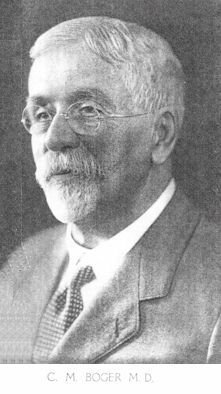
prescribed at her first visit. (C. M. Boger.)
INTERMITTENT FEVER
Case 47
R., boy aged four years, had for fourteen months
continued attacks of tertian intermittent. Quinine had been given until
the little fellow sensibly refused to take more.
In August, 1880, I learned that he had had a paroxysm every other day
for seven months. The malarial and quinine cachexia was well marked, and
with the chill, which began between 10 and 11 A. M., there was intense
thirst for large draughts of water, and during the fever which followed
he complained of his head “hurting and jumping.” One dose of Natrum
mur. (30) was given at the end of a paroxysm. He remained
free from another attack until in the following October, when, the same
symptoms presenting, another dose of Nat. mur.
was given, and he has no chills since (May, 1881), and has continued to
live in the same place, and his health is constantly improving. This
case came under observation while I was visiting the section in which he
resides with his parents, and on learning that many cases of a similar
character were in the neighborhood I felt a vial of Nat. mur., with
directions to give one dose to any case met with ; and I learned a
few months afterwards that several cases had been cured with that
remedy. (Geo. H. Clarke.)
LIVER DISEASE
Case 48
R.,
lad, ćt. 12, living at Park-gate. He suffered for some time from
constipation, loss of appetite, dirty looking complexion, emaciation,
frontal headache going round to the back, sleepiness towards evening
and, first thing in the morning, urine thick, with nasty smell.
Excepting the “nasty” smell, which the boy could not define, I
find these symptoms in the pathogenesis of Natrum
muriaticum in Allen’s Encyclopćdia of Pure Materia Medica
and numbered respectively 529, 353, 251, 885, 64, 970, 561. Therefore, Natrum
mur. 6, and that six grains in water, forenoon and afternoon.
After taking 24 powders he returned, cured of all the symptoms except
the odor of the urine and the emaciation, and “feeling very much
better.” The prescription was repeated and the patient did not
return. His father subsequently informed me that the cure was complete.
(Burnett.)
SUPPRESSED INTERMITTENT FEVER
Case 49
April
21, 1878, John H—–, ćt 29, seaman, had fever and ague two or three
times a day, with watery vomiting, in Calcutta, in September, 1877. Was
in Calcutta Hospital three weeks for it and took emetics, quinine and
tonics. Left at the end of the three weeks cured, but before he was out
of port the ague returned, or he got another, and he had a five months’
voyage home to the port of Liverpool. During the first three months of
this homeward voyage he had 2, 3, 4, 5 attacks a week, and took a great
deal of a powder from the captain, which, from his description, was
probably Cinchona bark ; then the fever left him and the following
condition supervened, viz., “pain in right side, under the
ribs ; cannot lie on right side ; both calves very painful to
touch, they are hard and stiff ; left leg semi-flexed, and he
cannot stretch it.” In this condition he was two months at sea, and
two weeks ashore ; and in this condition he comes to me, hobbling
with the aid of a stick and in great pain from the moving.
Urine muddy and red ; bowels regular ; skin tawny ;
conjunctiva yellow. Drinks about three pints of beer daily. I recommend
him not to after his mode of life till he is cured and then to drink
less beer.
The former part of the recommendation he followed, as I learned from his
brother ; of the latter part I have no information.
Therefore ordered Natrum mur. 6
trit., six grains in water every four hours.
April 27th. Pain in side and leg went away entirely in three days, and
the water cleared at once ; but the pain returned on the fourth day
in the left calf only, which today is red, painful, swelled and pits. He
walks without a stick. Continue medicine.
May 4th. Almost well, feels only a very little pain in left calf in
walking. Looks and feels quite well, and walked into the room with
perfect ease without any stick.
He thinks he had a cold shake a few nights ago.
He continues to perspire every night ; ever since he got the ague
the sheets have to be changed every night.
Continue medicine.
May 11th. Quite well. No medicine.
July 20th. Continues well. (Burnett.)
RÉSUMÉ
1. Melancholy ; depressed ; sad and weeping ; consolation
aggravates.
2. Great emaciation, even while living well ; shows most in the
neck.
3. Anćmia, with bursting headaches, especially at the menses ;
also school girls’ headaches.
4. Great dryness of mucous membranes from lips to anus ; lips dry
and cracked, especially in the middle ; anus dry, cracked,
fissured, costive.
5. Heart palpitates, flutters, intermits, throbs violently, shaking the
whole body, < lying on left side.
6. Itching eruptions, dry or moist, < at the margins of the hair.
7. Modalities : < 10 to 11
A. M. (many complaints), especially malarial affections : lying
down, especially on left side ; (heart) heat of sun, or heat in
general ; (exercise) abuse of quinine or nitrate of silver. I have
selected more than the usual number of cases under this remedy because
it is such a “stunner” to the old school and I like to
“rub it in.” Again as I wrote in my “Leaders in Homśopathic
Therapeutics,” there is no remedy in the Materia Medica, I think,
that so disgusts the advocates of the low potency, and low only, as this
one. The unquestionable cures of the most obstinate cases of
intermittent fever with the 200th potency demoralizes them. That people
eating salt in appreciable quantities right along and can’t live without
it don’t get well on it, and do get
well on the same thing potentized, does not hold to reason, the
microscope, molecular theory, spectrum analysis or anything else
scientific (so called), not being able to discover any material in the
dose. But there stand the cures, like the blind man whom Jesus healed.
It is a hard thing to be confronted by such facts against our
prejudices.”
Any school of medicine, or any physician in any school of medicine who
refuses to accept such testimony of the power of this remedy, even in
the potencies, to cure the sick (and there are many other remedies
equally convincing) has no right to lay any claim to being scientific,
or even reasonable.
Article