HISTORIC SKETCH OF THE
MONUMENT ERECTED IN WASHINGTON CITY
TO THE HONOR OF SAMUEL HAHNEMANN
Compiled by the Rev. B. F. BITTINGER, D.D.
Presented
by Sylvain Cazalet
DESCRIPTION OF THE MONUMENT
Taken from the description prepared by the Sculptor,
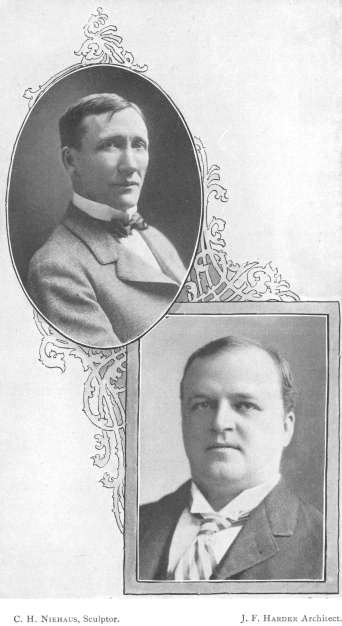
Mr. C. H. Niehaus, and the Architect, Mr. Julius F. Harder.GENERAL DESCRIPTION.
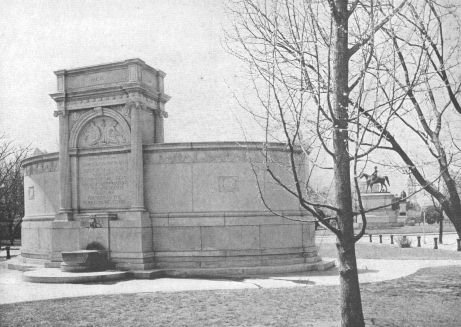
The Monument is a true ellipse in plan, its fundamental
motive being the Greek exedra form. It is approached from the front by
four steps leading to a platform upon the minor axis, and at the back of
which rises the superstructure. The central portion, before which is
placed a sitting statue of Hahnemann, is composed of four columns carrying
an entablature; above this rises an attica bearing the principal
inscription.
Between the two front columns, and forming the
background for the statue, is a niche, again elliptical in plan, and
terminating in a semicircular arch above the impost. This impost line
continuing to the right and left forms the vertical termination of the
flanking walls, which end at the extremities of the major axis of the
plan. The base courses of these curved flanking walls form seats occupying
the space between the central portion and the end terminations.REAR ELEVATION.
As the Monument is in an open place observable from all
sides, it was sought to make it attractive from every point of view, and
much attention was devoted to the design of the back. The main lines of
the central portion repeat themselves here, excepting that the niche is
omitted and becomes instead a flat curtain wall with decorated tympanum
above the impost. These together with the projecting lines form
architectural vertical divisions of this elevation, which is thus resolved
architecturally into component parts, resulting in a well-proportioned and
equally balanced composition.
DECORATIONS.
Rising from the platform in front of the central
portion is a simple pedestal supporting the statue upon the face of which
appears the inscription “SIMILIA SIMILIBUS
CURENTUR.” Other inscriptions which appear at the sides
and below the bronze entablatures are the following,-familiar to all
disciples of Hahnemann: “AUDI SAPERE,”
“NON INUTILIS VIXI,” “DIE MILDE MACHT IST GROSS,” and “IN OMNIBUS CARITAS.”The upper portion of the niche behind the statue is
decorated in glazed mosaic, in colors, with a design composed of the
foliage and flower of the cinchona plant. On either side of the arch are
decorative emblems in bas-relief; a bowl and serpent – the symbols of
wisdom; and a lamp and book – typical of knowledge and instruction. The
former in association with a palm branch, the latter with a wreath of
laurel.The keystone of the arch bears a lion’s head, the
symbol of strength and leadership.Upon the rear the date of erection appears across the
center in Roman numerals and the dates of Hahnemann’s birth and
death-Meissen, April 11th, 1755; Paris, July 2d, 1843 – encircled with
laurel wreaths, are inscribed to the right and left.In the center, filling the tympanum of the arch appear
two figures in bas-relief, emblematic of the science and art of medicine.
Underneath this occurs the broad curtain of hammered granite, upon which
is recorded the following important inscription:CHRISTIAN FREDERICK SAMUEL HAHNEMANN,
Doctor IN MEDICINE,
HOFRATH.
LEADER OF THE GREAT MEDICAL REFORMATION
OF THE
NINETEENTH CENTURY.
FOUNDER OF THE
HOMŚOPATHIC SCHOOL.Below this inscription is a fountain in the form of a
fluted basin fed by a stream of running water issuing from a carved
dolphin.
STYLE.
The style of the design is essentially Greek in spirit
and in its form, profiles and decorations; the delicate play of light and
shade resulting from the elliptical form adding materially to this
quality.
View of the statue which is the central figure of the
monument.STATUARY.
The statue itself, in standard bronze, cast by
the Gorham Manufacturing Company, is the culmination of the plan of the
Monument. The features have been faithfully copied from the bust by the
famous David, who also made the well-known bust of Napoleon I.; but it is
designed to convey by their expression, and by the pose of the figure, to
the observer, the characteristics of the Philosopher, the Philanthropist,
the Teacher.The commemorative tablets are placed in two panels, on
either side of the niche, upon the curved walls representing in
bas-reliefs of standard bronze the four epoch-making periods of
Hahnemann’s life: the nightly vigils of the student; the investigations of
the chemist; the self-sacrificing experiments of the great discoverer; and
finally a fourth (composed partly for the sake of symmetry), to
commemorate the brilliant success of his treatment of the typhus patients
in the hospitals at Leipsig, mentioned by his biographers. The dates of
these episodes-1775-1777, the student years; 1779-1789, the period devoted
to chemical study; 1790, the date of his experiments upon himself with
Peruvian Bark etc.; and 1813, that of his wonderful cures in Leipsig-are
severally inscribed on labels above and below circular discs at each end.
These bronzes are also the work of the Gorham Company.
MATERIALS OF CONSTRUCTION.
The foundations and superstructure of the Monument are
built of fine-grained white granite from the quarries of the Maine and New
Hampshire Granite Company, a material admirably calculated to withstand
the vicissitudes of time and climate.Not only is the statue sublimely impressive in its
delineation of the scholar and philosopher, but the setting of the statue
is superbly classical. The entablatures in bronze which represent epochs
in his life are full of character and vigor. Altogether the American
Instituts will have the honor of presenting to our country a work of art
with which every contributor will be proud to be identified.
BUST OF HAHNEMANN
Photograph of the original marble bust by DAVID
D’ANGERS, now in the Hospital St. Jacques, Paris. The head of the
Hahnemann Statue in Washington is modeled after this bust.2000
Article