Chapter I
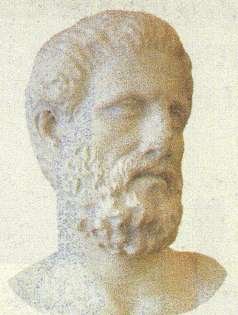
The Psychological Point of ViewHippocrates
Great
Personalities – All great forward movements in religion, science or art originate
in the And of some individual Who appears at the psychological moment and announces his
mission. His personality and his teaching represent the truth for which he stands.To a Moses or a Luther, to a Washington or
a Lincoln, to a Plato or a Bacon, to a Hippocrates or a Hahnemann, each in his own sphere
and period, the world comes and must come for instruction, inspiration and leadership.Always, following the appearance of a great
teacher or leader, opponents, detractors, or corruptors spring up and attempt to stay, or
destroy, or divert to their own glory the progress of the pew movement. Disciples or
would-be disciples have always to be on guard against false teaching. Their principal
safeguard is in maintaining a sincere and intelligent loyalty to the historic leader whose
personality and teachings represent the original truth, and in intellectual and personal
fellowship with other followers who maintain the same attitude and relation.Lesser lights and lesser leaders there must
and always will be, to whom, each in his own rank and degree, honor and loyalty are due; but
the disciple is never above his master. He only is “The Master”, to whom the first
great revelation of truth. was made and by whom it was first developed and proclaimed; for.,
such epochal men are supremely endowed and specially prepared, -usually by many years of
seclusion, intense thought and labor. They are raised up at last to do, a great work. They
stand on the mountain tops of human experience, from whence they have a field of view and a
grasp of truth never before attainable. Like Moses they have, as it were, received the
“Tables of the Law” direct from the hand of the Almighty.Homœopathy, the science and art Of
therapeutic medication, as a twofold existence – as an institution – and in the personnel of
its loyal, individual representatives.These two constituents are pervaded by a
common animating spirit, which finds expression respectively in its organizations. and
literature and in the life and practice of its followers.Homœopathy a
System.- The fundamental principles of homœopathy are embodied in a system of
doctrines, laws and rules of practice which were first formulated, named and systematically
set, forth by Hahnemann in his Organon of the’ Rational Art of Healing. By that, homœopathy
was given a name, an individuality and a character which defines and identifies it for all
time.The practical demonstration of homœopathy
is committed to its personal representatives, whose success will be proportionate to their
efficiency. Efficiency in homœopathy implies and, involves native ability, acquired
technical proficiency and logical’ consistency in the application of its principles. The
exercise of these qualifications requires honesty, courage, fidelity to a high ideal and a
right point of view.Every problem with which homœopathy deals,
therefore, must be approached and every technical process conducted systematically from a
particular and definite mental standpoint. The student or practitioner of homœopathy must
not only know what this point -of view is, but he must acquire it and act from it in each
case. This might be called the personal side of Homœopathy for in the last analysis
homœopathy, from the psychological standpoint, is essentially a state of mind existent in
the person of its representative. In this sense personally, or be, sum of all the essential
attributes and qualities of the individual is a condition-precedent to professional success.Having defined the qualities and attributes
that enter into, the makeup of the homœopathician the various practical problems and
technical processes of homœopathy can be taken up and discussed from the point of view
already established.As a prerequisite to a clear understanding
of the subject, as well as to the attainment of efficiency in the practical application of
its -principles, it is assumed that homœopathy is what,. it is claimed to be a complete
system of therapeutic medication.’ As a scientific system it is made up of certain facts,
laws, rules. and methods or processes, each of which is an integral part of the whole.Nothing conflicting with its established
principles can be added to it, nothing taken away, if it is to stand in its integrity.. Once
it is determined what these essential elements and principles, are, homœopathy must stand
or fall as a whole.A mutilated homœopathy is a lame and crippled thing, compelled to
sustain itself by crutches, splints and braces. An emasculated homœopathy is an impotent
homœopathy, without the virility necessary to maintain or reproduce itself. Some
shortsighted, superficial and weak-kneed individuals, actuated by their prejudices, or
through their failure to comprehend the subject as a whole, have adopted an emasculated
homœopathy for themselves and attempted to support their crippled eunuch as a candidate for
general acceptance. Subjects such as the “life force” the single remedy,
potentization, infinitesimals, the minimum dose, and the totality of the symptoms as a basis
for the prescription, they have characterized as unessential, “so long as the principle
of similia was maintained.” They do not perceive
that each of these doctrines is logically drawn from and inseparably connected with the one
fundamental doctrine which they profess to accept and apply. It is this which has brought
homœopathy, as an institution, down to a point where as
very existence is threatened.Within its sphere homœopathy is entirely
adequate to, meet all its own problems in its own way, when it is practiced in its. purity
and entirety. But homœopathy will fail if it is forced outside or beyond its real sphere,
or if it is perverted and emasculate? To know me true sphere and limitations of homœopathy
is necessary to practical success as to know its technic and resources.Mere formal knowledge of the “law of
cure” and the technic of prescribing does- not make’ a homœopathic physician in the
true sense of the Word. Something more than that is needed. Into that cold and inert body
the breath of life must be breathed before it becomes a living soul. Homœopathy is a spirit
as well as a body of rules and principles and the spirit must be incarnated in every true
believer and follower. That incarnation takes place when the mind of the neophyte is opened
to the philosophical truths which underlie both the method and the principles, and he
becomes imbued with the desire and the purpose to make them the ruling influence of his
life.Methods of adapting and applying the
principles have changed to some extent as the scope and technic of prescribing have been
developed, but homœopathy is essentially the same to-day that it was a hundred years ago..
Individual practitioners, nominally followers of Hahnemann, have drifted away from his
teachings and method, and some have attempted to inject into Or graft upon homœopathy all
sorts of “fads and fancies;” but the mongrel thing thereby created deceives no one
who has derived his knowledge from the fountain head. Homœopathy as set forth by Hahnemann,
while not perfect, is completely in all essentials as a system. It is supreme within its
legitimate sphere because it is the only method of therapeutic medication which is based
upon a fixed and definite law of nature.The validity of this law has been disputed
by the dominant school of medicine ever since it was first promulgated by Hahnemann; but it
has never been denied by any one who has complied with all the conditions necessary for a
scientific demonstration, of its verity. To comply with those conditions in good faith and
test the matter is to be convinced.It is conceivable and probably true that
one reason for the rejection of the homœopathic principle is that the principle, as usually
stated, has never been fully understood. It is a fact that most, if not all of the attempts
(with an exception to be brought forward later) to state the principle have been faulty.
Analysis and comparison have not been carried far enough, in most cases, to clearly identify
the principle and its relations, and establish ‘homœopathy in the “circle of the
sciences” where it belongs.The dominant school of medicine has not
only denied that the so called “homœopathic law” is a law of nature, but denied
that there is any general law which governs the relation between drugs and disease and have
ceased searching for one. The existing situation has never been better characterized than by
Mons. Marchand de Calvi in an eloquent and stirring address to the French Academy of
Medicine.“In medicine,” he said,
“there is not, nor has there been for some time, either principle, faith or law. We
build a Tower of Babel, or rather we are not so far advanced, for we build nothing; we are
in a vast plain where a multitude of people pass backwards and forwards; some carry bricks,
others pebbles, others grains of sand, but no one dreams of the
cement; the foundations of the edifice are not yet laid, and as to the general
plan of the work, it is not even sketched. In other words, medical literature swarms with
facts, of which the most part are periodically produced with the most tiresome monotony;
these are called observations and clinical facts; a number of laborers consider and
reconsider particular questions of pathology or therapeutics that is called original
research. The mass of such labors and facts is enormous; no reader can wade through them-but
no one has any general doctrine. The most general doctrine that exists is the doctrine of homœopathy! This is strange and lamentable; a
disgrace to medicine – but – such is the fact.”Principles and
Organizations – A common mistake, and one of the greatest that can be made, is
that of rendering to organizations the spiritual submission that belongs in the highest
degree to principles only.Organizations are formed for the purpose of
maintaining and advancing principles, but it often happens that in the stress of building
and maintaining the organization the principles are pushed into the background, neglected or
forgotten. The man too often becomes the slave of the machine instead of its master. The
organization becomes a: Frankenstein which destroys its creator. Worse even than the mere
neglect or forgetting, is the willful corruption and perversion of principles which is often
the result of the mad struggle for organization prestige, power and position. Moreover,
individuals connected with or responsible for the success of the organization are easily
infected with the germ of selfish personal ambition. They come to regard their official
contract with it as a through ticket on The Limited to the city of their dreams.Out of these conditions, which it is not
necessary to illustrate or enlarge upon, arise some of the most
serious problems -of the world. Organizations-civil, military, medical, political, social,
religious and educational-may and often do become corrupt, mercenary, tyrannical; a menace
to; liberty and progress; enemies to the principles they are supposed to represent and
agents of compulsion.The individual truth-seeker must,
therefore, keep his eyes open and walk circumspectly if he would keep in the path of
progress, maintain his mental integrity and preserve liberty of thought, speech and action.It has come to pass that individual liberty
is calculated only in percentages now. The increasing pressure of official and institutional
compulsion encircles us. The moral compulsion of the “Drive” is but a short remove
from the physical compulsion of the “Draft.” Metaphorically, the internment camp,
the prison, the dead wall and the firing squad are just beyond.The world is in a state of war. It is a
“War of the Worlds.” The political world, the industrial world, the social world,
the religious world, the medical world–organizations all-are torn by war because importance
has been attached to organizations that belongs only to principles.Organizations like men are subject to
disease, decay and death. When they become corrupt they die, for corruption is elementary
death. Institutions, nations, whole civilizations have died, disappeared and been forgotten
until brought to light by the excavations of archeologists centuries or perhaps millenniums
afterwards. But principles never die.Principles are essential truth, represented
by or corresponding to facts. The essential characteristic of truth is its steadfast
conformity to law and order. Truth is Life, Mind, Spirit; absolute, infinite and immortal.
Organisms in which truth embodies itself are transitory. They change, decay and pass away,
but life is continuous. Truth, like the fabled Phoenix, burns itself on the altar and arises
from its own ashes.Homœopathy, as already pointed out, has a
two-fold existence-as an institution or organization and in the individuals who make up its
following. The spirit and principles of homœopathy have never been and never can be solely
in the keeping of any institution, for organizations are continually changing and dying.Individuals unite in small or great
societies and work together harmoniously for a time, but not for long. Disagreements arise,
they dissolve their original relations and form others; but the work goes on because the
Spirit of Truth always draws together those :of like minds for the attainment of a common
object. At critical periods and in the long run it is always the individual who preserves,
passes on and perpetuates the truth.Upon individuals, therefore, as living
embodiments and representatives of the truth, rests a great and solemn responsibility. No
man can shift his personal responsibility to an organization. As a creator and member of
organizations he does not cease to be an individual trustee, nor should be become slavishly
subject to the organization. The creator is greater than the creature. He may work in or by
means of an organization, but he may not work for an organization, lest he presently find
himself in bondage to a creature which has become corrupt.It follows that our greatest concern as
followers of Hahnemann and representatives of homeopathy is primarily with individuals – men
and principles rather than with organizations. We will build men into organizations and keep
the organizations clean and useful as well as long as we can; but let us be sure that we build principles into men.Nature puts man first. Truth is
not revealed to institutions, but to men. Let us have done with fictions and deal with
realities. An organization is a machine; an inanimate, soulless thing; a figment of the
imagination; a creature of the law, deriving its existence and seeming vitality only from
the individual men who compose it; ceasing to be when their relations are dissolved. Man is
a real living, thinking human being, “made in the image and likeness of God,” an
individual embodiment and personification of a portion of the Infinite and Universal Mind,
endowed with the ability to exercise creative power within his appointed sphere and destined
for immortality. Let him exercise it in liberty, using organizations judiciously but not
becoming enslaved by them.
Article