The Life and Letters
of Dr Samuel Hahnemann
By Thomas Lindsley Bradford,
M.D.
Presented by Dr Robert SérorChapter 11.
Beloved
Leipsic
Cullen’s Materia Medica
First experiments with Peruvian bark
First provings upon the healthy
Beloved Leipsic
Once more established in his beloved
Leipsic,
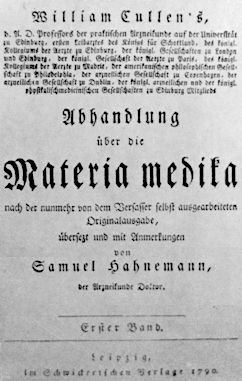
he resumed his translations. In 1790 he published a translation from the
English :“
Ryan on
Diseases of the Lungs,”
and the same year, from the Italian : “Fabbroni
on the Art of Making Wine on Rational Principles,”
adding, as was his custom, many notes.Crell’s Annalen
says : (Ameke, page
40)“Well
merited applause this work has received. Besides the fact that this
translation is faithful and successful, HerrHahnemann
has added precious notes which expand and elucidate Fabbroni’s
principles ; he has thus enhanced the value of the work.”We now come to the translation of a very important book, from which
must be dated the discovery of the Law of the SimilarsCullen’s
” Materia Medica.”It has been asked why
Hahnemann
at this time happened
to translate this
particular book, and it has been asserted that he used it as a blind to
foist on the world his particular theories.It is not probable that when he commenced upon ”
Cullen
” Hahnemann had
any particular medical theories, but only a growing disgust for the
medical fallacies of the day.This is clearly evidenced by his writings at that time. It is not to be
wondered at that he should translate the work at that time. He was
translating for money, for the booksellers and publishers ofLeipsic,
and it is not likely that he selected the books which he was to translate.
Cullen’s Materia Medica
Dr.
Cullen
was an authority on the subject of the Materia Medica of his day, an
experienced lecturer, a talented chemist, and a brilliant and popular
teacher in Edinburgh.
Naturally the Germans wished to learn of his new and peculiar theories
regarding disease, as well as to obtain the use of his Materia Medica,
that at this time was a standard work. (Cullen died in 1790).Hahnemann
was the
most accomplished translator of medical works of the time, and what more
natural than that the task should be given to him. Cullen
published the first edition of this book, in London, in 1773.Another edition was issued in 1789 in two volumes, and it was this
edition thatHahnemann
used in translation. In this book, Volume II, Cullen
devotes about twenty pages to Cortex
Peruvianis (Peruvian
Bark),
giving its therapeutical uses in the treatment of intermittent and remit
tent fevers, advises its use to prevent the chill, and gives minute
directions for the safest period of the disease in which to use it.Hahnemann
was
impressed with the use of this drug, with which he as a physician had
before been familiar. Something in the manner in which Cullen
wrote decided Hahnemann
to experiment with it upon himself and to see what effect it would have
upon a person in perfect health.
First experiments with Peruvian bark
The
result of this experiment will be given inHahnemann’s
own words. In the translation of William
Cullen’s ” Materia
Medica,” Leipsic, Schweikert,
1790, page 108 of Volume II, appears the following footnote by Hahnemann
:“By combining the strongest bitters and the strongest astringents,
one can obtain a compound which, in small doses, possesses much more of
both these properties, than the bark, and yet no specific for fever will
ever come of such a compound.This the author (
Cullen)
ought to have accounted for. This will, perhaps, not so easily be
discovered for explaining to us their action, in the absence of the Cinchona
principle.”“Substances which excite a kind of fever, as very strong coffee,
pepper,Aconite,
Ignatia, Arsenic, extinguish
the types of the fever. I took by way of experiment, twice a day, four
drachms of good China.
My feet,
finger ends, etc., at first became cold ; I grew languid and drowsy ; then
my heart began to palpitate, and my pulse grew hard and small ;
intolerable anxiety, trembling (but without cold rigor), prostration
throughout all my limbs then pulsation in my head, redness of my cheeks,
thirst, and, in short, all these symptoms, which are ordinarily
characteristic of intermittent fever, made their appearance, one after the
other, yet without the peculiar chilly, shivering rigor.”” Briefly, even those symptoms which are of regular occurrence and
especially characteristic – as the stupidity of mind, the kind of rigidity
in all the limbs, but, above all the numb, disagreeable sensation, which
seems to have its seat in the periosteum, over every bone in the body –
all these make their appearance.This paroxysm lasted two or three hours each time, and recurred if I repeated
this dose, not otherwise ; I discontinued it, and was in good
health.” (Brit.
Jour. of Hom., Vol. 24, p. 207. Ameke, p. 103.)The next note, occurring but a few pages beyond, in the German
translation, is as follows :
“Had
he (Cullen)
found traces in bark of a power to excite an artificial antagonistic
fever, he certainly would not have persisted so obstinately in his mode of
explanation.”Further on
Cullen
says :
(Cullen : Treatise of the Materia Medica. Edinburgh, 1789 Vol. 2, p. 64.)“Although I would not rigorously insist on the employment
of a single dose near to the time of accession, yet I am strongly of
opinion, that the nearer the exhibition is brought to that time, it will
be the more certainly effectual. To explain this not commonly understood ;
we must remark, that the effects of the bark on the human body are not
very durable. I have had opportunities of observing that a considerable
quantity of bark given, was not sufficient to prevent a relapse in a few
days after.”Hahnemann
makes the
following footnote about this :“How comes it that the effects of bark are so short lived, as is
indeed the case, if it be not true that bark, besides the astringent and
tonic bitter propensities ascribed to it by writers, especially by the
author, possesses another power, (that of exciting fever of a peculiar
kind) ?” (Brit.
Jour. of Hom., Vol. 24, p. 215.)A very graphic description of these experiments of
Hahnemann
is given in ”
Samuel Hahnemann, a Biographical Study, ” as follows : (Hom. World,
Vol. 10, p. 234. 1875.)” To judge of the physiological effect of bark he took several
doses as prescribed by the profession for ague.The result was that in his previously healthy system there occurred
decided paroxysms resembling those of ague.
First provings upon the healthy
The
experiment had carried him farther than he anticipated. It had taught him
not only the exact physiological effects of bark ; it had shown him that
those effects were apparently the same as the symptoms of the disease it
was given with undeniable success to cure. Does Bark, then, be asked,
produce the same symptoms as it removes ? Does it alike produce and cure
Ague ?It is called a Specific. (Well known to physicians at that time.) Is
the Specific curing power of drugs founded on such a principle ? Do they
all uniformly excite a counterfeit disease to that which they remedy ?Drug after drug, specific after specific was tested on himself and on
healthy friends with one unvarying result – each remedy of recognized
specific power excited a spurious disease resembling that for which it was
considered specific.But many more symptoms than those diagnostic of any one disease
resulted from almost every medicine, and aroused a hope in the
experimenter’s mind of specifically treating a greater number of diseases
than had ever been so treated before.Besides discovering many valuable medicinal phenomena undreamt of, he
verified his discoveries and observations by ransacking the volumes of
recorded experiments on Materia Medica and the whole history of poisoning.The effect of his investigations was not, therefore, a blind leap from
one false theory to another which might be equally fallacious and more
mischievous than the former one. Six years were expended in proving drugs
and verifying his principle before proclaiming it to the world.Regarding these first experiments in proving drugs on the healthy,
Everest
says : (“Popular
View of Homoeopathy,” p. 85. New York, 1842.)“In as much as the action of the same substance varied according
to the age, sex, and idiosyncrasy of the subject to whom it was
administered, it was not considered, sufficient to experiment on a few
individuals.His own family were all pressed into the service, and each substance
was tried in various doses on many different persons, under every possible
variety of circumstance, and beneath the immediate inspection ofHahnemann
himself.”
Article