American Homeopathy in the World War
by Frederick M. Dearborn, A.B., M.D.
Presented by
Sylvain Cazalet
Forty-Eight
A History of U. S. Army Base
Hospital No. 48Traveling Overseas
It cannot be said that anyone
was unhappy to leave Ft. McHenry because it meant that the departure for
overseas was imminent. At 10 A. M., June 20th, eleven officers and two
hundred and four enlisted men of Base Hospital No. 48 left Baltimore via
the Pennsylvania Railroad and arrived at Camp Mills, Long Island, N. Y.,
at 8 P. M. the same day. This proceeding was per special order No. 209,
Headquarters, Eastern Department, dated June 9th, 1918. The trip up from
Baltimore was pleasant because of the anticipations and hopes enjoyed by
all. In common with the lot of traveling troops in our country there was
much spasmodic feeding at every stop. Let it here be said that this
temptation to indigestion was overdone in this country and underdone
abroad. During the last ten days of June the remainder of the officer
personnel reported for active duty, Lieut. Woodmansee being the last to
materialize. One of our complement, Lieut. Dessloch, never reported
because he had in the meantime been attached elsewhere.Hiking Party, Officers of
Base Hospital No. 48, Roanne, July 1918Our Chaplain, Father Walter
O’Brien, was unable to sail due to a mix-up in orders and Lieut. Broderick
developed pneumonia and was transferred to the base hospital at Camp Mills
on July 2nd. To enumerate the other temporary casualties it is only
necessary to state that Privates Carretto and Granger were also
transferred to the hospital. Private Brady went A. W. O. L. and Sergt.
Freedman was transferred to Newport News. Lieut. Broderick and Privates
Granger and Brady eventually rejoined our hospital in France. To offset
these losses, Sergeant Rosse was transferred to our Unit from the Medical
Research Laboratory at Mineola, N. Y. Thus, of the original complement of
thirty-nine officers and two hundred and four enlisted men, the actual
number sailing became thirty-six officers and two hundred and one enlisted
men. No less than eight of the officers had received their promotion to
the next higher grade before leaving Ft. McHenry, and Lieut. Miller
received his Captaincy while in Camp Mills. Originally the Unit was housed
in tents off the main avenue of the camp but after the first week we moved
to Section 3, nearer the entrance and just back of camp headquarters. The
food supply was excellent and the preparation by our own cooks even
better. Every day fresh excitement was caused by the departure of various
units for overseas, including Base Hospitals No. 15, No. 25 and No. 42.Rumors from sources
unmentionable had it that we were to go everywhere from Italy to the North
Pole. Many of the officers and men received visitors and members of their
families and not a few gifts such as supplies of cigarettes and cigars
were left as the result of these excursions. A gift of a hundred and
forty-four specially manufactured hypodermic sets were received for
officers and nurses and duly packed. It is pathetic to relate that many of
the gifts, such as the comforts enjoyed by Major Grant in his tent, had to
be left behind and were donated to the permanent camp. Numerous
examinations were held to determine the physical fitness of the outfit and
on Wednesday, July 3rd, they were finally passed as perfect. The
discipline of the entire personnel at this time was exceptional but
nevertheless, three cases of “cooties” were found July 1st and
energetically exterminated. A detail of interest relates to the very
special charge of Corporal Clifford, our bunny Rhinelander and his
preservation for a sad fate overseas. This animal was our real mascot and
much esteemed. It may be noted that extra and useful equipment, such as
officers’ revolvers were procured and the necessary initialing of all
baggage was duly attended to in these last few days. Everyone who presumed
that he had the slightest excuse, attempted to get some leave.
Bunny
“Rhinelander”On the morning of July 4th the
headquarters’ and officers’ heavy baggage was collected by a Quartermaster
truck and taken to the Clinton Avenue station to be guarded by Lieut.
Chase and a detail of eight men. After a delay of some hours they loaded
the duffle and sped on their way to the boat. It is recorded that there
were eighty-four pieces of officers’ hand baggage packed at the last
moment in an itinerant Ford which had been hired by some thoughtful
officer. Included in this lot were thirty-six of those elaborate bathing
suits which were supposed to keep one alive even after the occupant had
been in the ocean many hours. At 10 A. M. on our Country’s natal day, Base
Hospital No. 48, minus the detail referred to, left for the station in
columns of fours. A Sanitary Train and Trench Motor Battery were also
along. Leaving the Clinton Avenue station at 11 A. M. we arrived at Long
Island City where a ferry boat traveled down the East River around the
Battery and up the Hudson to Pier 54. This trip of forty minutes was
enlivened by the noteworthy and elevating singing of the enlisted men.
Eventually the S.S. “Aquitania,” a Cunard liner of huge size and
recent vintage, was boarded at 3:30 P. M. Lunch had been eaten all the way
from Camp Mills to the boat but on the dock the women of the Canteen
Service of the Red Cross served additional “feeds” and handed
out post cards announcing our safe arrival, a somewhat premature
precaution it seemed to all. Both officers and men boarded from the second
floor and soon had made themselves completely at home. This beautiful day
was marred only by the physical effort necessary to carry individual
baggage. It is anticipated that anyone reading this will know that every
officer who had a huge bag has regretted it to this day. Only those who
enjoyed mental responsibilities had details to carry some of their kit.
Fortunately the spiral stairs of the dock were not used and the lift was a
welcome succor.
S.S. Aquitania – Cunard
LinerOur first official meal at
6:30 P.M. on the ship augured good food, not wastefully distributed but of
fair variety. The enlisted men had the first class salon because it was
more roomy, while the officers dined in the second class in two messes.
The rooms, many with private baths, were splendid and it can be said that
every officer was more than pleased with his home for the sea trip. The
“Aquitania,” the largest commercial liner in service, was built
in 1914 with tonnage of 45,600, length 901 ft. and breadth 97 ft. She
carried a crew of eight hundred and about sixty-two hundred troops. Major
General Hodges of the 76th Division was in command with the 151st Brigade
Headquarters; 302nd Infantry, two batteries of the 111th Field Artillery,
104th Sanitary Train, 104th Trench Motor Battery, No. 1 Mobile Operating
Unit, a special laboratory detachment, the nurses of Base Hospital No. 46
plus fifty others for the mobile group, some casual officers and men as
well as ourselves. There were probably three hundred officers aboard of
whom nearly half were medical. Colonel Moncreif was the senior medical
officer while our C. O., Lieut. Col. Herbert, was appointed Sanitary
Inspector of troops. Lieutenants DeTuncq and Robertson were detailed to
help look after the Field Artillery. The ship’s hospital contained
forty-five beds as well as a contagious ward of fifteen beds and was
placed under the care of Base Hospital No. 48. Regular details of our
enlisted men and the nurses of Base Hospital No. 46 officiated all through
the trip. Five each of our medical and surgical officers, one dentist,
Captain Leighton, and the Registrar, Lieut. Honan, comprised the officer
personnel for this hospital service which was light, varying from four to
twenty-six patients daily. The first operation was aspiration of the knee
joint, performed by Captains Reynolds and White on July 5th. An acute
appendix was operated by Major Grant on July 9th without interrupting the
course of the vessel. Just before the end of the trip a few cases of
measles developed and it was necessary to quarantine these as well as some
contacts. Inasmuch as the entire trip was pleasant with only slight
showers to mar the weather, sea sickness was practically absent. In a
vessel of this size the zigzag course pursued, inasmuch as we were not in
convoy nor protected by any war vessels, was no hindrance to the comfort
of any aboard.
“Martian” BoardWhile it might be interesting
to dwell in detail upon the occurrences of this most satisfactory cruise,
it will suffice to say that most of the passengers were quite oblivious of
danger and enjoyed themselves as much as their official duties would
permit. Naturally no lights were allowed after sundown, in fact no one was
even permitted to smoke on deck. It was noticeable, however, that the
ship’s officers did not take this precaution probably because they felt
that the ends of their cigarettes and cigars were not visible to the
undersea Germans. Setting-up exercises were regularly held for officers
and men and boat drills were frequent. Lectures on the proper
interpretation of the Manual of the Army Medical Corps were indulged in to
the joy of everyone. It was not intended that time should be wasted and
about the only leisure that anyone had was when wrapped in the arms of
Morpheus. As many of Base Hospital No. 48 had had a strenuous time prior
to their sailing, the trip across was indeed a rest. The usual concert and
entertainment was held Tuesday evening with a collection for the worthy
objects usually exploited on shipboard. The enlisted men had movies and
boxing matches in which Base Hospital No. 48 was ably represented by
Sergeant Hallam as a fighter.Our departure from the United
States and approach to England were noteworthy because of the ample
protection afforded in each event. We left the dock New York City, exactly
at 3:21 P. M. July 5th and Ambrose Light was passed at 5:26 P. M. While
there was a good deal of whistle blowing and waving of hands as the boat
went down the river, everyone was ordered to quarters before reaching the
Battery and only allowed out again after reaching the Narrows. Forward
where four six inch guns were, a gun pointer of the British Navy was
stationed, assisted by a detail of American artillerymen. There were also
four similar guns at the stern. On the way out we passed a sausage balloon
and submarine chasers. A dirigible hovered over us at the harbor entrance
as well as two hydroplanes which accompanied our course for at least ten
miles off shore. At the Ambrose Lightship, six destroyers attached
themselves to us and these beautiful camouflaged creations of cubist
design stayed with us until midnight. Nearing the end of our journey,
Thursday, July 11th, at 10 A. M., four United States destroyers were
picked up off starboard and within an hour were arranged two on each side
of us. Everyone was glad to see this evidence of Uncle Sam’s Navy because
of the comfy feeling engendered. About 5 P. M. a fifth destroyer came up
off the southwest corner of Ireland which was now distinctly visible. The
mental atmosphere of the few that were depressed was now much improved and
some gaiety was visible even among the enlisted men far down below. At 8
A. M., Friday, July 12th, Wales was plainly discernible to the right and a
dirigible, No. 51, joined to accompany us up the Irish Sea, which was as
smooth as a mill pond. Steamers, trawlers and sailing ships were much in
evidence. The destroyers were still with us and likewise a mine sweeper
ahead. The Bar Light was reached at 11:45 A. M. and a pilot came on board
at noon going up the Mersey to Liverpool on our final lap. At the Light
the destroyers and No. 51 left our ship while dirigibles No. 34 and No. 35
kept tabs on us effectually and came very near overhead while we
maneuvered for the dock. The 302nd Infantry was landed shortly after 2 P.
M. and thereafter the troops went ashore at regular intervals but Base
Hospital No. 48 did not leave her satisfactory quarters until after supper
and then departed by the London and Northwest Railroad at 1.0:30 P. M. for
our two hundred mile trip to the South of England.Despite the fact that it was
now night, very few slept but managed to catch glimpses of ghostly scenery
as shown by various manufacturing plants at work with double shifts, day
and night. What sleeping was enjoyed on this trip was in the sitting
posture but it was a splendid introduction to what was to come. In the
early morning the beautiful countryside of South England was much
appreciated by everyone and the names of the towns were so familiar that
many thought they were back in our own New England. The remains of our
twenty-four hours rations issued on ship were eaten at the usual odd
intervals indulged in by troops in transit, with the result that only
those cautious ones known to all outfits had anything left when we reached
Southampton. About 8 A. M., July 13th, the march was taken up to the rest
camp, three miles north of Southampton. This was a rapid performance
without a halt, demonstrating the lack of military knowledge enjoyed by
the officers in charge. More than one individual dropped out because of
heat or mental prostration, it being difficult to diagnose the exact
cause. After the usual poor breakfast served in these camps, sleep was
suggested on mattresses for a few hours. The camp was prettily located
with splendid trees about and supplied with Y. M. C. A. and Red Cross
tents. However, these were principally famous because of their lack of
tobacco and sweets. A few of the officers and men were able to go to town
and make such purchases as a civilian larder afforded. It was necessary to
get a special permit from the town commandant to procure two large war
cakes for Major Dearborn’s birthday. Lieut. Col. Honan, Major Grant and
Captain Reynolds managed to get a game of golf, which was the first of
many attempts that these ardent enthusiasts made during their service
abroad. After a travel ration of two sandwiches of jam and war bread had
been issued, the outfit marched four miles back through town saying
good-bye to the various children who seemed the only ones interested.
Plenty of able bodied men were indulging in sports on the play ground in
the center of the town as we passed at 3:30 P. M., but inasmuch as all
parts of England were filled with convalescent and wounded soldiers it is
possible that these games were a therapeutic attempt.Shortly after 7 P. M., July
13th, the S.S. “Caesarea,” a small Channel steamer, was boarded
and we sailed for Havre with another troop ship. It was still daylight at
9:15 P. M. as we passed the Isle of Wight on the right. Plenty of shipping
lay outside of the net line guarded by destroyers, two of which left their
anchorage to convoy us. Seaplanes were abundant in all directions. We
anchored at the head of Spithead for a few minutes and then proceeded on
our way for a relatively smooth passage. This was the only thing that
prevented much seasickness inasmuch as the boat was jammed as tight as may
be imagined. While the officers had staterooms or bunks, most of the men
found it convenient to wedge themselves in after the manner of sardines.
On France’s birthday, July 14th, at 3:30 A. M. we docked at Havre. It was
raining and chilly and the much advertised birthday cakes of the previous
day were consumed for breakfast along with something called coffee. At
7:30 we disembarked and started on a four mile hike to the American Rest
Camp of Sanvic, outside of the city and beautifully situated on a
promontory jutting into the sea. It rained off and on all through this day
but it cannot be said that our happiness at being in France was dampened
thereby. The march to and from the camp was accompanied by singing and
whistling and at one point an American band played us on just about at the
psychological moment when everyone was well worn out. A few fortunate ones
had the opportunity to see well-built Havre and to enjoy the celebrations
staged on this day. Inasmuch as our enlisted force had their entire
equipment with them, they were able to find comparative comfort in the
rest camp but the officers, who had nothing, spent an unhappy night on
wooden floors. This was made all the more attractive by a certain
Captain’s loud and continuous snoring.It would seem that July 15th
was mainly devoted on the part of everyone to getting a good meal. In the
main these efforts succeeded and before we departed at 11:45 that evening
for our destination at Roanne, nearly everything in sight was purchased so
that it may be said that the two days emergency ration just issued was
augmented to such a degree that the trip was hardly a starvation jaunt. Of
the journey that started late July 15th and ended at Roanne at 11:30 A.
M., July 18th, this much can be said it was a distinct novelty to a great
majority of Base Hospital No. 48. The pleasant French countryside, the old
towns, the many troop trains of soldiers going to the Front, convoys of
wounded, sick and ticket of leave men returning, not to mention the
frantic efforts on the part of everyone to stretch their legs on the least
excuse, all contributed to keep one interested. We were far better
accommodated than were many of the Combat Troops inasmuch as six officers
were allotted to a compartment and eight men to a box of like dimensions.
The famous cars labeled “Hommes-36-40. Chevaux-8.” were in
evidence everywhere and we were to become well acquainted with these
before our tour in France ended. After following the Seine to Poissy we
started an encircling movement about Paris, passing St. Cyr and Versailles
to Juvisy. At the last mentioned place we were held up for various reasons
for hours. Being only six miles from the center of Paris we were able to
see the Eiffel Tower and other familiar objects. An air raid over the city
was heralded by the sirens which blew for twenty minutes and later
“all clear” was sounded. Some isolated cannon shots heard during
this time were our first introduction to real war. Our second concrete
evidence of the same was numerous German prisoners, husky looking chaps,
working in the railroad yards and apparently enjoying their lot.Our train had been shifted and
reshifted until at last Base Hospital No. 48 occupied all the remaining
coaches, two being for the officers, six for the men and two for baggage.
Nevers, which we were to know well later on, was passed during the night
and at 6 A. M. Thursday we all awoke at Moulins. Here were many evidences
of the air raids but much new building, with factories and camps all
about. Following the Allier River after leaving Nevers we crossed a
beautiful hilly plateau by La Pallice to Roanne, after three nights and
two and a half days travel. We were informed sometime afterward that it
had been the intention of the Mayor and authorities of this thriving
manufacturing town of fifty-five thousand people to give us a formal
reception, but our arrival was so much delayed that the plans were called
off. The entire command marched out to the northern confines of Roanne to
temporary French Military Hospital No. 84 for lunch and then to a modern
one story hospital just beyond the new barracks where the 1919 class of
French recruits were being trained. These quarters of ours were known as
No. 96, were well built with good water supply, toilets, laboratories and
kitchens but no operating room facilities. It could accommodate about four
hundred patients, hence our C. O. had it in mind to put in the necessary
wooden huts to increase the capacity. Our weeks stay in this bustling town
was a happy one except for the many flies. It was almost necessary to
fight with a hornet for anything sweet that you anticipated eating.
Regular courses of lectures for officers and men were instituted, hikes
taken and all reasonable attempts made to acquire the proper equipment
with which to start operations. Inasmuch as a Ford ambulance was the only
vehicle in evidence, Private Sacco was sent to Rochefort for a Packard
truck. About this time we made the acquaintance of Lieut. Clark, S. C. of
Colonel Ruffner’s staff in Nevers. He met us officially and condoned our
lot.
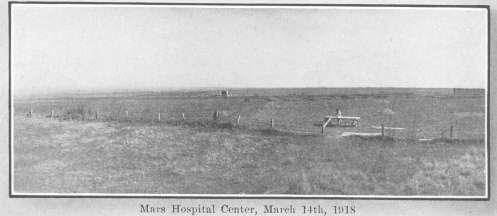
Mars Hospital Center, March
14th, 1918Our first mail was received on
July 23rd but a few fortunate ones were the only individuals interested.
There were many delightful walks about Roanne and these, together with the
attractive inns, were early explored by officers and men. An excursion to
Perreux was much enjoyed because of the elevated location of the town and
its evident ancient origin. On one of the official hikes a good photograph
of the officers was taken by an itinerant photographer and the same will
be found reproduced in the text. Our advent in this neighborhood was a
distinct novelty to the inhabitants inasmuch as the only Americans seen
hereabouts had been a small detail of engineers. It seemed to many that it
was unwise to unpack to any extent because it was doubtful if our stay in
this locality was to be long. The institution which we occupied was not
large enough for a base hospital’s work but rather suited for a camp
hospital, which it afterwards became. Hence no one was surprised when on
July 23rd orders were received directing the bulk of the outfit to entrain
for the Mars Hospital Centre, about a hundred miles north of our present
situation. Lieut. Col. Herbert, Captains Calvert and Miller, Lieutenants
Tyler and Bickford and seventeen men were left at Roanne to take charge of
the property with the understanding that they would undoubtedly join us
later. Major Dearborn, Captain Clark, Lieutenants Hynard and Grosvenor
were ordered to the Mesves Hospital Center but traveled with the Unit as
far as Mars. Our train as it left Roanne at 11:40 P. M., July 24th,
consisted of nine cars and progressed very slowly, arriving at
Mars-sur-Allier at 4 P. M. the next day. It was then switched on the U. S.
Government tracks to the hospital center about two miles beyond.
Article