American Homeopathy in the World War
by Frederick M. Dearborn, A.B.,
M.D.
Presented
by Sylvain Cazalet
The Battle of Pougues-les-Eaux
A History of U.S. Army
Base Hospital No. 44
– – – – –
Count Off !
The long deferred and
anxiously awaited action of the War Department came, when, on the
twentieth of February, 1918, Special Order No. 52 was issued, directing
Captain Lee “to proceed from Camp Greenleaf to Boston for the purpose
of mobilizing the enlisted personnel of Base Hospital 44,” and
specifying that “upon completion of the mobilization, he should
proceed, together with the enlisted personnel, to Camp Dix, Wrightstown,
N. J., for temporary duty at the Base Hospital.” The requirements of
the order were carried out, and on Sunday, March 10, at one o’clock, at
the Out-Patient Department of the Massachusetts Homeopathic Hospital, the
first roll call of the organization was held. Of the one hundred and
fifty-three enlisted men included in the order, one hundred and
forty-seven responded; two men failed to appear, one man was sick in the
hospital, and the others were awaiting official transfer from another
branch of the service. Chaplain Wylie also reported for the purpose of
accompanying the Unit. Lunch was served, and an inspiring address was
delivered by Director, Major Wesselhoeft. Mr. Baker, President of the
Board of Trustees of the Hospital, extended his felicitations and good
wishes in behalf of the institution.
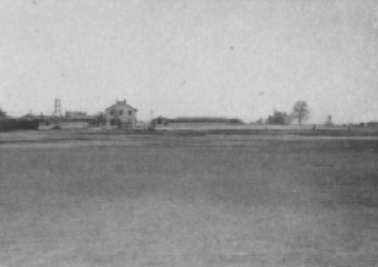
General
Headquarters.
Camp DixIn a heavy snow storm the
Command proceeded by special trolley cars to the armory in Charlestown,
which was reached at three o’clock; and the task of outfitting was at once
begun. The garments of civilian life were discarded, and from their skins
out these men became soldiers. Fortune favored those whose names began
with the early letters of the alphabet, and many were the misfits which
developed as the length of the waiting line decreased. The scene became
almost pathetic as the last men displayed their newly acquired belongings,
and endeavored to enclose number nine feet in size seven shoes, or to take
up the slack in a pair of trousers at least eight sizes too large.
Exchanges were in order, and the evening was occupied in friendly
“swaps” and in preparations for the night. When “taps”
was sounded the tired boys lay down upon their army cots under the arching
roof of a military shelter, and slept-or thought. The activities and
interests of civilian life had suddenly been temporarily, perhaps forever,
terminated; they were leaving all that was dear and familiar to them, and
were entering upon a new and tremendous adventure. They had ceased to be
free moral agents, and were now units in a vast military organization,
with no will but to obey, and no definite knowledge of what was before
them.Monday was spent in
adjustments of seemingly impossible combinations and conditions of
equipment; and the officers and soldiers at the armory were most kind and
helpful, doing everything possible to facilitate matters. At six o’clock
the Command left the building, proceeding to South Station by trolley, and
occupying three special cars attached to the Federal express which left
Boston at 7:30. As strict orders had been given that the time and place of
leaving should not be announced, the departure was entirely lacking in the
emotionalism and enthusiasm usually characterizing such occasions.
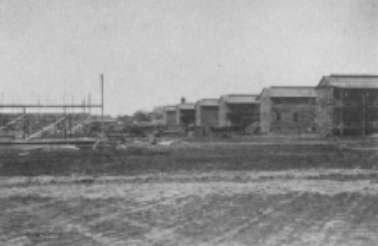
New Hospital
Buildings,
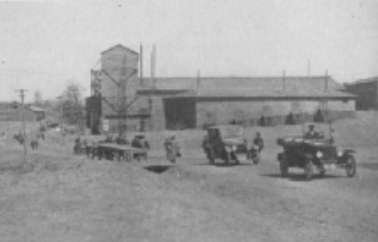
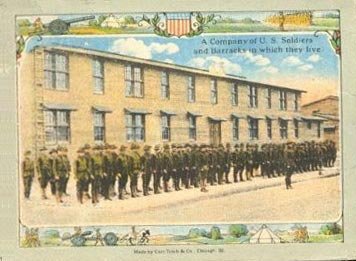
Temporary Barracks for enlisted Men of Base
Hospital No. 44 – Camp DixThe Detachment was supposed to
reach Camp Dix in the early morning of March twelfth, but owing to a long
delay in New York, did not arrive until after nine o’clock. Undaunted by
the fact that the reception committee and the band had failed to
materialize to bid them welcome, the sturdy soldiers marched to the Base
Hospital, where they were informed that arrangements had been made to have
them temporarily cared for at the 303rd. Sanitary Train. A half hour’s
hike brought them to their destination, and having partaken of a special
mess, the task of getting placed and adjusted was begun. Acting on the
principle that “an army moves on its stomach,” mess kits were at
once issued. Cots were then assigned in the barracks of Field Hospitals
311 and 312, and Ambulance Companies 309, 311 and 312, sections of the
Sanitary Train.A volume might be written
about the experiences of the three weeks spent at this first station. The
commanding officer of the Sanitary Train, Major Webster Calvin, did
everything possible to make his temporary guests comfortable, and the
officers of the organizations with which the men were quartered, were
uniformly considerate and helpful. Lieutenant S. A. Vanderwater devoted a
large part of his time to drilling and instructing the men, and his
kindness and valuable assistance will never be forgotten. Headquarters
were established, and Sergeant Perkins, the only noncommissioned officer
with the outfit, assumed the responsibility for the paper work. A barracks
sergeant was chosen for each of the five buildings in which the men were
quartered; temporary clerks, noncommissioned officers and squad leaders
were appointed; and various working details were arranged. Drills and
hikes were the chief features of the daily schedule, and competitive
weekly drills were held; a course of lectures was given by officers of the
camp; a series of French lessons was begun; inoculations and vaccinations
were completed; allotments and insurances were written; sports were
arranged, and exciting baseball games were played and won; religious
services were held; ordnance and equipment were issued; inspections were
endured; and a vast amount of routine work was accomplished under
difficult conditions. The men all entered the new life with a
determination to “make good,” and their development as soldiers
was rapid and inspiring. There were no occasions for punishment; very few
cases of illness developed; the morale of the men was at the maximum; and
the officers of the Sanitary Train were enthusiastic in their praises of
the men and their work.
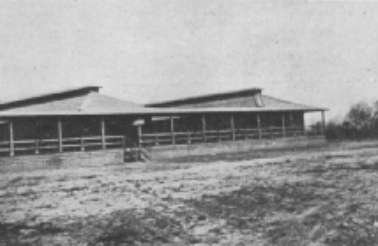
Headquarters and
Barracks of Base Hospital No. 44
Camp DixOn the first day of April an
order came for the Unit to leave its temporary abode, and to transfer to
the Camp Dix Base Hospital. With many regrets the men packed their
belongings into their barracks bags and left the good friends and pleasant
associations connected with the Sanitary Train. With all their possessions
on or attached to them, they toiled perspiringly across the fields under a
scorching midday sun, and arrived at their destination tired but
“game.” Quarters were assigned and the next phase of their army
life was begun; but the members of the Unit who passed through the
vicissitudes of the life at the 303rd. Sanitary Train, look back upon the
three weeks spent there as among the best and happiest in their military
experiences.Meanwhile Capt. Wiggin had
been called to active duty for the purpose of mobilizing the forty-seven
men needed to complete the two hundred comprising the enlisted personnel.
On the second of April he and forty-four men arrived at the Base Hospital,
after having passed through a preliminary process similar to that
experienced by the original contingent.Orders for the mobilization of
the commissioned personnel were received early in April and within a few
days the medical officers had nearly all reported for duty. The Nurse
Corps was mobilized on the first of April, and the nurses were divided
into detachments and stationed in fourteen cantonments for duty. By the
middle of April the mobilization of the Unit was practically completed.
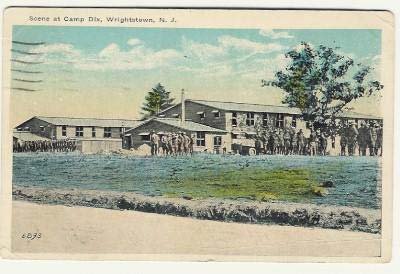
Camp Dix
Right Dress !
The training of the members of
the organization for their overseas duties was at once begun at Camp Dix.
The officers were assigned to various stations in the hospital for the
purpose of observing and assisting, thus familiarizing themselves with the
methods of an army institution. The enlisted men were detailed to
different departments for work, each man being given experience in the
duties which he would be expected to perform in his own organization.
Drills were held daily; but the military aspect of the routine was
subsidiary to the task of training the men in hospital technique and army
methods.The experiences gained in the
weeks spent at the Base Hospital were valuable, and were conducive to the
success of the work done when the Unit was “placed upon its
own.” Incidentally the presence of our men was of distinct advantage
to the hospital, and for a considerable period of time the members of
Forty-Four were, to a large extent, carrying on the routine work of the
institution. It is unnecessary to record that their work was of the
highest grade and that it was appreciated by those in authority.
Liberty Theatre
Camp DixDuring this developmental
period many interesting and exciting events transpired. The arrival of
Major Wilds on the sixteenth of April ended the numerous speculations as
to who the commanding officer was to be. Various “moving days”
developed; the officers left their comfortable and congenial location in
Ward 33, and were distributed as more or less unwelcome guests among the
officers of the Base Hospital in the officers quarters; while the enlisted
men were shifted from ward to barracks, from laundry to barracks to
laundry (all in the same afternoon), from chapel to barracks, and from
barracks to other barracks in a dizzy manner. A mild and quickly
controlled epidemic of scarlet fever developed early in April, and another
of German measles shortly after ; but only eleven of the enlisted men were
sick and all made a complete and uninterrupted recovery. The first pay day
for the men occurred on the twelfth of April and was a time of
considerable interest and importance. Wrightstown, a flourishing
metropolis consisting of a few permanent inhabitants, and a considerable
wartime population with commercial aspirations situated within easy access
of the hospital, gave opportunity for shopping, amusement, and
refreshment, of which the men freely availed themselves. The palatial
establishment known as the “Bucket of Blood” was somewhat
popular. St. George’s, the Liberty Theatre, the “Big Y” and the
Hostess House, all situated in or near the camp, offered many attractions
which helped to keep the men happy.The members of the Unit
rapidly became adjusted to the conditions of their new life and work, and
were generally well satisfied. Naturally the question, “when do we
sail?” was uppermost in the minds of all, and there were many wise
ones who could read the future or who had “inside dope” which
enabled them to answer the query satisfactorily to themselves.
Mark Time !
On the nineteenth of April, an
official message was received which stated that the Unit would leave for
overseas duty on or before the first of May, and a period of intense
activity was at once inaugurated. The commanding officer made a hasty trip
to Washington; messengers hurried hither and yon; frantic efforts were
made to complete the equipment of the men; baggage was weighed and marked;
daily physical inspections were held; goodby letters and messages were
sent; the office force worked night and day preparing passenger lists,
qualification cards, and endless collections of data; all leaves of
absence and passes were refused; each man was “on his toes.” The
official photograph of the organization was taken on the twenty-fourth,
and the final inspection of the equipment was made by a headquarters
officer on the twenty-sixth. The Unit was reported to be ready to move.Sunday, the twenty-eighth, was
a memorable day. The fond parents, distressed wives, tearful sweethearts
and admiring relatives and friends of the brave soldier boys flocked into
camp by train and automobile, and the adieus were said and done. The
parting of the ways had apparently been reached, and the Unit awaited the
command, “Forward, March!”
Camp Dix
At Ease !
The fateful day arrived-and
nothing happened. Other days came and went and still no orders were
forthcoming. Rumors there were aplenty, but the “powers that be”
preserved a sphinx-like silence. Gradually the tension relaxed; daily
inspections were discontinued; work details were resumed in a half hearted
manner ; everybody was disappointed and many were discouraged. As orders
for the Unit to move were expected at any time, it was not considered safe
to issue passes covering periods of more than a few hours, and thus the
men were virtually confined to the vicinity of the cantonment. Some of the
men had their wives boarded near the camp, but most of them lived in the
expectation that three day passes would be granted, enabling them to visit
their homes. On two occasions such passes were forthcoming for a portion
of the Command and there were wild scrambles for the coveted slips of
paper.Several false alarms
developed, one of which having such a close resemblance to the “real
article,” that another final physical and equipment inspection was
held on the thirty-first of May. Naturally this state of uncertainty and
the frequent sudden calling of the men from their duties in the hospital,
seriously interfered with their work, and materially affected the morale
of the members of the Unit unfavorably. Many were willing to “put up
good money” that Base Hospital Forty-Four would never go overseas,
and were anxious to transfer to some other unit which they felt sure would
be called for foreign service. Officers and enlisted men alike felt the
depression of this trying period and found it difficult to keep up
courage.To add to the difficulties of
the situation, Wrightstown went bad from a sanitary standpoint, and
entrance to this panacea for the blues was absolutely prohibited. And as
though this disaster was not sufficient to make life miserable, the camp
was closed to visitors over three week ends owing to the movement of
troops, and nobody was allowed to leave the cantonment during the same
periods.Among the many interesting
occurrences during this interim a few stand out prominently. On April
nineteenth the first announcement of ratings of enlisted men was made, and
resulted in both pleasure and dissatisfaction. The work done by the men
had been so uniformly good, and so many had attained equally high
standing, that it was extremely difficult to determine to whom the limited
number of advancements allowed should go, and many who were not favored
were naturally disappointed. The officers will never forget the
“continuous performance” at Cafeteria No. 1 during the latter
part of May, when they examined sixteen thousand drafted men arriving at
the camp, working night and day until the task was completed. On the
twenty-third of June Lieut. Fellows was married in one of the mess rooms,
with a few of the officers and enlisted men of Forty-Four as witnesses.
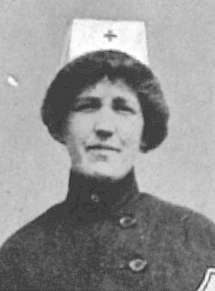
Miss Evelyn V.
PetrieThe first death to be recorded
in the Unit occurred in May, when Miss Evelyn Petrie, a member of the
Nurse Corps, died at Fort Oglethorpe, Georgia, as a result of being thrown
by a frightened horse, while riding. She was a graduate from the Training
School of the Massachusetts Homeopathic Hospital, and resided in Boston.
The tragic circumstances associated with her death rendered the affair
especially sad.
Article