PILOCARPINUM.
Pilocarpinum, muriaticum, and nitricum.
An alkaloid obtained from Pilocarpus pinnatus
(Jaborandi).
Preparation
, Solutions.
Authorities.
1,
Ringer and Jaunson, Pharm. J., ser. III, 5, 965, effects of the
injection of 0.0325 grams of the nitrate of P.; 2,
Weber, Med. Central. Blatt, Wien, 1876, p. 769, experiments on himself
with small doses of 5 c.c. of a one-half p.c. solution; 3, Bardenheuer, Berlin Klin. Woch., 1877, p.
7, effects of subcutaneous injections of small quantities in several
persons; 4, Leyden, ibid., p. 85,
effects of subcutaneous injections of a one-half to two p.c. solution; 5, Scotti., ibid., p. 141, subcutaneous
injections.
HEAD.
►
A sensation of throbbing in the temples frequently accompanies the
acceleration of the pulse, [5].
EYE.
►
Increased secretion of tears, [4].
► Profuse lachrymation, [3]. ►
One drop of a solution of the nitrate in the proportion of 1 to 480 was
put into the eye. In about twenty minutes the pupils were contracted to
the size of a pin’s head, without pain or discomfort. Previous to the
instillation the patient was barely able to see Snellen’s type 4 1/2 at
the distance of five feet; after the contraction of the pupil had taken
place, he was able to see easily the same type fully nine feet distant, [1]. ►
Contraction of the pupil commenced, lasted for twelve hours after all
the other effects had passed away (from subcutaneous injections); from
the local application to the eye of one drop of two per cent. solution
contraction commenced in ten minutes; reached its maximum in twenty to
thirty minutes, lasted about three hours, and the pupil did not return
to its normal size until after about twenty-four hours, [2]. ► Myosis
caused by local application of the two per cent. solution; this
continued after three or five minutes, and reached its maximum in
fifteen or twenty minutes, and continued two or three hours or longer,
according to the amount; during this contraction of the pupils there was
but slight change in the refraction of the eye; the far point
approximated somewhat, but was overcome by concave glasses of 1/40 to
1/36; Atropia seemed to be a perfect antidote, [5].
NOSE.
►
Increased secretion from the mucous membrane of the nose, [3].
MOUTH.
►
Very sudden salivation, without the prodromal stage; the secretion
reached its maximum in about fifteen minutes, usually continued an hour
and a half to two hours, and amounted to from one-fourth to
three-fourths of a liter of thin saliva, very poor in specific
constituents, [5]. ► Profuse salivation accompanied the
perspiration, [4]. [10.] ►
Increased secretion of saliva occurring in from three to five minutes
after the subcutaneous injection, and lasting usually longer than the
perspiration, [2]. ► Increased salivation (after three
minutes); gradually increasing and reaching the maximum in about twenty
minutes, then slowly decreasing, [3].
► In a case of lead paralysis, it
caused profuse salivation and perspiration, accompanied by a sensation
of great coldness and excessive tremors of the extremities, [3].
STOMACH.
►
Nausea occurs only when the salivation is complete; this nausea does not
amount to vomiting, as is often the case after the infusion of
Jaborandi, [2]. ► The violent, repeated vomiting noticed
after Jaborandi, does not occur after Pilocarpin, [3].
RECTUM AND ANUS.
►
Urging to stool was sometimes noticed, [5].
URINARY ORGANS.
►
Increased desire to urinate, [4]. ► Desire to urinate, with violent pain in
the urethra, without ability to pass urine; increase of the urinary
secretion was occasionally noticed, but was not the rule, [5]. ► Violent
dysuria, with violent pains in the penis, [3].
► Increased secretion of urine,
though only transient; the aggregate amount of urine passed during
twenty-four hours after the drug is not increased, indeed, rather
diminished, [4].
SEXUAL ORGANS.
[20.]
► Menses two days earlier than usual
in a woman who menstruated regularly, [5].
RESPIRATORY ORGANS.
►
Increased secretion of bronchial mucus, usually accompanied by moist
cough and expectoration, [4].
HEART AND PULSE.
►
Weakness of the heart (after two or three hours), [4]. ► Slight
acceleration of the pulse from 5 to 10 beats during the perspiration, [2]. ►
In its primary effect it causes slight increase in the frequency of the
pulse, and slight diminution of the blood, pressure, from small doses;
after larger doses the pulse becomes slow, with great diminution of the
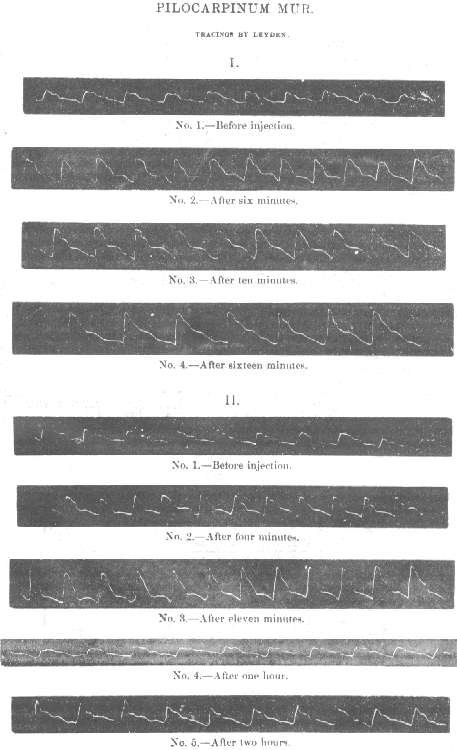
blood pressure, [4]. ► The pulse curve exhibits at first an
increased systolic elevation, a more abrupt curve, a more sudden
downfall, and a very decided recurrent elevation; the artery is filled
rapidly and violently, and collapses suddenly; symptoms of relaxed tone
of the vessel and accelerated heart’s action; the character of the
pulse-curve is most pronounced after ten or fifteen minutes; it
gradually returns to the normal; the pulse-curve of a rather rigid and
unyielding radial artery in a patient sixty three years old was very
interesting; the elevation was stronger and more vertical, but was not
much higher than normal; the curve did not immediately descend after
reaching its highest point, but continued for some time almost
horizontal, and then suddenly fell; the recurrent elevation, which
normally could scarcely be noticed, was now very pronounced, [5]. ►
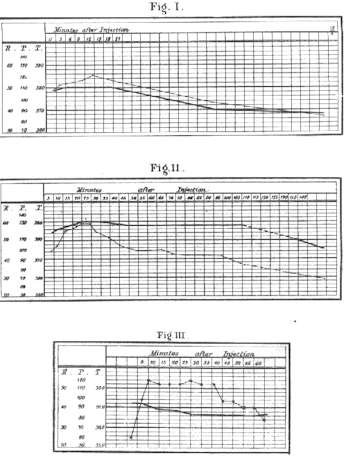
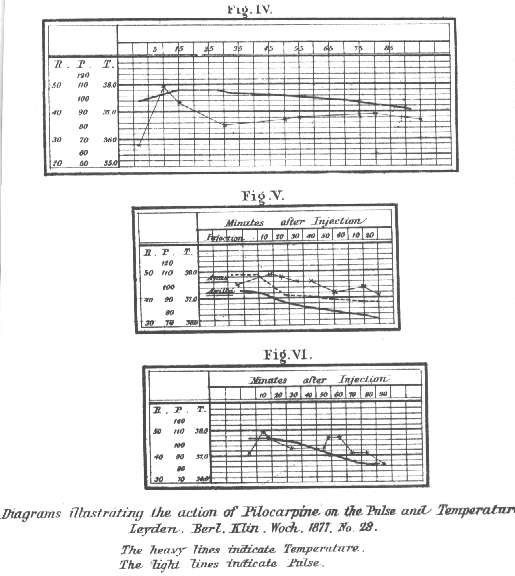
Increased frequency of the pulse by 10 to 20 beats, coincident with or a
little later than the salivation, [5].
► Diminution of the arterial tension
a few minutes after the injection, even before perspiration, [3]. ►
After the perspiration the pulse falls and gradually sinks to the
normal, [5].
GENERALITIES.
►
The dilatation of the vessels began after two or three minutes, and
lasted from half an hour to an hour, accompanied by redness of the skin,
and soon followed by perspiration; there was speedily noticed a decided
swelling of the bloodvessels of both the arteries and veins; the
temporal artery, which before the injection could scarcely be noticed,
became a thick prominent cord, with visible pulsation; its diameter
doubled; at the same time the veins in the forehead became swollen and
appeared as large blue vessels, so that as the perspiration began the
patient had the appearance of one excessively heated; the same
dilatation is noticed in the radial arteries; the veins on the forearm
and hand frequently seemed swollen; the pulse was fuller and more rapid,
sometimes decidedly dicrotic; the pulse rose from 80 to 100, or even
120, [4]. [30.]
► The loss of weight, after two or
three hours of copious secretion, varies from about four and a half to
nearly nine pounds, [2]. ► Before the injection, temperature 24.7,
pulse 104. The drug began to exhibit its effects in forty-five minutes,
when the face and chest became red, and covered with slight
perspiration; five minutes later the whole body was covered with profuse
sweat, together with copious salivation; temperature 37.1°, pulse 100.
The salivation and perspiration lasted about five hours, after which the
patient was very thirsty, but in other respects well, [1]. ►
Exhaustion, during, which most of the patients fell asleep (after two or
three hours), [4].
FEVER.
►
Chilliness. ► A sensation
of coldness and even shaking chill was experienced by some patients
during the perspiration, though the thermometer showed no fall of
temperature, [5]. ► Heat and Sweat. ►
Increase of temperature from 1/2° to 1° C., in some cases, during the
feeling of intense cold, [2]. ► The temperature was almost always
increased by 1/2° to 1°, at the commencement of the acceleration of
the pulse; it usually continued so until the whole body was bathed in
copious perspiration, then slowly returned during the course of two or
three hours to 1° to 2° below the normal, [5]. ► The
forehead and face become red, the veins on the forehead swollen, when
the perspiration begins on the face and over the whole body; the
perspiration is thin, odorless, slimy, acid, or neutral (after two to
five minutes), [4]. ► Redness of the face, with a sensation of
warmth, with perspiration at first over the forehead, along the margin
of the hair, then extending in a short time over the face to the neck,
chest, trunk, arms, and at last over the lower extremities, continuing
an hour and a half. The patient usually loses from one to two
kilogrammes in weight, during the perspiration, which, however, he
recovers after twelve or twenty-four hours, [5]. ► The
variation in the temperature is somewhat as after an infusion of
Jaborandi; during the maximum of perspiration it fell from 0.5° to
0.6° Cent.; as the perspiration diminished, it gradually rose to its
former height; this was a constant effect, [3]. ► The
temperature at first showed a slight variation of 0.1° to 0.5° in some
cases, in other cases no rise at all; as soon as the perspiration began
the temperature slowly sank, [4]. [40.] ►
Excessively profuse perspiration, [3].
► Profuse perspiration, so that it
stood in drops on the forehead and face (after five to ten minutes), [4]. ►
Perspiration commences later than the salivation by about five minutes,
occurring first on the head, gradually extending over the whole body,
often with a feeling of intense cold, so that the patient chatters and
wishes to be wrapped up; the duration of the perspiration varies,
according to the size of the dose, from one to three hours, [2]. ►
Perspiration (much less marked than from the infusion of Jaborandi),
followed by a feeling of great relief and increased vigor, [2].® 2000
Article