HELONIAS.
URINARY ORGANS.
►
Kidneys. [60.] ► A great deal of weariness, and feeling of
weight in the region of the kidneys, and with much more general fatigue
than usual, in the afternoon and evening (fourth day), [3]. ► Pain in
the kidneys, which is followed by albuminuria, indicating congestion,
and large discharges of urine, with slight increased specific gravity, [5]. ►
A sensation as if my kidneys were two bags of hot water; this feeling
was so distinct, that I felt certain I could have traced the area
occupied by these organs by following the outlines of the burning (fifth
day), [7]. ►
It seems as if the kidneys ache at 10 P.M. (eighth day), [7]. ► Urethra.
► (Urination was very painful, on
account of the scalding sensation as the urine passed over the denuded
mucous membrane), [6]. ► Irritation of the urethra, [5]. ►
Micturition. ► Kidneys
somewhat stimulated, and a larger amount than usual of clear,
light-colored urine has been voided during the past twelve hours, in the
evening (second day), [3]. ► Every time I urinate I seem to completely
empty the bladder, yet when I have put the “indefinite
article” back in my breeches, out spurts a quantity of urine; no
matter how much I endeavor to contract the bladder, this extra leak
happens every time I micturate (sixth day), [7]. [To this day, February 4 th, 1871 (nearly
three years) I have not overcome this weakness. As I was ever very
“sure on the trigger,” I am the more willing to ascribe this
to the Helonias. In functional derangements of the prostate, it will be
well to bear this remedy in mind, for if this prostatic freak obtains
and is attended with somewhat frequent and profuse urination, the urine
being very pale and watery, or containing a deposit of the amorphous
phosphates, Helonias promises fairly. I may here add, that a close
examination reveals no enlargement of the prostate in my case.] ► Since the proving, the presence of a
deposit of the amorphous phosphates in the urine is the exception, and
not, as previously, the rule of my life, [7].
► Urine. ►
Urine had a faintly alkaline reaction before the proving; neutral (after
four hundred and eighty minutes, sixth day); strongly acid (seventh
day), [7]. [70.] ►
The design of this whole experiment was, if possible, to induce
saccharine or albuminous urine. From the specific gravity, it will be
seen that there is little chance of finding either. The test by heat
alone would have led to the supposition that albumen existed, from the
flocky curdling of the phosphates, but Nitric acid never gave an
albuminous precipitate, [7]. ► The sugar was sought for with Fehling’s
test, freshly prepared, and
invariably with negative results, [7].
► The urine was carefully examined
with the microscope throughout the whole research, and the results show
that the action of Helonias upon the kidney is purely functional. There
is no evidence of any epithelial desquamation, or degeneration, and
Helonias, as a renal remedy, may be classed with Cantharides, but not
with Arsenic or Phosphorus, [7]. ► So far as my experiment is concerned,
these three facts are sufficient to justify the job; the other fact,
that Helonias can render a neutral or an alkaline urine acid is a clear
grain, [7]. ►
I think it must be allowed that Helonias is somewhat diuretic; a daily
average of 46.347 ounces is certainly a plus
for one of my stature and weight. I do drink water freely, but I
“chew tobacco,” and my spittoon will testify that the salivary
glands do extra duty. I think the primary action of Helonias is to
reduce the renal excretion. When this remedy is in full action, the
kidneys have an even burning feel, and they ache; evidence, I take it,
of renous congestion, retarded blood flow, hence the urinary plus, [7]. ►
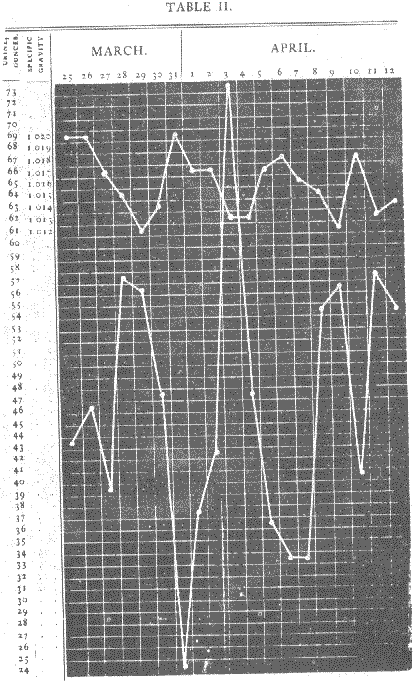
On March 28th, 29th, and 30th (fifth, sixth, and seventh days of the
proving), 1380 minims in all were taken. A glance at Table II will show
the effect upon the renal excretion. It decreases from 57 1/2 ounces to
24 ounces 3 drachms. Three days’ time are required with the doses taken,
then the drug is suspended, and in the next three days the quantity of
urine increases from 24 ounces 3 drachms to 73 ounces; a plus of nearly
50 ounces. On the following day, it falls from 73 ounces to 47 1/2. Such
variations are beyond even the maximum of physiological oscillation. On
the 26th, I dined at 12, emptied the bladder at 1 P.M., and again at 2.
The rate of excretion was 2 1/4 ounces in an hour. On the 29th, I
repeated this process, and found the rate to be 7 1/4 ounces in an hour.
On the latter date, at 12 M., I had taken 480 minims of the tincture.
Possibly this phenomenon of renal stimulation may be ascribed to the
alcohol. However, as the tincture was diluted with thrice its quantity
of water, it is a probable that the stimulation is due to the Helonias.
According to Böcker and Hammond, alcohol lessens the water of the
urine, and this must be borne in mind in estimating the downward slope
of the quantity line for the 29th,
30th, and 31st. The decrease begins on the 29th, and reaches the minimum
on the 31st, the whole quantity eliminated being 128 1/8 ounces. The
increase began on April 1st, and reached the maximum on April 3d, the
whole quantity 163 1/4 ounces. The
“reaction” is plus. These quantities added, give
48.55 ounces as the daily mean, another plus. As a like quantity of
water was drank daily, and as no change in the temperature of the
weather occurred to explain this plus by skin
action, I am disposed to ascribe it to the drug. If we assume
45 ounces as my daily rate of excretion, which is certainly liberal, we
shall find that nine of the nineteen days give a quantity below this,
while the remaining ten are above it. The nine minimum days give, as a
total, 350 7/8 ounces, which is 38 3/10 ounces per diem. The ten maximum
days give 551 3/8 ounces, 55 13/100 ounces daily. If we take enough from
the maximum, ten days’ quantity, to bring the minimum, nine days
quantity, up to the mean of 45 ounces per diem, we still have a plus of 46 3/8 ounces. That Helonias is a diuretic in the same sense as Apocynum
cannabinum, I am not prepared to affirm; that it is a renal stimulant, I
think may be safely assumed. Let not the term stimulant
mislead. The Helonias renal stimulation is a condition of debility, renous paresis, the result of previous
arterial tonic contraction, [7]. ► Helonias lowers the specific gravity. A
mean of 1.01571 for nineteen consecutive days is not normal. Suppose
that, on account of the experimenter’s sedentary habits, we assume 1.018
as the normal specific gravity of his urine, we then find that under the
Helonias action it is for fourteen days of the nineteen below this, and
that for seven of these fourteen days it is at 1.014 for two, 1.013 for
three, and 1.012 for two. A glance at Table II will show that the
depression of specific gravity is not directly dependent upon the
quantity of urine excreted. On different days we have 73.572 and 47.7
ounces, each of 1.013 specific gravity; 46, 43.4, and 24.3 ounces of
1.020; 42.3, 39.4, 37.2 and 36.5 ounces of 1.017. The consideration of
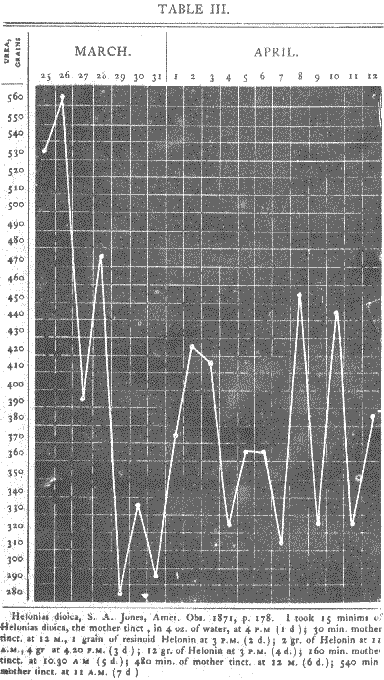
this leads us to the urea. As the daily average, according to Table II,
exceeds the “physiological amount” by nearly 50 grains per
diem, one would say that the primary action of Helonias is to increase
the elimination of urea. A glance at Table II will show that on only
seven of the nineteen days did the urea fall below the daily rate of
345.94 grains, and the greatest minus
will be found to coincide with the days in which a great amount of
alcohol was taken. In three days, 28th, 29th, 30th (of March), 1380
minims of tincture were drank, and in the urine of the 29th, 30th, and
31st, the effects of the alcohol is shown in a minus
of 130.58 grains of urea. On twelve of the nineteen days there is a plus of urea, which extends from 9.76 to
215.26 grains daily. So far, then, as these data go, we must believe
that Helonias primarily increases the elimination of urea, [7].
® 2000
Article