SUPPLEMENT: GLONOIN.
Authorities.
(135
and 136, from Berridge, Hom. World;
vol. xiii, p. 401); 135, Dr. George
Harley, Med. Times and Gaz., 1858, vol. xvi, p. 356, experiments; 136, Mr. F. A. James, ibid., p. 383,
experiment; 137, Allinson, Times,
July 31st (Pharm. Journ., 1866-7, p. 263), a man drank a quantity; 138, Conrad Wesselhoeft, M.D., North Amer.
Journ. of Hom., New Ser., vol. vii, 1876, p. 6, experiments.I touched my tongue with the cork moistened with the
1st cent. dil., but experiencing no effects beyond that which usually
follows the application of Alcohol or Ether to the tongue, I put 2 drops
into my mouth: At first I felt a kind of sweet and burning sensation,
and soon afterwards a sense of fulness in head and slight tightness
about throat, but without nausea or faintness. In a minute or two these
effects went off, and could not help thinking that they were partially
due to imagination. I now took 5 drops more, and as these did not cause
any increased uneasiness, I took in the course of a few minutes 10 more
drops. Being at the time quite alone, I became somewhat alarmed lest I
should have taken an overdose, and very soon my pulse rose to above 100.
The fulness in head and constriction in throat I thought were more
marked than before. In a minute or two my courage returned, and the
pulse soon fell to 90. The fulness in head lasted some time, and was
followed by a slight headache. I took a drop of pure Glonoin by degrees,
and found that on bringing it in contact with the tongue it at first
gave rise to a sweet flavor, which was rapidly followed by a most
disagreeable acrid burning sensation, lasting several minutes.
Immediately after taking the drop the pulse was 105. I imagined, too,
that I felt fulness in head and some tightness about, throat; but as the
effects gradually passed off in the course of a few minutes, I thought
they were most probably due to fear and imagination. March 29th, at
12.45 P.M.; my pulse being 80 and my breathing 22, I took a solution
containing 1 part of Glonoin to 6 3/4 of spirit, a quantity equal to 1/6
drop of pure Glonoin. At 1 P.M. pulse was 90. I felt some fulness in
head and slight tightness about throat. At 1.5 P.M. I took 1/3 drop of
pure Glonoin. In three minutes more pulse was 98. At 1.16 P.M. I took
1/2 drop, and in four minutes afterwards, my attention having been
directed to another subject, the pulse was 94. At 1.30 P.M. I took a
drop of pure Glonoin, and in six minutes the pulse was 106. In ten
minutes more, when I had become convinced that I ran no risk, the pulse
fell to 78, the breathing being 18. The effect on the heart’s action I
consider to be entirely due to fear. The head and neck symptoms are too
constant to be attributed to the same cause, though I have no doubt the
imagination exaggerates them, [135].
► I took a minim of Glonoin, my pulse
being 80. Half an hour before I had seen my brother take the same dose
without any serious effect, and we now purposely changed the subject of
conversation. In the course of a few minutes I exclaimed, “I feel
drunk.” This sensation was quickly followed by a dull aching pain
at back of head, which was alternately better and worse, each accession
becoming more and more severe. It soon extended to the forehead and the
back of the neck, in which there was a decided feeling of stiffness.
There was also some difficulty of swallowing, succeeded by nausea,
retching, and flatulence. A profuse perspiration ensued, and in fifteen
minutes the symptoms began to abate, but I continued dull and heavy. My
pulse was now 100. Considerable headache remained, which increased in
the afterpart of the day to such an extent that, at 6 P.M., I was
compelled to go to bed. At daybreak I was not relieved, but after a few
hours more sleep I arose in my usual health, [136]. ► Was
instantly seized with great pain, and his body became diffused with a
dark-blue tinge. The unfortunate man only survived a few hours, [137].The Glonoin used was the dilute nitroglycerin of
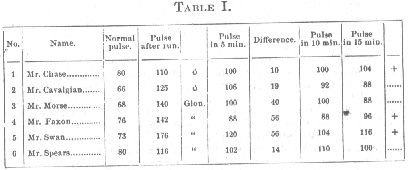
commerce in proportion of 1 to 80.Table I.
Table I.
►
Six provers first ascertained their normal pulse, then excited it by
running at their utmost speed for about five minutes out of doors;
immediately on returning to the room each prover’s pulse was counted by
another person, and at the same time, just as the counting began, four
provers each took a drop of Glonoin in a teaspoonful of water. In five
minutes the pulse of each prover was again counted; the result, as
exhibited by the table, shows the pulse of the two who took no Glonoin
to have been reduced 10 and 14 beats respectively; while the pulse of
the other four who took Glonoin after running was reduced 40, 56, 56,
and 14 beats respectively. So far the result agrees with that obtained
by Dr. Hering. But the experiment shows also, certain undulations of the
pulse. This was counted again ten or fifteen minutes after running. No. 1, who took no Glonoin, shows the pulse
to have risen to 104 beats, after having previously sunk to 100. No. 2, without Glonoin, shows a steady
decline from 125 to 88. No. 3, with
Glonoin, shows a steady decline from 140 to 88. in five and ten minutes.
No. 4, with Glonoin, shows a decline
from 144 to 88 in five and ten minutes, and then a rise to 96 in fifteen
minutes. No. 5 was still more
remarkable in this respect, showing a rapid diminution of pulse, from
176 to 120 in five and to 104 in ten minutes, and then a rise up to 116
in ten minutes. Prover No. 6 showed
a gradual decline. We have then a falling and rising of pulse, after
severe exercise, without Glonoin, but the
falling and rising is much more marked in two out of four provers who
took Glonoin. The next table exhibits the effects of Glonoin
on the pulse of eight provers, without preceding exercise.
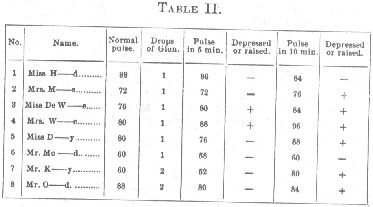
Table II.
Table II.
►
Eight provers, five women and three men after ascertaining their normal
pulse during rest, took 1 or 2 drops of Glonoin, and then counted the
pulse every five minutes; the result was remarkable. The pulse of No. 1 sank from 88 to 86, and then to 84, as
also observed by Dr. Hering. Nos. 2, 3, and 4
showed a rise after five minutes. No. 5
showed first a falling in five minutes, then a rise after ten minutes. No. 6 showed a rapid fall after two minutes,
a rise in five, and a fall again in ten minutes. No. 7, having taken 2 drops, showed a decided
fall in five minutes, and a rise in ten minutes. No. 8, like No. 1,
after two drops, showed a decline both in five and ten minutes. Aside
from the probable homœopathic effect, we see in Table I that in two out
of four instances (Nos. 4 and 5) there is a depression preceding a rise
in the pulse, under the effect of Glonoin given during excitement by
running. And Table II shows four out of eight provers to have
experienced a gradual increase of the pulse, and four others a very
marked decline immediately after the medicine. This
shows clearly in both tables that the primary action of Glonoin may be
depression as well as elevation of the pulse. And we would be justified
in drawing the inference that all other symptoms are liable to exhibit
such a fluctuation, illustrating how in one or in different individuals
the same drug may produce opposite effects, which are not necessarily
primary or secondary.
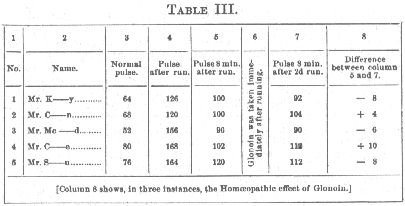
Table III.
Table III
is introduced to show that the
pulse, having subsided after exercise, and having been excited again
soon afterwards by a second effort, will be reduced by Glonoin. This was
the case with three provers out of five. In Nos. 1, 3, and 6 the pulse
was reduced lower in eight minutes after Glonoin than it was without it.
This most probably finds its explanation in Table II, showing that the
primary effect may be both diminished and increased action of the pulse,
according to the individuality of the prover. It will therefore not
always act homœopathically. Supposing, for instance, the prover to be
one whose pulse is primarily depressed by Glonoin, it is then possible
that the prover’s pulse, when increased by running, would not be met by
Glonoin homœopathically, but antipathically; for it may be found higher
eight minutes after glonoin was
taken during arterial excitement, than it was eight minutes after such
excitement without the Glonoin. If
homœopathic, it should have reduced the pulse more quickly than it
would have subsided of its own accord. The instance is illustrated by
Nos. 2 and 4 of Table III. It is to be hoped that the subject will be
established by further experiments.
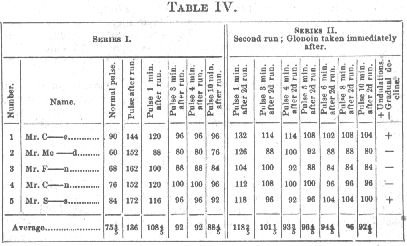
Table IV.
Table IV
shows very similar results,
illustrated by a larger number of counts. The columns of Series I show a
steady decline of the pulse after running without Glonoin; while the
columns of Series II show a decidedly irregular falling and rising of
the pulse, which first diminishes, then increased and finally diminishes
again. This was the case with provers 1, 2, and 5. No. 1 had after excitement and Glonoin a
diminution of pulse, till in eight minutes it rose from 102 to 108, then
fell off again in ten minutes. No. 2,
after a decided fall of pulse to 88 in three minutes, had an increase to
100 in four minutes, then a gradual decline. And No. 5, after having his pulse diminished to
92 in four minutes, had an increase to 96 in five minutes, and 104 in
six and eight minutes, before falling to 100.It Will be observed that prover No. 2, whose pulse was primarily depressed in
Table II, showed considerable fluctuation in Table IV; he is the only
prover who appears in both tables. So far we are able to conclude that
the conditions of a prover may vary at different times, showing
different results from the same experiment. Furthermore, that Glonoin
may raise the pulse at once in some provers, and that it may primarily
diminish it in others before elevating, it during the quiescent
condition of provers (Table II), and that it will affect it in a similar
manner when the pulse has been excited by exercise (Table IV).Though in a fair number of cases Glonoin will
diminish the pulse quicker after its excitement by exercise than it
would diminish without Glonoin, we also learn by Table IV that such
homœopathic diminution does not always occur, but that the pulse may
sink even more slowly under Glonoin than without it, as also shown by
provers 2 and 4 in Table III.Another purely physiological effect is also apparent,
when provers excite the pulse by running a second time in ten or fifteen
minutes. It will then be slower to sink under Glonoin than if only one
effort to excite the pulse had been made, as in Tables I and III.The dose is also a matter of importance. In the above
experiments drop doses of the tincture (1.80) were used, and it was
observed several times that increase of dose caused differences of
results; thus in Table II provers 7 and 8 had 2-drop doses, followed by
rapid primary depression; these were men. Two women (Nos. 1 and 5),
taking only 1 drop, experienced from it the same effect as the men did
from 2 drops.Experiments are yet wanting to determine if higher
attenuations will diminish the pulse quicker and with more certainty
after running than the drop doses of tincture used by the provers above
named, and which failed in Table IV to produce a constant decline, but
tended rather to elevate the pulse.As for Glonoin as a substance, it is one of those
whose active qualities are not latent or difficult to develop. Like its
new relative, Nitrite of amyl, it acts more quickly upon the organism
than most other substances. It is therefore well adapted to proving, and
to illustrate to novices the effects of drugs upon the body, [138].® 2000
Article