American Homeopathy in the World War
by Frederick M. Dearborn, A.B.,
M.D.
Presented
by Sylvain Cazalet
The Battle of Pougues-les-Eaux
A History of U.S. Army
Base Hospital No. 44
– – – – –
Route Step !
Forty-Four was doomed to
another heart-breaking period in its history. Day after day passed and no
word arrived from the “Great Unknown.” Rumors began to circulate
that the Unit had been dropped from the sailing list, and unexpected
difficulties with the property accounts developed. On the fourth of
February Lt. Col. Wilds was transferred to Brest, Lt. Col. Wesselhoeft
becoming the commanding officer of the Unit, and thus was inaugurated a
series of transfers of officers and detachment men to all sections of the
A. E. F. for duty. Dire disaster seemed to threaten, and it looked as
though the organization was to be completely broken up and the members
retained indefinitely in France. The only hope was that orders to go home
might be received, thus checking the process of dissolution.
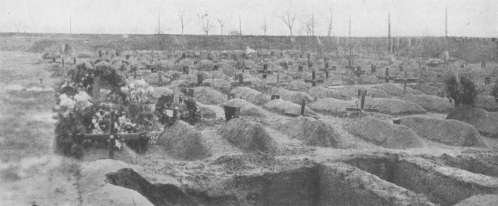
American Cemetery,
Mesves Hospital CenterDeep, dense, dreadful gloom
prevailed as the officers and men were gradually taken away, and an
apparent impasse in the medical property situation developed; and distress
turned to despair when Evacuation Hospital Twenty-Nine, which had taken
over the work of Forty-Four so that it could depart for America left for
Germany on the twenty-second of February. The morale of the Unit utterly
succumbed and was formally buried by the detachment men with appropriate
ceremonies consisting of sad music, a solemn funeral procession and
impressive committal services. The only redeeming feature of this period
of profound depression was that opportunities were given to most of the
officers and men to visit Paris, the battlegrounds, and the leave areas in
eastern and southern France.
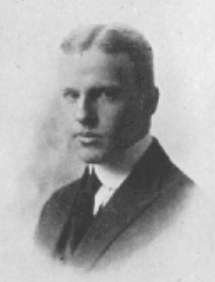
Elmer R. BolinderOn the seventeenth of
February, the death of Elmer R. Bolinder, the second member of the
enlisted personnel to pass away, occurred. Sergeant Bolinder had been
transferred from Fourty-Four a few days prior to his illness, but had not
changed his quarters and was still counted a member of the Unit. He was a
graduate of the Harvard Dental School and had done exceptionally fine work
in the dental department of the hospital. Immediately following his return
from a delightful period spent at the Nice leave area he developed
meningitis and died within three days. Notification that his commission as
First Lieutenant had been granted as a result of examinations successfully
passed, was received on the day before his death. He was buried in the
American cemetery at Mesves on the eighteenth, the entire membership of
the Unit marching to the grave behind the flag-draped casket and
witnessing the military burial. A memorial service was held on the
twenty-third at the Red Cross hut. Sergt. Bolinder will always be
remembered as one of the most faithful, popular, and successful members of
the organization.
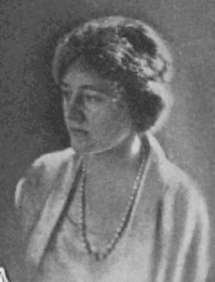
Marion H. PeckAnother especially sad
occurrence at this period was the death of Miss Marion H. Peck on the
seventeenth of February. Miss Peck was a member of the non-enlisted
personnel of Forty-Four and served as dietitian during the period of
activity of the hospital. She had been granted a discharge from the
service to resume her civilian work, and was on her way home when she was
stricken with pneumonia, in Paris, and passed away after a brief illness.The first anniversary of the
mobilization of the enlisted personnel of Base Hospital Forty-Four was
celebrated on the tenth of March. The Red Cross hut was beautifully
decorated and the mess department served a banquet which was the
“last word” in the culinary art. Speechmaking, music, and
original “stunts” by members of the Unit contributed to render
the occasion an unqualified success.The paper work and property
accounts of the organization were finally completed, the proper releases
obtained, and everything was in readiness for the final move. On the
seventeenth of March orders for the Unit to proceed to Brest arrived.
There was an instantaneous resurrection of the erstwhile defunct morale of
the outfit, and everybody worked willingly and industriously at policing,
packing, paper work, and property adjustments. The Unit had at last
reached the end of the long and trying waiting period, and everybody
smiled.
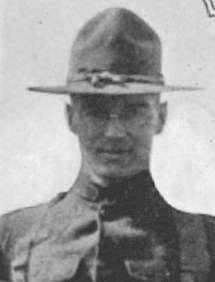
Harold R. BlakeOnly one thing occurred to
modify the happiness of the men at this time, the sudden illness and death
of Harold R. Blake, the third of the enlisted men to make the supreme
sacrifice. Corporal Blake died on the nineteenth of March after a few days
illness with meningitis, and was buried on the twentieth in the American
cemetery at Mesves. He had been a most conscientious, faithful and
valuable worker in the Registrar’s department of the hospital and was
beloved and respected by every member of the Unit.At three o’clock in the
morning of March twentieth a hasty mess was consumed and the “last
things” were done. In company with two other units, Base Hospital
Fifty and Base Hospital Seventy-Two, the Command marched to the Mesves
station and entrained, and at seven thirty o’clock the journey to America
was begun. Cars containing two other hospital units were attached to the
train at Bourges, making a train of thirty-eight coaches.Much might be said about the
discomfort and annoyances of the trip to Brest ; the long delays ; the
filthy cars ; the messing difficulties ; the penetrating cold ; and the
crowded conditions. But ca ne fait rien now, and everybody could be
cheerful; the men were HOMEWARD BOUND!Brest was reached at noon on
the twenty-second, and the beckoning Atlantic with the waiting vessels in
the harbor looked good to the travel worn veterans of Forty-Four. The
march of three and a half miles to Camp Pontanezen was accomplished after
a standup mess on the pier, and the Unit was billeted in Section Five.The two weeks spent in this
demobilization camp were interesting in many ways. Every fifth day the men
were “deloused”; work details were furnished to all parts of the
camp for various duties; entertainment was provided in numerous huts; and
everything was done in a surprisingly systematic manner. The method of
espionage carried out in the camp and the reputed practice of detaining
organizations and individuals not conforming to certain military
standards, kept the members of the Unit up to the highest degree of
efficiency; for the predominant desire in the mind of each was to get home
quickly. Of the thirty-five fair days said to be due in this section
annually, five were enjoyed during the sojourn of Forty-Four, the
remainder of the period being devoted to a succession of clouds, fogs,
mists, and torrential rains.
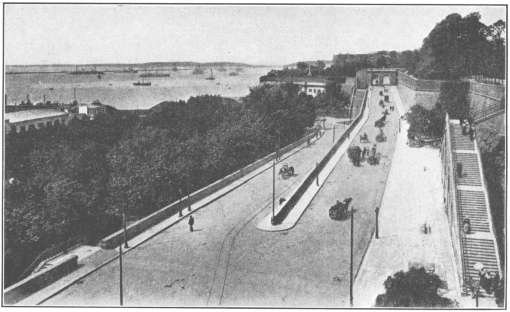
The Stairs and
Roadstead, BrestThe order to bid good-by to
“Sunny France” was forthcoming on the sixth of April, and on the
seventh, nine officers and one hundred and fifty-three men, comprising the
remains of Base Hospital Forty-Four, marched to Pier Five and were
lightened out to the Graf Waldersee, which was boarded at 2:30 o’clock. At
6:30 o’clock the vessel began to move, and as the men watched the receding
French shore, their minds were full of thankfulness that their period of
enforced tenancy of this war-worn section of the earth had ended, and that
they were on the last lap of the long journey to their own
country-“God’s country.”
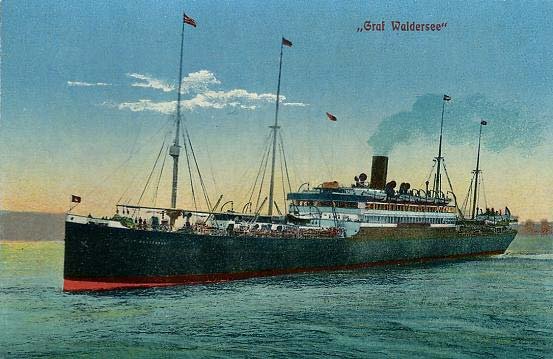
Graf WalderseeThe voyage was not one
continual round of pleasure. The Graf Waldersee was undertaking her first
trip to America since the armistice, and was not in the condition usually
expected of a palatial transatlantic liner. She “made haste
slowly” ; she had been stripped of most of her decorations and
movable equipment before being leased to the United States government; she
was dirty and out of repair; and her facilities for preparing food were
entirely inadequate. But all the discomforts of the voyage were endured
with a commendable degree of fortitude, and the weather conditions were
fortunately generally propitious. Things might have been worse.At five o’clock in the morning
of April twentieth, Easter Sunday, a pilot boat came alongside the vessel
and a pilot climbed aboard; and a little later the Statue of Liberty
loomed out of the morning mists. Cheer upon cheer rose from the soldiers
on the ship, and these were answered by the welcoming shouts of those who
had come down the harbor to greet the returning troops. Bands played
stirring airs, and eager relatives on the harbor crafts recognized their
loved ones among the soldiers on board and gave vent to their emotions by
wild gesticulations, tears, and a bombardment of their heroes with fruit
and candy.
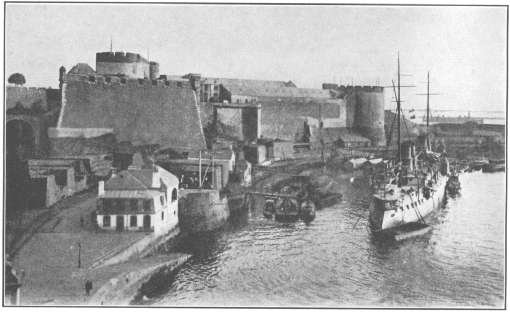
The Chateau, BrestThe Graf Waldersee docked at
10:30 o’clock, and by a strange coincidence, forty-three of the original
Forty-Four nurses, in charge of Capt. Belding, arrived on the Zeppelin and
landed at the same pier at about the same time. A real American mess was
served, the chief features of which were “bot-dogs,” pie and
apples; and the men did justice to these long absent delicacies by
consuming “seconds” liberally.More than nine months had
elapsed since the Unit left New York-months crowded with varied
experiences ; but as the men stepped again upon American soil and looked
about at the familiar sights, everything was forgotten in the supreme joy
of realizing that they were “back home.”
Article