CALCAREA MURIATICA.
Calcium chloride.
Authority.
August Wimmer, M.D., “The Salt-waters of
Kreuznach,” translated by the author, Kreuznach, 1878.I made these experiments first in October, 1876, in a period of three
weeks. In the first seven days, I determined the quantity of the oxidation of my body; I
determined, therefore, daily the weight of my body, farther the weight of the solids and
fluids which I partook of, and the weight of elimination of the urine, of the dejecture, and
by the skin and the lungs; the latter, by comparative calculation of the excretion of urine
and of dejecture with that of the body.Twice a day, in the morning at 8 o’clock and in the evening at 6 o’clock,
the quantity and quality, the reaction and specific weight of the urine were determined and
analyzed, after the well-known methods of “Titrirung,” of Neubauer and Vogel, into
the constituents of urea, uric acid, sulphuric acid, phosphoric acid, and chlorine, with the
utmost carefulness, and with the observance of all precautionary measures.The temperature, the state of the barometer, the direction of the wind,
weather, the state of the health, and the functions of the skin, were at the same time
carefully observed.In the period of seven days following that of the preliminary
examination, I took daily 0.5 gram, and in the seven days following the second period 1 gram
Calcium chloride, dissolved in a glass of spring-water, and I continued the daily
determination of the weight of my body, of the reception and of the elimination, as well as
the analysis of my urine, and observed as much as possible the same relations with regard to
the movements of the body and to the food as during the preliminary examination.Only the determination of solid food was too difficult, and as my mode of
living for many years has been the same daily with regard to the quantity of vegetables,
bread, sugar, etc., I only weighed my daily portion of meat, because meat essentially
influences the secretion of urea and uric acid. The results of the three weeks’ series of
examination were so abundantly convincing that a second series would not then have been
necessary. However preferred making a second one of a longer duration, to guard against the
imputation of a premature judgment. The execution of the same was not possible until April,
1877.I found no reason to deviate from the method followed in the first series
of examination, and preceded it also by a preliminary examination of seven days. In the
first four days I determined the weight of solids and fluids; only later, the daily quantity
of the meat and the fluids. I separated the latter from the fat, and took it partly raw,
chopped, partly slightly cooked. A change was made of the different kinds of meat, beef,
pork, and veal. For the first breakfast I took tea and white bread without butter; for the
second, bread and butter; for dinner, meat, soup, vegetables, and raw or cooked meat, with
only a few potatoes; in the afternoon, a cup of coffee, and in the evening, tea with bread,
butter, and meat.I give in the following the results of the second four weeks’
examination, made in April, 1877, in calculated average amounts, because the statement of
the daily results of examination would take too large a space, and the average amounts are
fully sufficient for judging the matter.I only add that the results of the second series of examinations are
fully indentical in regard to the essential points with those obtained by the first series
of examinations, and that I am fifty-seven years of age.
The taste of Calcium chloride is salt and disagreeably bitter. It caused
no burning, and particularly no disagreeable feeling in the stomach and in the intestines
during the whole examination.The appetite was not increased, but also not lessened. The tongue showed
no change, as also the heart and pulse no difference from their normal state.Only the feeling of thirst began to increase the middle of the III period
of examination, and was necessary to allay it by drinking more water (75 grams per diem).
For the rest the supply of solid food remained the same; it produced also no need for more
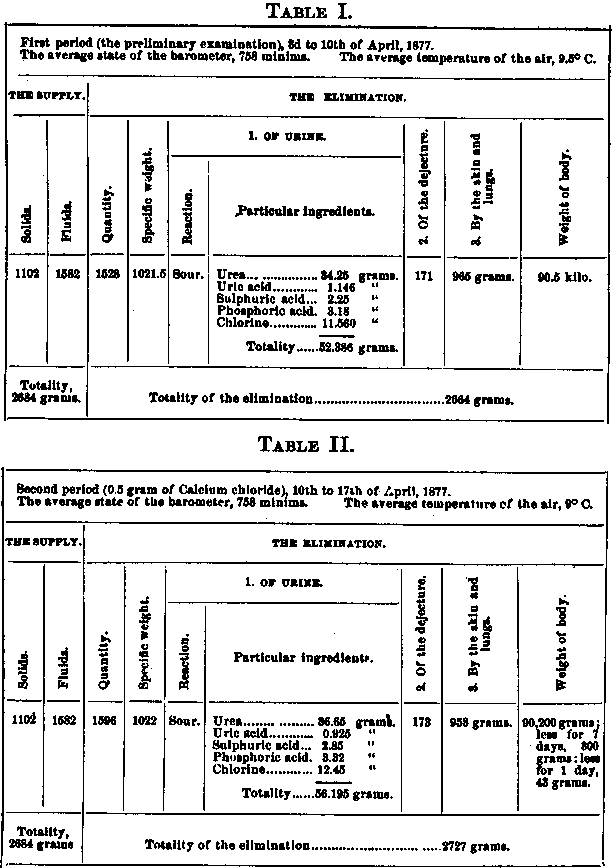
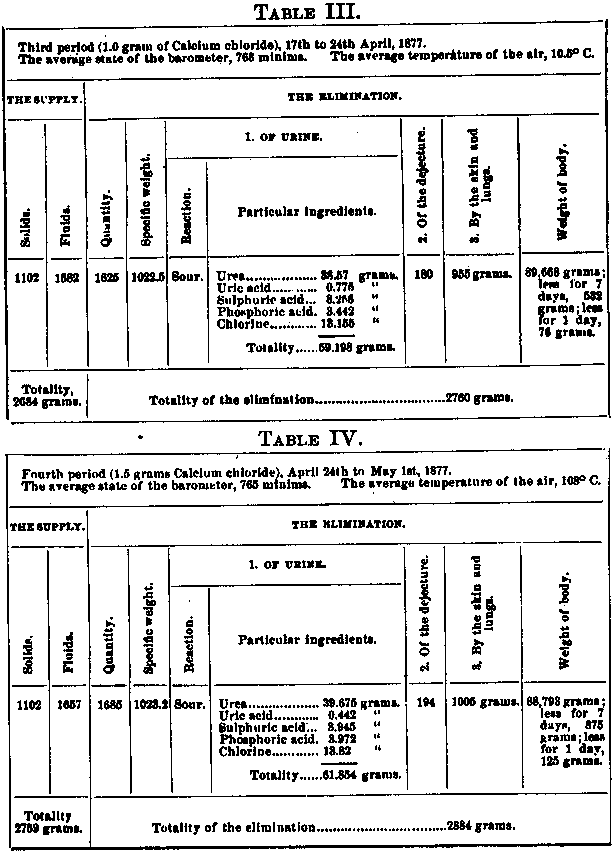
food, but rather and indifference for it.Calcium chloride has a diuretic effect, as the tables show. In the II
period (0.5 gram per diem) the secretion of the urine increased daily to the amount of 68
grams. This effect began first on the fourth day of the II period, and increased in the
following days. In the III period in increased daily to the amount of 29 grams, and in the
IV period, however, by daily increased supply of 75 grams of water, to 60 grams.The dejecture was not changed in regard to the compactness; in the III
period the same increased daily to the amount of 6 grams, and in the IV period of 19 grams,
in comparison with the I period of the preliminary examination. The consistence in the IV
period was more pappy.The discharge through the skin and by the lungs had, in the II period,
hardly changed at all; in the III it on an average daily diminished to the amount of 13
grams; however in the IV period increased daily to 40 grams. This increase is probably to be
attributed to the higher temperature in this period; the activity of the skin was greater
during this period with regard to the secretion of perspiration.Notwithstanding the diuretic effect the Calcium chloride increased also
the solid parts in the urine. The specific weight of the same increased regularly from
1021.5 in the period of the preliminary examination to 1023.2 in the IV period.The quantity of all the solid ingredients of the urine, with the
exception of the uric acid, was increased.The urea gradually increased in the
course of the III period, and was finally secreted, in the IV period, to an average daily
amount of 5.42 grams more than in the I period of the preliminary examination.On the contrary, the uric acid was
regularly less secreted, upon an average daily of 1.146 grams in the I, and 0.442 gram in
the IV period, therefore less 0.704 gram per diem.
Sulphuric acid
and chlorine
offer an almost equal progressive increase: the former in theI period 2.25 grams.
IV period 3.94 grams.
Therefore increase 1.69 grams.
The latter in the
I period 11.56 grams.
IV period 13.82 grams.
Therefore increase 2. 26 grams.
The Phosphoric acid was only a
littler increased in the II and III period; however in the IV, on average daily of 0.79
gram, in comparison with the results in the I period of the preliminary examination. The
regular decrease of the weight of the body corresponds with the increased oxidation. In the
I period it remained nearly the same; in the II period it decreased 43 grams; in the III
period to 76 grams; in the IV period to 125 grams, on an average daily; so that the body had
lost during three weeks 1700 grams (1.7 Kilo.). Also the state of health had changed towards
the middle of the fourth week. A feeling of exhaustion, weakness, and disinclination to work
began to be felt. Although a part of these feeling may be attributed to the spring air, the
steady decrease of the weight of the body and the falling of subcutaneous cellular texture
(paniculus adiposus) were too evident facts.Although it had been my intention to continue the examination for the
fifth week, these feelings hindered me.The process of oxidation was much increased in the II period (0.5 gram
Calcium chloride) and in the III period (1 gram Calcium chloride, and, nevertheless, the
need of food was not increased; however the oxidation in the IV period increased to such an
extent (daily average decrease of the weight of the body 125 grams) that one might have
expected in consequence an increased need of food. Instead of this a certain indifference
for was felt. [2].® 2000
Article