Main
Pioneers
of homeopathy
by Dr Thomas
Lindsey Bradford
Presented by Dr Robert SérorBenoît
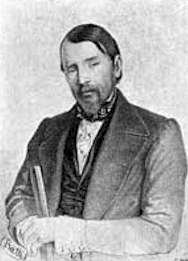
Jules Mure (1809-1858)
Dr. MURE,
Jules, Benoît (1809-1858)The editor of the
British
journal in a review of Dr. Mure’s book gives the following account of this notable
man :Doctrine de l‘ École de Rio de Janeiro et pathogénésies
Brésiliennes. Paris, 1849.This work is the production of Dr.
Mure,
the indefatigable apostle of Homoeopathy, of whom many of our readers may
have heard, though they may not be aware of the immense energy displayed
by this zealous disciple of Hahnemann, in the propagation of the new system.We think it may not be uninteresting to our readers to give a slight
sketch of the labors of Dr.Mure,
as far as we are able from the documents to which we have access.His whole career bears such an air of knight-errantry and romance about
it that it seems something like a fiction, but we have every reason to
believe that all the facts we are about to relate are in the main true,
though perhaps somewhat highly colored by the zeal of the narrators.M.
Mure was a French merchant, well known at Palermo, and having fallen into extreme ill-health (phthisis
pulmonalis is said to have been his malady) he was given over by his
allopathic physicians.Apparently in the last stage of consumption the ”
Organon ” of Hahnemann fell into his hands, which he eagerly perused, and struck
by the new light revealed in this extraordinary work a ray of hope beamed
upon him, and he hastened away from Palermo
to seek that relief from the hands of the homoeopathists which he was
unable to obtain from the adherents of the old school.On his arrival at
Lyon he placed himself under the care of
the venerable Dr. Count
Des Guidi.Such was his miserable condition on leaving
Sicily, his friends scarcely expected he would survive the
fatigues of the sea voyage. Their astonishment was great when they saw him
return in a few months in perfect health. All Palermo flocked around him and begged he would give them
information respecting the system which had produced on him these
marvellous results.He made some cautious experiments with homoeopathic remedies, and with
complete success. Several physicians ofPalermo
were convinced by the proofs they saw of the efficacy of Homoeopathy, and
set about studying it with diligence.Mure was now resolved to consecrate the life that had been saved by
Homoeopathy, to its propagation, and, abandoning his commercial
pursuits, he went toMontpellier to study medicine and obtain the
legal qualifications for practicing as a physician.Having completed his studies and obtained his degree, he began to
devote himself to propagate Homoeopathy.Malta was the first spot he chose for. his operations. He
arrived there in 1836.In the Grand Hall of the Knights of
Provence,
at Valetta, he got up an exhibition of his
cures ; something, we suppose, in the style of those formerly witnessed in
this country, though on a more extensive scale, but not on that account of
less questionable propriety, but Dr. Mure in
his proselytizing ardour was no stickler for professional etiquette.
He succeeded in making converts of some medical men there, particularly
of Drs.Fennich,
Buona-via, and De Claude.The cholera having broken out in the kingdom of
Naples, he crossed over to Palermo in 1837, and on the voyage wrote some
papers on the progress of Homoeopathy and the homoeopathic treatment of
cholera, with Hahnemann’s instructions for the cure of that
disease. These he published on his arrival.
Docteur Benoît Jules Mure (1809-1858)The cholera not appearing in
Sicily,
he went elsewhere to propagate the faith, but was speedily recalled to Palermo by the invasion of the Pest in June, 1837 ;
he did not arrive there, however, until the disease was already in its
decline, after having carried off near a quarter of the population in
forty days.Whilst most of the allopathic physicians had fled from the town during
these fatal days, two ofMure’s
disciples, Drs. De Blasi and Bartoli, remained faithful to their post, and were instrumental
in rescuing a number of persons from the grave.However, the Academy of
Palermo,
which had erased De Blasi’s name from among its members on
account of his heretical opinions, refused to register the cases treated
by the homoeopathists, but the Government, appreciating the excellence of
their treatment, took care to spread a knowledge of the method pursued by
them among the parts of the country still ravaged by the plague.Our hero now set about translating a repertorium from the German, for
the use of theSilician physicians, and established a
pharmacy, where he made all the homoeopathic preparations with his own
hands.He here invented a machine for triturating the medicines, and another
for succussing the dilutions, of which he has given us drawings in theBibl. Hom. de Genève, and also in the work before us.
His plan was to triturate every substance, mineral, vegetable and
animal, up to the third attenuation, and with his succussion machine to
give 300 shakes to each dilution. He undertook to supply every medical man
gratuitously with all the homoeopathic preparations.Not being able to obtain bottles in sufficient quantity, he established
a glass-blowing manufactory, himself instructing the workmen, whereby he
was enabled to supply with pocket pharmacies all the medical men who
applied to him, and who were by no means few in number.During this time he translated, into
Italian,
Jahr’s Manual.In the beginning of
1838 he opened a dispensary at Palermo, and soon afterwards a second in the centre of
the town on a magnificent scale. In less than a year the number of
patients daily seen here amounted to upwards of 200, and above six
physicians were occupied in attending to them.Physicians, students, lawyers, priests, literary men, flocked to this
temple of charity to hear from the patients themselves an account of their
astonishing cures, we are told; and thus this dispensary became the centre
of the propaganda forSicily.
The allopathic physicians, our informant assures us, found themselves
almost deserted by their patients, the apothecaries begged to be allowed
to sell the homoeopathic medicines, and the wards of the great hospital
were almost forsaken.In some public hospitals Homoeopathy was adopted, viz., in the
hospitals ofMorreale, Mistretta, Pietra-perzia, and that of the brothers of
San Giovanni de Dio, their physicians having become
converts to the new system.In a very short time about thirty physicians declared themselves
favourable to the new doctrines, the principal of whom were,Tranchina, De Blasi, De Bartoli,
Morello, Tripi, Calandra, Bandiera, the Marquis Inguagiato, Vasallo,
Lipomi, Cinirella, Aceto, Maglienti, Strina, Selvaggio, Perez, Evola,
Bonelli,, Bataglia, Magri.Under the editorship of De
Blasi
the Annali di la
med.. Omeopatica, a periodical journal for the
propagation of Homoeopathy, was established.A homoeopathic society was formed, which in
1844 was formally recognized by government and converted into
“The Royal
Homoeopathic Academy.”
Courses of lectures on Homoeopathy were delivered.Having thus given the impulse to Homoeopathy in
Sicily, our indefatigable colleague, desiring a new
field for his beneficent conquests, turned his eyes towards Paris, and thinking things were not going on quick
enough there to his liking he resolved. to stir up the energies of his
dormant confreres.Arrived in
Paris in 1839, he immediately set about the foundation of a
Homoeopathic Institute, for the purpose of spreading the system, by
practice, instruction and publications.A dispensary was opened every day for the poor ; courses of lectures
were announced, on clinical Homoeopathy, by Dr.Croserio, on the theory and history of Homoeopathy and on materia
medica, by Dr. Jahr.Two newspapers for the indoctrination of the public were set a-going- a
daily one, theCapitole, and a weekly one, the Nouveau Monde.
A
homoeopathic
pharmacy was established, provided with all Dr. Mure’s ingenious apparatus. A library containing all the
homoeopathic works necessary for the student was formed.The opening of this Institute on the 10 th November,
1839, was rendered peculiarly imposing by the
presence of Hahnemann himself, and a long oration was
pronounced by Dr. Jahr, which is reported in, the Bibl. Hom. de Genève for 1840, where also may be found, numerous particulars
relative to the impulse given to Homoeopathy in France by Dr. Mure, the opposition, he encountered and
the spirit with which he attacked his adversaries.But this restless spirit yearned like
Alexander for new worlds to conquer ; he desired to find some land
where he might be the first to break the ground, and to convey blessings
hitherto unknown to a race of men ignorant of the glorious doctrines of Hahnemann.He determined to cross the ocean and rear the standard of Homoeopathy
in the virgin soil ofSouth
America. Accordingly he
sailed for Rio de
Janeiro, and arrived
there in 1840.The traces of Homoeopathy in the
Brazilian empire were but few before this time. In 1834 a Dr. Maya
had published an article against Homoeopathy.In
1837 a M. Jahn had presented a thesis on Homoeopathy to the Faculty of
Medicine of Rio, in which he related some cases of
homoeopathic treatment, but these were performed with massive doses of
medicines in the crude state, and were not crowned with much success. Dr. Mure himself had before this time sent books and
medicines to Brazil, but no one seems to have taken any
notice of them.Shortly after his arrival in
Rio he
converted a young surgeon of considerable celebrity as a skilful operator,
A. J. Souto de Amaral, who died two years afterwards
without ever abandoning entirely allopathic procedures.He was shortly after his arrival dispatched by the
Brazilian Government to Ste. Catherine, in order to found a phalansterian colony, for our hero
is an ardent Fourierist, and a disciple of Swedenborg to boot.On his journey he treated many patients and spread abroad a knowledge
of the system.At
Sainte Catherine, he made a convert of Dr. T. de Silveira.
We do not know what success his phalansterian scheme met with (heaven
grant it did not prove likeCabet’s Icarie ! ), but at the end of March, 1841, we find him again at Rio,
where he was joined by Dr. Lisboa,
and he soon succeeded in converting a number of allopathic physicians, and
vigorously assailed the old school by his publications and successful
practice.He traveled about from place to place creating wherever he went a
homoeopathic public, whom he left in charge of some medical man, of whom
he had made a convert. His custom, we believe, was, when he arrived in any
new town, to address appeals to the priests, in the name of charity andChristianity, to assist him in the propagation
of the system, and by this means he made numerous converts among the
clergy, whose influence with the laity served to spread a knowledge of
homoeopathy in a very short time, and crowds speedily flocked to his
gratuitous consultations.His resources being speedily exhausted in these disinterested efforts
to spread the cause, he found himself forced to settle down to
remunerative practice, which he did inRio in 1842.
Towards the end of that year, with the assistance of Dr.
Martins and Dr. Lisboa,
he founded the Brazilian Institute, and open the first
dispensary in Rio.In July,
1844, the foundation of homoeopathic
school was laid, and the course of study was opened in January, 1845.
The following is the plan of study :
Preparatory.
Languages
:
Portuguese, French, German, Latin.Sciences
: Geometry.
Geography, Natural History, Chemist Natural, Philosophy, Astronomy.Medical studies.
Anatomy, Physiology, Homoeopathic Doctrine, Pharmacology, Pathogenesy,
Pathology, Hygiene and Prophylaxis, Surgery Operations, Accouchements,
Clinical Homoeopathy, Toxicology, History of Medicine.These studies are distributed over a period of three yew after a
prolonged struggle and numerous difficulties, among which the
incarceration of some of the homoeopaths accused poisoning, accusations of
assassinations, etc., may be mentioned at length, in1846, the Secretary of State for Justice authorise
the school to give certificates of study to prove the capacity of the
students ; and on the 2nd of July, 1847, a
grand assembly was held in order to confer the first certificates.The description of the ceremony in a hall hung with crimson damask and
ornamented with gold and silver flowers and portraits read amazingly fine,
and was doubtless very imposing.The president (Dr.
Mure) made a touching speech, and was
followed by the secretary (Dr. Martins),
then the vice-president and director (Dr. Moreira) announced that he had examined the candidates, and found
them fully entitled to certificates of study, and in virtue of the
imperial ordonnance so and so, the homoeopathic school would now proceed
to grant these certificates.Here upon eight of the members, including the president, each put round
their necks a white ribbon with two knots – the colour indicating the
purity of their motives, the form denoting the orbital human knowledge,
the knots representing religion and science, which bind man toGod and his neighbour, the whole signifying the
inexhaustible mercy of the Deity,
wherein is a refuge from error and falsehood.The profound significance of
Lord Burleigh’s celebrated shake of the head is totally eclipsed by that
of this bit of white ribbon.Ah ! que n’ai je étudié plus tôt pour savoir tout cela?
The director now calls up the candidates and one for all pronounces the
following words, which we cannot resist quoting entire :” Receiving the certificate of study which is conferred on me by
the homoeopathic school of Brazil, I voluntarily make my profession of
faith, and take the oath hereafter to be signed by myself and two
witnesses in double copy, of which I keep one.
“Profession of Faith.
“My hand upon my conscience, [?] and my eyes upturned to heaven, I
embrace Homoeopathy, and declare, after having examined attentively and
impartially the various systems of medicine :1.-That I acknowledge the doctrine of
Hahnemann to be the only true medical doctrine.
“2-I believe all the functions of life to be guided by an
essentially spiritual force, which I express by the words, vital dynamism.“3.-I believe, that as the perturbation of that force constitutes
disease, the only mode of restoring it to its ordinary state, called
health, consists in stimulating– it by agents endowed with the
power of producing in the healthy person symptoms similar to those
manifested by this perturbation termed disease.“4.-I believe that all substances in nature, even those regarded
as the most inert, possess the power of acting on the vital dynamism,
because all contain a spiritual principle which they derive fromGod.
“5.-I believe, that trituration, succussion, and the other
processes designed to separate in an ever increasing degree the molecules
of matter, develop their dynamic properties.“6.-I believe, experimentation with these substances, thus
prepared, made upon men and women in good health, to be the only means of
attaining to a knowledge of their dynamic properties, and of obtaining
efficacious medicaments.“7.-I believe it to be a sacred deity for every man, and
particularly everyChristian, to submit himself to pure
experimentation as far as his health admits of it, remembering that our
divine Redeemer consented to suffer an ignominious
death on the cross to redeem us from sin, and to obtain for us eternal
happiness.” 8.-I adopt the theory of doses taught by
Dr. Mure in Sicily, France and
Brazil, in order to
develop it by my own experience.” 9 -I acknowledge surgery to be the only branch of the old
medical sciences of any real and positive value, and that only for lesions
that require the aid of mechanical means in order that life may be
preserved or improved.”Having repeated this creed, the student puts his name to it in due
form, and all the candidates say :“This is also our profession of faith.”
And now in religious silence all the company arise to hear the oath,
which runs as follows” By our
Saviour
Jesus Christ, who
suffered and died for us, redeeming our sins by his precious blood, and by
virtue of his pains, obtaining for us eternal felicity ; by our divine
Redeemer, whom I ought to imitate as far as human weakness permits,” I swear :
” 1.-To redeem the sufferings of the sick by the preventive
sufferings of pure experimentation, which I shall make myself, or by means
of persons animated by the like charity.” 2.-Not to treat patients but by medicaments whose effects have
been well proved, which are in the domain of pure Homoeopathy, as I have
acknowledged and declared in my profession of faith.” 3.-To observe strictly the precepts of the gospel in the
exercise of my duties, regarding as sacred objects the secrets of
families, virtue, the modesty of women, and the indigence of the poor.“4.-To propagate the knowledge of the principles of pure
Homoeopathy by all lawful means in my power.” 5.-To profit as much as possible by the propagation of the
principles of Homoeopathy, and by the advantages of its application, in
order to make them serve to diffuseChristianity, to further Christian instruction and the civilization of the Indians,’ and to require of Pagans, idolators and other infidels their conversion to the
faith before initiating them into a knowledge of the principles of
Homoeopathy.” And this I swear in the name of the
Father, of the Son,
and of the Holy Ghost”To this is affixed the name of the candidate and of his two wit nesses.
And all the other candidates say, “And this we swear.”The spokesman then proceeds :
” I promise on my honor,
” 1.-To make upon myself one pure trial annually.
” 2.-To communicate faithfully to the direction of the
Homoeopathic Institute ofBrazil
the result of these trials.” 3.-To give at least once a week gratuitous advice to the poor in
a dispensary of the Institute, or in one of its affiliated associations,
furnishing at my own expense the necessary medicines.”Here he signs his name ; and all the candidates say, “We promise
this.”The president then pronounces the following benediction :
” In the name of
Hahnemann, discoverer of Homoeopathy, from whom I have received the
mission and the power, and with the assistance of my coadjutors, the
disciples of that messenger from heaven, I now declare you fit to exercise
the new art, acknowledge you as my colleagues, and as professors of pure
Homoeopathy.”The ceremony concluded by the candidates receiving a triple embrace,
whilst the band of the Imperial marines struck up the “Hymn of
Homoeopathy.”The secretary then attempted to make a speech, but broke down, or as he
expresses it :” Emotion and satisfaction extinguished his voice and obscured his
ideas.”Fortunately the marines came to his aid, and to the tune of the
Brazilian-” God Save the King ” or Emperor, the
meeting was dissolved.This august ceremony was repeated last year, and it is hoped the
occasion for it may be perennial. (Brit. Jour. Hom., vol. 7, p. 530.)
Numérisation,
vérification, mise en page,