Sommaire
PHOTOTHÈQUE
HOMÉOPATHIQUE
présentée par Homeopathyforce.com
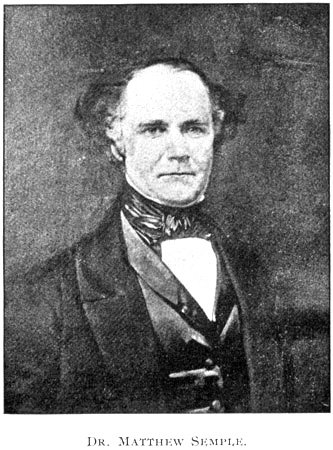
Dr Matthew
SEMPLE (1813-1867)
Photo collection Sylvain Cazalet.
SEMPLE, MATTHEW. Was born
in Philadelphia, May 21, 1813. Being brought up in a wholesale drug store in
Philadelphia, and entering at an early date the Philadelphia College of
Pharmacy, it was but natural that he should have chosen chemistry and
pharmacology for his specialty in his youth he possessed a laboratory of his
own, crude though it was, and with the aid of old bottles and blow pipes he
constructed rude retorts and performed experiments in chemistry.
He commenced the study of
medicine in 1830 and graduated from the University of Pennsylvania in 1838.
Shortly afterwards he began the practice of medicine. He was led to
investigate Homœopathy through reading a pamphlet on the great success of
this school in the French hospitals. His pupilage in Homœopathy was under
the guidance of Dr. Jacob Jeanes. Continuing his studies for some time on
this subject, he was about to drop it entirely from his mind as a visionary
thing, when an incident in his practice led him to give it more careful
attention. A little scarlet fever patient, whose life he had made every
effort to save, seemed to be almost a hopeless case. He decided as a last
resort to try the efficacy of a homœopathic remedy. To his surprise and
delight, excellent results ensued and the patient made a perfect recovery.
He was induced to assist
in founding our College and to accept the chair of Chemistry and Toxicology
by his. personal friend, Dr. Jacob Jeanes. Having become identified with the
new College as a member of its Faculty his desire for its welfare knew no
bounds. At that time the College was struggling for the money necessary to
support it. Professor Semple’s enthusiasm was so great that he not only gave
his services as an instructor, but was also so great that he generously
contributed several thousands of dollars to aid in maintaining the
institution.
As a teacher he was
markedly successful, being greatly loved by his students.
It was largely through his
help and council that the Homœopathic College in New York was founded, and
he became a member of its Faculty.
So great was his faith in
the practical value of Homœopathy that through his efforts the Faculty of
the Homœopathic College proffered their services to the Board of Guardians
at Shockley, in 1859, asking one year’s trial to openly, publicly, and
fairly test the merits of the respective schools of medicine. They offered
to take charge of that hospital for one year, to maintain it free from all
cost to the city for that length of time-to give their full, careful and
faithful attention to all patients of that institution, and to furnish all
medicines at their own expense, thus saving from ten to fifteen thousand
dollars to the public purse. Dr. Semple him-self assumed the financial
responsibility that would be incurred in making this generous offer. The
offer of the Faculty was not accepted.
He was the first Professor
of Chemistry and Toxicology in this Institution, filling the chair from 1848
to 1858, and again from 1859 to 1863, and for three years, 1860 to 1863, was
Dean of its Faculty.
At the opening exercises
of the session of 1895-’96 Dr. Joseph C. Guernsey, on behalf of the family
of Dr. Semple, presented to the College a beautiful portrait, in oil, of the
late Professor Semple. (This portrait now hangs in Alumni Hall.)
He was a firm believer in
the higher education of women. For several years he filled the chair of
Chemistry and Toxicology in the Woman’s Medical College of this city.
Dr. Semple died in
Philadelphia, after a very short illness, of congestion of the brain, with
effusion and paralytic manifestations, on May 17, 1867.
Source (photo & biographie)
: HISTORY OF
The Homœopathic Medical College of Pennsylvania ;
The Hahnemann Medical College and Hospital of Philadelphia.
BY THOMAS LINDSLEY BRADFORD, M. D.,
Sommaire