Sommaire
PHOTOTHÈQUE
HOMÉOPATHIQUE
présentée par Homeopathyforce.com
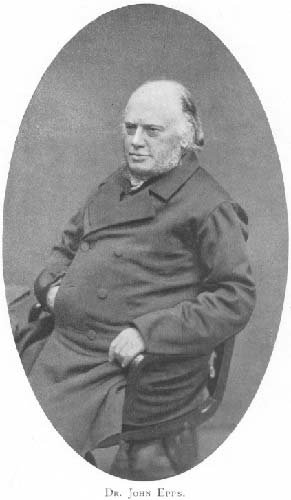
Dr John
EPPS (1805-1869)
Source : “The life of Peter Stuart” – Courtesy
of Francis Treuherz
Dr John Epps
(1805-1869). Epps was medical director of the Royal Jennerian and London
Vaccination Institution. He also published ‘Evidences of Christianity
deduced from Phrenology’.

Source : “The life of Peter Stuart” –
Courtesy of Francis Treuherz
DR.
JOHN EPPS, 1805-1869 was a political, religious and medical radical, who
was loosely associated with Quin, and more closely with Curie, Dunsford,
Highly, the co-founders of the radical and breakaway English Homeopathic
Association.
DR. JOHN EPPS; from
the The Monthly Homeopathic, Obituary: The death of this well-known
physician and active politician has caused a widely spread feeling of
regret. One of the earliest members of the profession in this country to
avow his faith in Homoeopathy, a clever lecturer, an popular writer
thereon, and extensively engaged in its practice, Dr. Epps was one of
the best-known man of our body. Dr. John Epps was the son of an active
reformer of a past generation, John Epps, of Seven Oaks, Kent. Dr. Epps,
inherited much of the energy and public spirit of his father, and
scarcely any important public movement for the advancement of
commercial, political or religious freedom has, during the last forty
years, been inaugurated without receiving his sympathy and aid. His love
of religious equality brought him early in life into active co-operation
with the eminent reformers of his day in procuring Catholic
emancipation, and the repeal of the Test Acts, in resistance to church-
rates and the relief of Nonconformists. A disciple of Major Cartwright,
he associated himself with Francis Place, W. J. Fox, Burdett, and
the men of 1833 in the council of the political unions in London, in
agitating for the Reform Bill. He was an active member of the
Anticorn-law League, and with Campbell, Lord Dudley Stuart, Mazzini, and
others, joined organizations in favor of the Polish, Italian, Hungarian,
and American nationalities. He was educated at Mill Hill, and articled
to Dr. Drury. At eighteen he went to Edinburgh, where he graduated,
taking his degree at twenty-one years of age. Before this time he had
published “A New Way of Teaching English Grammar” and other
works. Immediately on taking his degree he came to London and commenced
practice, lecturing also to medical students on the Materia Medica, etc.
Many of the leading men of the present day were his pupils. He now
published ” An Introduction to Botany” intended as a textbook
for his students. He had, before leaving Edinburgh, embraced the views
of Gall and Spurzheim on the Science of Mind, and fought the battles of
phrenology before the medical bodies of the times. He now published :
“Evidences of Christianity Deduced from Phrenology,”
“Horae Phrenologica,” and lectured both in London and in some
of the most important provincial towns on this favorite science. In 1831
he became Medical Director of the Royal Jennerian and London Vaccine
Institution, an institution which up to his death he supported. He was
for some time co-editor of the London Medical and Surgical Journal, and
for a long period conducted The Anthropological Magazine, and The
Journal of Health and Disease. He was one of the first practitioners of
Homoeopathy in this country. Attracted by a work written by Dr. Curie,
and afterwards struck by the noble head of Hahnemann, he made such
earnest and thorough study of the subject as led to his entire
renunciation, at once and forever, of old-system practice. Whatever he
took up he took up with his whole heart and strength, from a deep
conviction of its truth, and it was eminently so in regard to
Homoeopathy. He ever steadily adhered to the doctrines of Hahnemann,
whose works, up to within a week or two of his death, were his daily
study. Every night he took a volume of these works upstairs with him,
under his arm. The beautiful character of this great Master, no less
than the glorious truths brought to light by him, secured this
affectionate and firm devotion. Henceforward he, by all means in his
power, and at much sacrifice, sought to spread what he regarded as the
truth in medical science. He lectured frequently on Homeopathy, both in
London and other large towns; and to medical students, on the
Homoeopathic Materia Medica, both at the hospital and when his health
failed, at his own house. He published, “What is
Homoeopathy?”, “Homoeopathy and its Principles
Explained,” and other works on the subject. His works on
“Constipation,” “Consumption”,” Epilepsy”,
“Affections of the Head”, etc., are well known. “Notes of
a New Truth,” has been for some years past edited and chiefly
supported by him. From a youth he was a Liberal, both in politics and
religion. Ever taking tip the cause of the oppressed and suffering, very
early he turned his attention to the question of slavery, which was ever
among those subjects dearest to him. He was prominently distinguished by
his love of truth and justice. Truth he must pursue at any cost.
Everyone who knew him remarked and valued his child like and unaffected
simplicity of character. He had warm and strong affections, and a
tenderness which was extended to the lowest-created beings. He could not
bear that the life even of an insect should be taken. He was in many
cases “a father to the fatherless.” By his patients generally
he was much beloved, and most of them became his personal friends. He
had no mean jealousy or envy, and was severe only against systems; all
that was oppressive, cruel and mischievous he hated, but man he loved.
He died February 12th, in his sixty-fourth year, from an attack of
paralysis, aggravated by acute asthma, from cold. He had long suffered
from asthma, and paralysis supervening, terminated his laborious and
useful life. He was interred at Kensal Green, February 10th, 1869.
Sommaire