THE
HISTORY OF THE LONDON HOMOEOPATHIC HOSPITAL
Presented by Peter Morrell & Sylvain Cazalet
PREFACE
by Peter Morrell
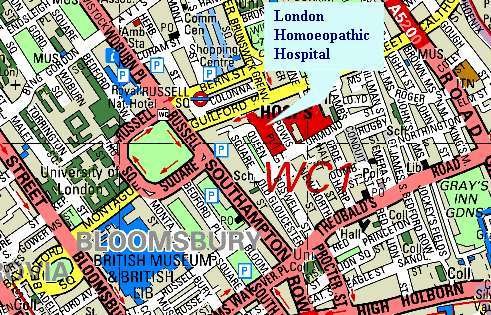
The London Homeopathic Hospital was founded on Oct 10, 1849 by Dr. Quin
for the free treatment of the capital’s sick poor. It opened its doors to patients on
Hahnemann’s birthday 10 April 1850. The hospital has been rebuilt and extended several
times from the original building. This book contains a lot of information about the hospital
up to the year 1914. It was compiled by Dr. Richard Epps, a member of that great ‘homeopathic
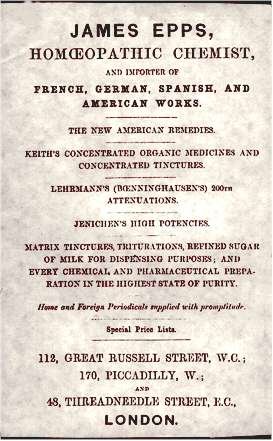
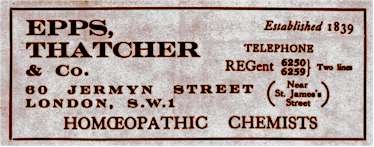
family’ of Epps’s, based in the London area with their homeopathic pharmacies in
Threadneedle Street, in the City and at 60 Jermyn Street, St. James’s, London, SW1. ‘Epps Thatcher’ pharmacies were first established in 1839,
but had all gone by 1962 [see London Telephone Directory, 1962]. The first of the
line was Dr. John Epps:
“Darwin…was not alone in extending the ethical net from
oppressed men to the forlorn brutes. The Quaker doctor John Epps – London phrenologist,
homeopathist, and disestablishment campaigner – had ‘come to consider all creatures as
being equally important in the scale of creation as myself; to regard the poor Indian
slave as my brother.’ (Epps, Diary, p.61)…’the whole creation travaileth and
groaneth’. This was Epps’s reading of St. Paul. He was adamant that ‘animals enjoy mind
– and with it personality, desires and pain’ (Epps, Elements, p.118).” [Desmond
& Moore, Darwin, 1991, p.238]
Dr. Epps ‘was of short stature and sturdy frame, and had a beaming,
self-confident expression. He was regarded by many of the working-classes as a prophet
in medicine…he impressed many people with…his great earnestness…and his evident
desire to benefit his fellow creatures. He had a great command of words, a fine sonorous
voice, and an animated manner. His philanthropic efforts and personal acts of kindness
were numberless.’ [Concise Dictionary of National Biography, Oxford, p.800]
He was also ‘an ardent champion of liberal causes at home and of
oppressed nationalities abroad.‘ [Charles Wheeler, Epps Obituary, BHJ 2, p525-7,
1912,]. Which is I suppose a very polite way of saying he was also well-connected with many
other rebels of the day. These include Guiseppe Garibaldi (1807-82), the Italian patriot;
Lajos Kossuth (1802-94), the Hungarian revolutionary who stayed in London for a time in the
1850’s where he ‘was received with respect and sympathy’ [Chambers Biographical
Dictionary, 1989, p.839]; and Guiseppe Mazzini (1805-72), another important Italian
patriot who ‘found refuge in London in 1837’ [ibid., p995]. No doubt at Dr. Epps’s
house!
His nephew, Dr. Washington Epps [1848-1912] was of similar disposition:
‘…at his residence in Wellgarth Road, Hampstead, there passed away
as gently as he had lived, Washington Epps, the last medical representative of a family
intimately associated with the rise and progress of homeopathy in the UK. He was the
youngest son of Dr. George Napoleon Epps, and nephew of Dr. John Epps, of Dr. Richard
Epps, and of Mr. James Epps, the
homeopathic chemist, all of whom were intimately concerned, in the early days of
homeopathy, in its being brought, by means of lectures and pamphlets, within the purview
of the intelligent laity all over the kingdom.’ [from Wheeler’s BHJ Obituary, 1912,
p.525]
Dr. Epps was at the London Homeopathic Hospital in the early days and
during its rebuilding and extension. In a very busy life, numerous items flowed from his
pen, including 14 articles in the journals and a sound homeopathic text on skin conditions: Skin
Diseases Treated Homeopathically and ‘now in its fourth edition’ [Wheeler,
BHJ 1912, p.526]. Wheeler says he was ‘of strikingly handsome personal appearance…and
very much beloved by all his patients.’ Upon his cremation on Thursday 17 October 1912,
at Golders Green, nearly all the medical and surgical staff of the London Homeopathic
Hospital were present.
The central importance of the London Hospital can be gauged from the fact
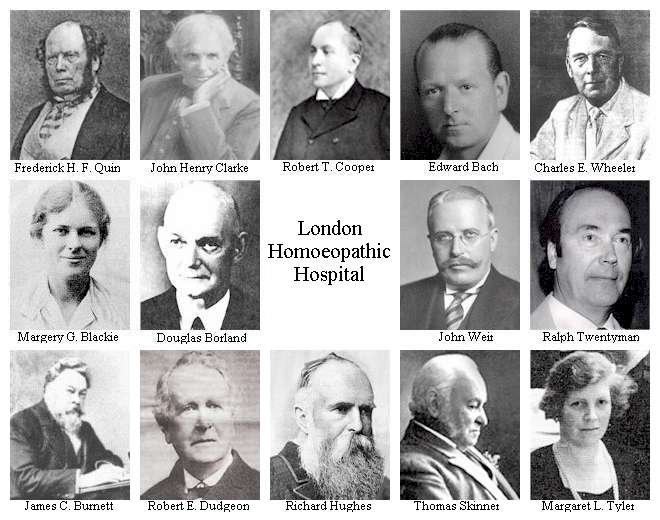
that almost all the famous UK doctors worked there at some time during their career. Figures
like Clarke, Cooper, Bach, Wheeler, Blackie, Borland, Tyler,
Weir, Twentyman, Quinton, Burnett, Hughes, Dudgeon, Skinner all worked at
the London hospital. We owe the existence of the hospital to the pioneering work of Dr. Quin
(1799-1878).
In order to read and make the most of this book it is helpful as
contextual material to see it against a backcloth of how homeopathy progressed in Britain
after its initial introduction in 1828 by Dr. Quin.
Dr. Quin
The two main aspects of Dr. Quin were that he
established UK homeopathy, in which he did an excellent job; he also involved himself in
the vigorous debate about medical licensing and legislation. Factors which dominated the
1850s.
At that time, unqualified and under-qualified sectarians were
numerically rampant throughout UK medicine, and thus something had to be done to try and
regulate this situation. Quin was actively involved in that and believed that properly
medically qualified doctors were the only people suitable to practice medicine. He thus
came to occupy a strange position, and at times what must have been a very uncomfortable
one. For instance, on the one hand he was a highly respected and medically qualified
aristocrat and friend of the fashionable and powerful, and on the other, he was the leader
of a deviant medical sect, which he had introduced into Britain and which was challenging
orthodoxy throughout the entire century. There is innately considerable friction,
therefore, between these two positions and he must have acutely felt, on many occasions,
the painful dilemma of divided loyalties.
Quin is also important as the founder of a movement within this
country. During a time of great social and political turbulence, the 1830s, he
successfully established homeopathy for the rich and fashionable as a viable alternative
to heroic regular practice. He gave an air of legitimacy to homeopathy when all the time
it was derisorily dismissed, within medicine, as yet another species of quackery. He was a
most skillful player in defending homeopathy, its right to exist and its right to an equal
treatment alongside allopathy.
He established, virtually single-handedly, the legal status of
homeopathy and prevented it from being outlawed. Primarily, I suppose, he was the single
person who rendered homeopathy as an alternative system of healing, a medical minority
which was begrudgingly tolerated by regular medicine. He managed to convince the more
open-minded of his profession that it was slightly more scientific than pure quackery and
that it was conducted by decent gentlemen, who honestly believed in its therapeutic
efficacy. In that sense he established a semi-legitimate heretical system of medicine. A
great tension resides again here, it being at the same time both ‘legitimate’ and ‘heretical’.
That duality makes him such a fascinating figure. The paradox of the man and of the early
movement is that it is hard to imagine how he could have successfully been both at the
same time and in equal measure. Yet somehow, he seemed to manage it.
The other main features of the early movement can be briefly listed as:
the continual ideological battles with orthodoxy; the battle for medical licensing and
legislation leading up to the Medical Act of 1858; and the way homeopathy very firmly
rooted itself into an extensive and mutually-cohesive social nexus of influential figures
in the political, social, aristocratic and religious movements of the day. The exact
nature and composition of that nexus has still been largely unexplored.
Reforms
Medical sectarianism dominated the 1840s and 50s.
The importation of medical fads like phrenology, hydropathy, Galvanism, spiritualism,
medical botany and Mesmerism all contrived to create a dangerously eclectic age, during
which everything was tried and nothing was ruled out. Until the 1858 Medical Act, ‘healers’
of every description freely peddled a staggering range of methods, for clients drawn from
every class. After 1858 that range steeply declined along with the numbers of unqualified
healers in the medical marketplace, even though the Medical Act did not specifically
outlaw them.
By mid century British homeopathy mostly became the preserve of the
rich and powerful. As we mentioned previously, homeopathy had become tolerated as a
semi-legitimised medical approach containing a deep but innate tension between its
internal orthodoxy as ‘medically qualified men’ and the fact of it being practised as
an heretical system of therapeutics which was rejected and deviantised by the mainstream.
By the latter half of the 19th century, it is clear that British homeopathy had peaked and
was occupying a comfortable though minor niche within the medical world. As we have seen,
it was continually patronised by Royals, the fashionable, clerics and aristocrats, who in
fact were its main supporters throughout Europe.
In the 1850-1890 period, homeopathy also had a fairly important ‘reforming
impact’ upon regular medicine, inspiring it to reduce its doses and reduce the
complexity of drugs in use. Forcing it also to reconsider its use of the more barbaric
heroic practices like bloodletting, use of calomel and emetics. Though deeply unpopular
with the public in their own right, repeated reminders by medical sectarians of the
harmfulness of these techniques (not to mention their therapeutic inefficacy) must have
gradually eroded their popularity and forced regular physicians to conceive ‘an impulse
for change’. And it was this impulse which ultimately translated into a move away from
heroic practices and towards less damaging therapeutic methods by the century’s end.
Homeopathy was not responsible for all of that, but certainly contributed to the process.
There was also considerable ideological damage caused to allopathy in
the 1850s by the backfiring of its own critique of homeopathic efficacy based upon ‘trusting
in nature’ and ‘self-limiting diseases’. Briefly, this meant that leaving the
disease to heal itself not only explained away the ‘efficacy’ of the small doses of
homeopathy, but also tended to undermine any underpinning justification for the dangerous
heroic practices of the regulars. That led to considerable ideological discomfort within
regular medicine, forcing it to reconsider both its philosophy and its methods.
1900
Several patterns and trends can be described for
the movement after 1900. The grim facts of decline were everywhere apparent for all to see
and in the early decades of this century, all homeopaths must have been keenly aware of
the problem and what, if anything, they could do about it. In many ways it derived from
their initial allegiance to a clientele composed almost entirely of aristocrats, who by
then were themselves going into slow decline (see David Cannadine, The Decline and Fall of
the British Aristocracy, Routledge, London, 1996). Thus homeopathy’s fate very much
shadowed theirs. The option of gaining wider publicity for homeopathy at grassroots level
never seems even to have been considered and discussed let alone acted upon. Without a
steady and loyal base of clients to fall back on, any enterprise is doomed to wither.
British homeopathy has seen only three great flowerings. First in the
1840s and 50s, an exciting age of unregulated medical eclecticism; the 1930s, during which
once again anything could happen and probably did; the current era since the mid-1980s.
These are the ages of alternative medicine in the UK. Each age has tended to be followed
by periods of stagnation, decline and tighter legal regulation. What the future holds is
hard to say. There are more homeopaths in Britain today than at any time in the past.
I hope this brief survey gives the reader a useful background against
which the contents of this fascinating book can be viewed and understood.
Peter Morrell
Stoke-on-Trent, UK, May 1999
* * * * *