

by Peter Morrell

ROYALTY
‘…homeopathy…retained an elite clientele, including members of the
royal family.’ [Sharma, 1992, p.185]‘…homeopathy still had much support from people in high places in the
mid-nineteenth century…’ [Sharma, 1992, p.183]
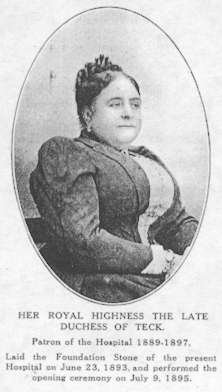
The Duchess of TeckThe British Royals are very closely related
to the German Royals, all of whom used homeopathy. There is some anecdote about one of the
German Kings who came to Queen Victoria’s Coronation in 1837 and was taken ill due to
overindulgence [a Nux vomica case, no doubt]. The whole entourage had to rush back to
the continent to get some homeopathic treatment. Soon after that the British Royals all
became firm adherents of Hahnemann’s new system.The Queen’s father George VI was a very
firm convert to homeopathy, as was his father before him. So it goes back a long way. Queen
Victoria herself did not use homeopathy at all, though many of her relatives did. Sir John
Weir, was apparently homeopathic doctor to 6 monarchs: King of Norway, King Edward the VII,
George V, Edward VIII, George VI and Queen Elizabeth II [see Anon, 1984, pp.158-9].All the European Royals were intimately
related and interbred and all very taken with homeopathy. This includes the royal families
of Belgium, Netherlands, Denmark, Sweden, Norway, Austria, Portugal, Spain, Greece, Germany,
England and Russia.The Royals throughout Europe were heavily
taken with homeopathy. Why was this? The most obvious reason was that it worked, and it was
gentle, painless and non-harmful compared to the alternatives on offer at the time , like
leaches, strong drugging and debilitating purgatives.Second reason is that it simply became
fashionable and that is hard to explain. It is a very difficult thing to define, quantify or
analyse. So the British Royals received homeopathy chiefly through the German Royals, who
were all very taken with homeopathy. The current British Royals [House of Windsor] were very
largely derived from the House of Saxe-Coburg-Gotha in Saxony, where all their Kings used
homeopathy from the time it first came on the scene in the early 1800s via Hahnemann and his
direct disciples. Queen Victoria was married to a German, Prince Albert, also of the
Saxe-Coburg-Gotha tribe. The Belgian Royals derive from the same lineage and our Dr Quin
became a doctor for Prince Leopold and Princess Adelaide before he became King of the
Belgians.
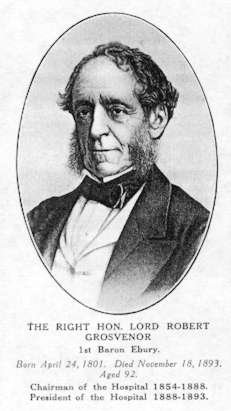
Lord Robert GrovenorThe UK Royals were heavily interbred with
the Russian and German Royals mainly, though also to a lesser extent with those of
Scandinavia and Spain, Portugal, Greece. Victoria’s huge family married into all these other
royal families and reinforced the previous links still further.What is the possible value that royal
patronage confers upon homeopathy? This is a complex question and has a long history. For
example, the Ainsworth’s Homeopathic pharmacy has all three Royal Warrants, Queen Mother,
Prince of Wales and the Queen as Royal Chemists. That shows that in the commercial world, a
royal warrant is a high-status thing to receive. Just like Tate & Lyle suppliers of the
royal sugar.Royals are undoubtedly aware of the impact
any of their interests may have on the public mind, but to what extent they bother about it
or cultivate it is very hard to determine with any certainty. Nelson’s, one of the oldest
homeopathic pharmacies in fashionable Duke St, London [est. 1860] was always the Chemists
Royal until c.1978. Yet it never had all three Royal Charters, only that of the Queen and/or
Prince of Wales intermittently, never together. John Ainsworth was their Chief Pharmacist
until he set up Ainsworth’s c.1978.If we now look at why Royals like
homeopathy then we can outline various reasons. Royals might be attracted to homeopathy
because it is rather nebulous, rather exclusive, rather special, ‘divine’ and private in the
way they probably think they are. It is also a rare, elite and minority treatment reserved
for the rich and clerics: traditionally that has been the case. It panders to their
arrogance and vanity perhaps, as it stresses the delicate, the subtle, the refined and
eternal like they probably feel they are. Those are probably the main reasons. I would mark
out the exclusivity and the rarefied and vitalistic or divine nature of homeopathy as being
especially important reasons in this list.Another theme is that homeopathy is
essentially organic and connects with all life, living forms, plants and insects, which to
rural-obsessives as Royals often were/are, is another chord of resonance between them.Homeopathy also very soon became a
tradition amongst the aristocrats and Royals and they love nothing more than their
traditions. Whatever their father or mother did, they also do. This theme of slavish
following of tradition is deeply typical of their approach to life in general. So once
something has ‘got into their veins’ as a darned good thing, then they tend to keep it and
lavish upon it an amazing amount of devotion and loyalty. I suspect that private schools in
UK use Arnica and Calendula in their sick rooms for precisely the same
reasons: it is a tradition of the aristocrats.Homeopathy also pandered to royal and
aristocratic squeamishness and horror of leaching and purging, at a time when only they had
the money to ‘try something different’. No surprise there really, we would all recoil from
that approach I suspect.is also true that the Royals are Christians and that may be linked
to homeopathy in subtle ways. Certainly homeopathy was very popular with clerics, especially
in the last century. Most if not all the homeopathic dispensaries [for the poor] were headed
by a board of governors composed mainly of clerics and bankers and a few titled persons and
minor aristocrats. That is the overwhelming pattern. And there were 70+ homeopathic
dispensaries in UK by their peak in the 1860-70 period.There are clear and repeated links between
the royal families of Belgium, Holland, Austria, Rumania, Spain, Portugal, Denmark, Norway,
Yugoslavia, Sweden, Russia, England, Greece and Germany. Many excellent examples of these
inter-connections can be summoned, especially from Queen Victoria’s large family.
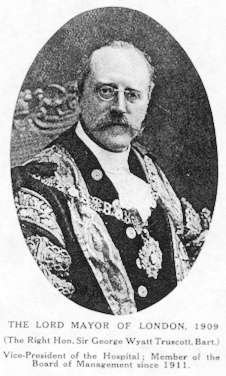
Sir George Wyatt TruscottMuch of the early expansion of
homeopathy only became possible through rich patrons. Quin himself was a son of the Duchess
of Devonshire [c.1765-1824] and was thus an aristocrat. When he began to practise homeopathy
in London, he mainly treated members of his own class , other members of the nobility. This
was very common at that time as poor people could not afford treatment from doctors and
tended to use the services of amateur herbalists and apothecaries for their medical needs.As in mainland Europe, homeopathy soon
attracted many followers amongst the upper classes, including Royalty, and many of these
turned into stoutly loyal rich patrons of the emerging homeopathic hospitals and
dispensaries. This considerably ‘smoothed the passage’ of the new therapy in the UK,
conferring upon it a gloss of legitimacy, even making it appear fashionable. A sample of
quotations taken from a wide range can be adduced to testify to this phenomenon:
‘[Hahnemann eventually settled in Paris…he won over a large and often
fashionable clientele and captured a significant fraction of the medical profession across
Europe and America…’ [Porter, p.391]‘The practice Samuel and Melanie Hahnemann established in the heart of
Paris soon became fashionable. The wealthy people of the city and, indeed, of Europe
generally, were more than ready to try a new medicine… they were predominantly members of
the French and British upper and professional classes: nobles, clergy, military officers,
doctors.. the British were among the earliest visitors: Lord Elgin…Lady Kinnaird
represented Scottish aristocracy…Dr Quin…Baron Rothschild…Viscount Beugnot… countess
Musard…Lord Capel…Lady Belfast and Lady Drummond, the Duchess of Melford…’ [Handley,
1997, pp.20-22]‘Homeopathy was especially successful among the more wealthy and
educated classes in the United States, in contrast to other irregular systems…’ [Blake,
p.85]‘Homeopathy…appealed primarily to those urban middle and upper class
persons who were seeking an alternative to regular medicine…homeopathy was extremely
fashionable among the European nobility and upper classes, whose tastes were often copied by
affluent Americans.’ [Rothstein, p.160]
‘Homeopathy rapidly became extremely popular among the wealthy in many
communities throughout the country…’ [Rothstein, p.234]

Sir Henry Tyler
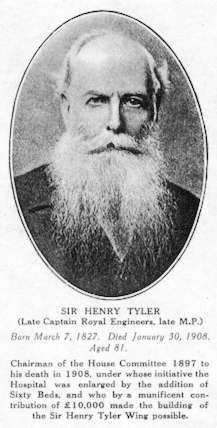
Sir Henry Tyler [1827-1908] was one such
rich patron. He personally contributed huge sums of money for the expansion of the London
Homeopathic Hospital and his daughter Margaret [1857-1943] became an influential homeopathic
doctor in London.
“When her father, the late Sir Henry Tyler, gave the Tyler Wing
to the London Homeopathic Hospital, he told her “I have done my part: now you must
do yours.” [Dr Margaret Tyler: An Appreciation” Sir John Weir, in
“Homeopathy” 1943]
Other patrons include HRH Princess
Adelaide, the Duchess of Teck [c.1880-c.1940] and the Lord Mayor of London Sir George
Wyatt Truscott [c.1860-c.1940]. There were dozens of these rich patrons of homeopathy
throughout Britain at the turn of the century. It spread like wild fire through the ruling
classes. Little wonder then that it became called the ‘rich-man’s therapy’. Other examples
of rich patrons include the Duchess of Hamilton and Brandon [c.1865-c.1940], Lord Cawdor
[1870-1914], Lord Robert Grosvenor [1801-1893], the Earl of Wemyss and March [1857-1937]
and the Earl of Donoughmore [1875-1944].
There seems always to have been a lot of
Royals, aristocrats, clergy and military men, baronets and rich titled people involved in
or supporters of homeopathy. The reasons are complex.