

by Peter Morrell
BASIC CONCEPTS
1.PROVINGS
“Undeterred by the magnitude of the task, Hahnemann set about
creating a materia medica which should embody the facts of drug action upon the
healthy.” [Close, 1924, p.147]Prior to Hahnemann, knowledge of the
specific and general effects of medicinal compounds on health was very poorly understood,
and was often based on the shape, colour, taste and texture of the material, before they
were actually used medicinally. This was often referred to as the “doctrine of
correspondences” [or “doctrine of signatures”]: a system which assumed that
the Almighty had inscribed in the plants of the earth secret signs and features whereby
their medicinal virtues could be ascertained by Man. Examples include yellow flowering
plants for liver complaints, red and peppery herbs for fevers and haemorrhages, etc.
“Lily of the valley…is under the dominion of mercury, and
therefore strengthens the brain, recruits a weak memory and makes it strong again.”
[Culpeper, 1652, p.149]Yet Convallaria [Lily of the Valley]
has very few brain or ‘mercurial’ symptoms at all [see also recent proving of Convallaria,
Konig and Santos-Konig, 1997], and is mainly used for heart conditions [ruled by Leo?].
Drugs at that time were mainly used on the basis of speculation and guesswork.
“The evidence of the homeopathic provings and of the efficacy of the
similimum selected from the specific symptoms totality demonstrates the fact that for every
possibility of personality as well as organismic pattern, hence for every possibility of
illness pattern there is also a substance pattern ‘out there’ which minutely duplicates
it.” [Whitmont, 1980, pp.9-10]Most of the Herbal Materia Medica was,
therefore, compiled by trial and error, and was, in many cases, pure guesswork. Herbs were
used on the basis of tradition, a semi-mythical method, stretching back in time before
recorded history. This was the case in nearly all cultures on earth.
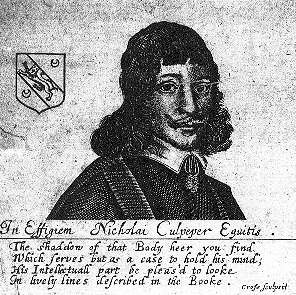
Culpeper NicholasFor centuries the medicinal qualities of a
drug were decided by astrological considerations, such as reference to planetary rulers. For
example, fruits, nuts and other nutritious or sweet-scented plants were deemed to be ruled
by Venus; reddish and peppery plants by Mars; yellow or orange plants by Jupiter; dark,
poisonous and bitter herbs were ruled by Saturn; silvery, white and watery [succulent]
plants came under the Moon’s rulership [see Culpeper].
“Paracelsus was also a firm believer in the doctrine of
signatures, and in illustration of it explained every single part of St. John’s Wort
[Hypericum perforatum] in terms of this belief “…the holes in the leaves mean that
this herb helps all inner and outer orifices of the skin…the blooms rot in the form of
blood, a sign that it is good for wounds and should be used where flesh has to be
treated.” [Griggs, 1981, p.50]Hahnemann was totally dissatisfied with
this approach and with the whole materia medica of his day, which he regarded as a mess.
“From the earliest beginnings until now, the materia medica has
consisted only of false suppositions and fancies, which is as good as no materia medica at
all.” [The Organon, v.110]“The…virtues of medicines cannot be apprehended by…smell,
taste, or appearance…or from chemical analysis, or by treating disease with one or more
of them in a mixture…” [The Organon, v110]“If one has tested a considerable number of simple medicines on
healthy people in this way… then one has for the first time a true materia medica: a
collection of the authentic, pure, reliable effects of simple medicinal substances in
themselves; a natural pharmacopoeia…” [The Organon, v143]


Dr K. Franz
Yet a surprising number of herbal ‘guesses’
were apparently confirmed by the provings. Examples include Chelidonium [Yellow
Poppy] for liver complaints, Euphrasia [Eyebright] for eye complaints and Pulmonaria
[Lungwort] for bronchitis. Presumably these properties were originally discovered from
their clinical use rather than from ‘signatures’. Other examples can be found in [Dudgeon,
1853, pp. 20-23].
Hahnemann conducted the first proving on
himself in 1790 [Dudgeon, 1853, p.176] with Cinchona [Peruvian Bark] and this was
followed in quick succession by many more and increasingly included his co-workers. These
co-workers were fellow doctors and members of Hahnemann’s and their families. Hahnemann is
said to have proved 99 drugs in all [Griggs, 1981, p.178], including, for example, Valerian,
proved by Hahnemann, Stapf and Franz [Blackie, 1979, p.203].

Dr Constantine Hering
Dr. Constantine Hering [1800-1880], is said
to have personally proved 72 drugs [Treuherz, 1984, p.139], including Tellurium in
1850 [Blackie, 1979, p.78], Hamamelis in 1848 [Blackie, 1979, p.214] and Glonoin
in 1848 [Tyler, 1943, p.391]. Hale proved Gelsemium in the 1870s, Drysdale proved
Pyrogen in 1875 [Tyler, 1943, p.688], Gundlach proved Sanicula in 1893 [Tyler,
1943, p.732], Raeside reproved Colchicum in 1965 [Blackie, 1979, p.170] and the
American Institute Of Homeopathy reproved Sepia in 1874 [Tyler, 1943, p.749]. Many
drugs have been reproved since the last century.
Later, many of the homeopathic drugs were
adopted by the allopaths and used far more frequently, e.g. Belladonna, Chamomilla &
Arnica. Many of the American herbs, derived from Amerindian medicine and used in the
Eclectic School, were proved and adopted by homeopaths; e.g. Ipecacuanha, Caulophyllum
[Blue Cohosh], Rhus toxicodendron [Poison Ivy], Euphorbia [Spurge]. Many were
later to find their allopathic uses; eg.Ipecacuanha and Lobelia inflata in
cough mixtures. These drugs were originally used in the Eclectic school of US medicine. For
a detailed account of this aspect see the two essays by Coulter [Coulter, 1972; see also
Nicholls, 1988, p.171; and Rothstein, 217-229].

Dr J. Stapf
Animal poisons were also investigated and
introduced into the materia medica via provings. Examples include Latrodectus mactans
[Black Widow spider venom], Lachesis [Bushmaster snake venom], Crotalus horridus [Rattle
Snake venom], Apis mellifica [Honey Bee sting] and Tarentula hispanica
[Tarantula spider venom]. For more recent similar material see M S Bonnet, Toxicology of
the Brown Recluse Spider, NEJH 7.1, Spring 1998, and also Brown Recluse Spider
Proving, by Lou Klein, NEJH 7.2, Winter 1998. Since the early 1990s, new provings have
greatly gathered pace and seem set to flood the materia medica with new remedies.
‘Hahnemann definitely rejected [the law of signatures]…in his
Materia Medica Pura we read under Chelidonium…’the ancients imagined that the yellow
colour of the juice of this plant was an indication (signature) of its utility in bilious
diseases…the importance of human health does not admit of any such uncertain directions
for the of medicines. It would be criminal frivolity to rest contented with such guesswork
at the bedside of the sick.’’ [Hahnemann quoted in Hobhouse, 1933, pp.137-8]
Thus, much like a modern scientist,
Hahnemann demanded more precise knowledge of the properties of individual drugs than any
of his compatriots. He wanted drugs to be used singly, not in mixtures, and for medicine
to be based on an empirical understanding of individual drug action, based on giving small
daily doses of a drug to healthy people, who would record the symptoms they experienced.
In this way a proving produces a ‘clean image’ of a remedy’s symptomatology, called the
Drug Picture; i.e. a mild form of poisoning, the precise symptoms of which are unique for
any one drug.
It is regarded as a ‘clean image’ because
on giving the drug to a healthy volunteer, its action could be observed without the
unreliable and misleading variations in symptom information that would inevitably come
from giving it to an ill person. This is a very important point, as it shows that
Hahnemann by no means trusted the clinical and empirical usefulness of a drug’s action as
a reliable and consistent source of information. It shows that he was aware that the
symptoms a person manifests at any one time are partly due to their illness and partly due
to the drugs they are given. He wanted one set of information but not jumbled up or
‘tainted’ in any way with the other. It is also an indication of his ‘scientific’ view
that the image of the drug and the image of an illness, though they can overlap in a
person, remain essentially separate images.
To homeopaths of a more metaphysical
stamp, the proving symptoms also reveal the ‘formative force’ or ‘secret essence’ of the
remedy substance. The key symptoms therefore represent, the profoundest expression of the
substance as an ‘innate force’ in the universe. Prior to provings and potentisation,
this information was only available in the symbolic/allegorical language form of myths,
dreams and meditative thought [Gutman, 1978, p.20-35; see also Norland, 1982; F X King,
1989; Whitmont, 1980 and 1994].
“He instituted “provings” of drugs upon himself, members
of his family, friends, students and fellow practitioners, keeping all under the most
rigid scrutiny and control, and carefully recording every fact and the conditions under
which it was elicited. This work continued for many years, parts of it being published
from time to time, until the mass of material reached enormous proportions.” [Close,
1924, p.147-8]
Hahnemann clearly regarded the technique
of provings as his most unique, important and valuable contribution to medical science:
“In the last three thousand five hundred years, not one single
physician, to my knowledge…has come upon this so natural, so absolutely necessary, so
uniquely valid proving of the pure, characteristic action of medicines…”
[Hahnemann, 1810, v.108]
“There is no other possible way of correctly ascertaining the
characteristic action of medicines on human health, no single surer, more natural way,
than administering individual medicines experimentally to healthy people in moderate
doses…” [Hahnemann, 1810, v108]
Hahnemann found some of the symptoms of the
provings to be the same as occur in accidental cases of poisonings. Examples include the
terrible cramping pains of Cuprum and the purging of Arsenicum. For this
reason, Hahnemann included in his Materia Medica not only the symptoms of provings, but also
those derived from accidental poisonings. He felt this gave a more complete picture of a
drug’s effects upon health. This was a matter of combining in the final drug-picture both
the gross effects of material doses with the more subtle effects of minute doses.

Dr Richard Hughes
Later homeopaths were also to include
clinical symptoms, that had been cured by the remedy. This also led to a serious ideological
debate over which, clinical symptoms or proving symptoms, are most valid as a basis for
homeopathic prescribing. The two polarised camps included the materialist homeopath Dr.
Richard Hughes [1836-1902] in England and the more metaphysical Dr. James Tyler Kent
[1849-1916] in the USA. Kent referred to Dr. Hughes as “that skunk I shall fight to
the end of my days.” which illustrates the emotional aspect of the controversy. As
we shall see later, it was Kent who eventually won this fight.
“…I found from the toxicological reports of earlier writers that
the effects of large quantities of noxious substances ingested by healthy people…largely
coincided with my own findings from experiments with those substances on myself or other
healthy people.” [Hahnemann, 1810, v.110]
Hahnemann claimed to have found case
histories and cures from many ancient cultures based upon the law of similars [Organon,
v110]. And he claimed from these historical studies that the poisonous effects of a drug
clearly point to its potential therapeutic properties. In other words, toxic and therapeutic
effects are frequently dose-dependent. This was the vital clue which initiated his research
into potentisation. It seemed to confirm the law of similars as a ‘resonance’ which exists
between the toxic and the therapeutic action of a drug. Toxicity and therapeuticity he
regarded as opposite poles of the same phenomenon.
Hahnemann also asserted primary and
secondary actions to a drug; rather like ‘action and reaction’ they are often opposed to one
another. For example, in the case of Opium its first effect is drowsiness and then
secondly sleeplessness; Cannabis indica gives firstly euphoria followed later by
depression of spirits; alcohol stimulates and then depresses the system. He even conceived
of the curative influence of a homeopathic drug and the homeopathic aggravation along
similar lines, ascribing the toxic and aggravatory effects to the primary action of the drug
and the therapeutic response being due to the secondary action of the drug combined with the
response of the body’s vital force.
Hahnemann conducted the first proving on
himself in 1790 with Cinchona [Peruvian Bark]:
‘Hahnemann having, by his simple and rational experiment with Cinchona
bark in 1790, conclusively established the great therapeutic law, that to cure diseases
medicines must be used which possess the power of exciting similar diseases, at once
perceived that the whole edifice of the old Materia Medica must be rebuilt from the very
foundation, as that Materia Medica furnished nothing positive regarding the [true]
pathogenetic actions of drugs.’ [Dudgeon, 1853, p.176]
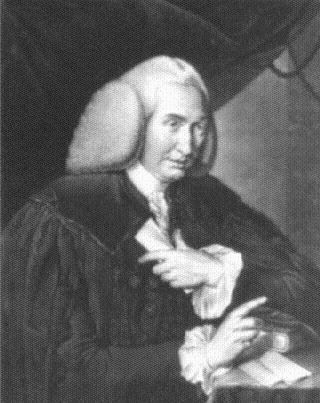
Dr William Cullen
Disagreeing with Cullen about the action of
Cinchona upon the stomach, Hahnemann resolved to take a little of the powdered bark
himself as an experiment to observe its effects more closely. To his astonishment he began
to manifest symptoms broadly similar to malaria itself. Symptoms which increased as he
repeated the dose, and which subsided once he discontinued the doses. This first proving was
followed in quick succession by many more and increasingly included his co-workers. He noted
down the mental and physical effects of drugs in increasing detail. For modern examples, see
Meinden, 1997, pp.37-38; L Klein, Helodrilus Proving, 1999, pp.36-38; Klein Proving
of Dinosaur Bone, 1999, pp.10-13.

Dr Donald McFarlan
Many provings and reprovings have been
conducted since Hahnemann’s time, and they are still conducted today, e.g. Julian [1979],
McFarlan [1947, 1956, 1962], Stephenson [1957], Gutman [1956, 1957, 1961], Raeside [1960,
1961], Sherr [1985]. Sherr [1985] Chocolate, Salmon egg [Sherr, 1996], Hydrogen,
Granite, Stonehenge, Sol, Scorpion, etc. See for example, J. Sherr, NEJH, 2.2, Spring
1993, Hydrogen.
The information Hahnemann gleaned about the
first Cinchona bark proving he described in his Essay On A New Principle
[1796], and the material from his further provings were compiled first into his Fragmenta
de viribus medicamentorum positivis [1805] and later into his Materia Medica Pura
[1811] [Organon, v.109a]. From studying these drug pictures, Hahnemann was able to
indicate the most appropriate drugs for many illnesses.
The drugs proved in the early days included
many important herbal drugs [e.g. Aconite, Belladonna, Digitalis, Hamamelis,
Arnica] and some from other continents that appeared to show peculiar or important
therapeutic properties, such as might suit them for certain conditions. Hahnemann also
introduced completely new remedies into medicine such as Silica, Natrum mur and Lycopodium.
Leaning heavily, as some might suggest, upon the pioneering work of Paracelsus, he proved
and introduced many minerals, metals and acids into the materia medica such as Silica,
Calcarea carbonica, Sulphur, Acidum nitricum, Aurum, Cuprum and Argentum, Kali
Bichromicum, etc. These substances were generally regarded as medicinally inert before
the provings of Hahnemann. He also greatly improved the medical knowledge and usefulness of
several conventional drugs [through proving them] such as Carbo vegetabilis, Mercury,
Arsenic and Sulphur.
In conclusion we might point out that
Hahnemann was not entirely setting out on uncharted territory, as there had been a few
ancient investigations of a similar type.
‘Among the ancients it is only in the school of the Empiricists that we
find experiments undertaken for the purpose of ascertaining the pathogenetic effects of
drugs and poisons…Attalos Philomenter, King of Pergamos, tested the antidotal powers of
Aconite, Hyoscyamus, Veratrum and Hemlock, etc. But it was chiefly the poetical physician
Nicander of Colophon…to whom we are indebted for an account of the action of various
poisons…it is remarkable, however, that these poetical records…have been pretty
closely copied…even to the most absurd errors…and very little else of a positive
character is to be met with in the records of ancient medicine.’ [Dudgeon, 1853,
pp.190-91]
As Dudgeon then goes on to point out, there
were a few more recent attempts. He mentions Dr William Alexander of Edinburgh who undertook
some near-fatal experiments of self-poisoning with Camphor,
‘…but this excited very little attention, and had it not been for
Hahnemann, who raised them up from oblivion, they would probably have remained altogether
unknown.’ [ibid, p.191].
Which makes Hahnemann’s experiments even
more remarkable and original.
