
GENDER
IN HOMEOPATHY
by Peter Morrell
bowl of cherries, 1990 – Peter Morrell
Paper presented to the Conference on The History of Unconventional Medicine, Univ
Linköping, Sweden, 10-12 Sept 1998
Outline History Of Homeopathy In Britain
Homeopathy was introduced into the UK by Dr F H F Quin (1799-1878) in the 1830’s.
Quin was of aristocrat birth, probably the illegitimate son of the Duchess of Devonshire.
After graduating MD in 1820 in Edinburgh, Dr Quin then became the Duchess’s family physician
and travelled with her entourage. He met Hahnemann, and travelled extensively in Europe,
residing for a time in Rome and Naples. He successfully used Camphor against Cholera in
Moravia (Czechoslovakia) and cured himself of the condition on Hahnemann’s advice (Bradford,
Cook, Hobhouse, Haehl). During the 1830’s and 40’s he was often in Paris among the inner
circle of Hahnemann’s protégés. He was a lifelong asthmatic, which was eased by
homeopathic treatment.
He introduced homeopathy into the very highest levels of English society: to Dukes,
Counts, Lords, minor Royals and Baronets [Leary, 1998, pp.252-3]. That was the world he was
at ease with and in which he had moved since birth. As a young man he was a very popular
socialite and wit on the fashionable London circuit, a great friend of Charles Dickens
(1812-1870), William Thackeray (1811-1863) and the Royal portraitist, Sir Edwin Landseer
(1802-1873), amongst many others, and no society party, or social gathering, it was said,
was complete without him. By nature of a very pleasing disposition, he was a man of great
personal charm (Leary, 1998, p.252). He was also latterly one of the regular dining partners
of Edward, Prince of Wales (1841-1910), the future King Edward VII (Leary, 1998, p.252-3).
Quin concentrated exclusively on introducing homeopathy amongst medically qualified
doctors and their predominantly upper-class clientele (Inglis, p.85). This level of high
society support for homeopathy, generated by Quin’s efforts, worked enormously to its
advantage, smoothed its passage and greatly assisted its easy acceptance into the British
medical marketplace. The fact that many of the German relatives of the British Royal family
were also devoted patrons of homeopathy, including Queen Adelaide (1792-1849), wife of King
William IV (1765-1837), also assisted its rapid social acceptance in Britain (Morrell, 1995;
Leary, p.252-3). Rich patrons of homeopathy (eg. the first Marquess of Anglesey, Sir Henry
William Paget (1768-1854), companion at Waterloo of the Duke of Wellington (1769-1852) not
only formed its client-base, but also funded and numerically dominated the committees which
ran the many homeopathic hospitals and dispensaries of the last century. Leading figures of
this period include Drs William Bayes (c1820-c1890), Robert Dudgeon (1820-1904) and Richard
Hughes (1836-1902) (Morrell, 1995).
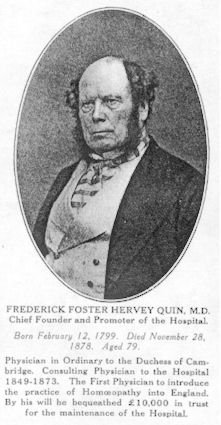
Frederick Hervey Foster QUIN (1799-1878)
Quin established the British Homeopathic Society (BHS) in 1843, a London hospital in
1850 and the British Journal of Homeopathy (BJH) in 1844. The BHS became the Faculty of
Homeopathy in 1944, while the BJH became the BHJ in 1911. The Faculty is the training and
controlling body of medical homeopathy in the UK and also trains many homeopaths from
abroad, especially many from India. Through his many influential contacts in the world of
politics (eg. Lord Ebury, 1801-93), Quin was able to obtain an amendment to the 1858 Medical
Act, withholding a recommendation about the type of medicine approved in Britain (Leary,
1998, p.253; Nicholls, pp.144-5; Inglis, p.80). As a result of this skillful manouevre,
homeopathy was indirectly tolerated without challenge and thus never censured by Parliament
as an unacceptable or deviant mode of medical practice.
‘Dr Quin was able to obtain an amendment to the Medical Registration Bill; a clause
was added enabling the Privy Council to withdraw the right to award degrees from any
university that tried to impose the type of medicine practised by its graduates.’ [Inglis,
p.80]
The rather draconian 1858 Act established for the first time the professional status
and legal regulation of formally qualified medical practitioners, as distinct from quacks,
and still regulates the practice of medicine in the UK today. The law was specifically
designed to outlaw quackery, which was rife at that time, by establishing a Register of
approved practitioners. Initially these guidelines were interpreted very strictly, confining
those on the Register only to holders of UK medical degrees, licences and diplomas. Even the
holders of Continental medical degrees and diplomas were excluded from the Medical Register,
for fear of encouraging deviant forms of medical practice in Britain, ie. quackery. In more
recent times these rules were relaxed, even allowing American medical graduates the right to
practice, whose degrees had previously been scorned as worthless pieces of paper. All
foreign graduates must still apply directly to the General Medical Council to be granted
permission to practise medicine in Britain.
There were attempts by some more radical homeopaths in the 1840’s, comprising some
medically qualified and some laypersons, who formed a breakaway but shortlived English
Homeopathic Association, to popularise homeopathy amongst the lower classes in Britain, but
in the nineteenth century these efforts were eclipsed by its continued dominance by the
medically qualified and their wealthy clientele (Nicholls, 1988). Quin distanced himself
entirely from the radical homeopaths and the other medical sectarians in general, regarding
them all as thoroughly disreputable amateurs (Nicholls, pp.110-14).
As a result of its continued domination by the medically qualified and by
upper-class patronage (Nicholls, pp.114-16 & p.135), British homeopathy could never
really shake off its aristocratic gloss, and thus it never established itself at a popular
level amongst the lower classes, which was in marked contrast to the other sects, all of
which enjoyed a good deal of mass, working-class support. It was always regarded, therefore,
as the ‘rich man’s therapy’, and the exclusive preserve of the wealthy, privileged and
titled. While this allegiance with the upper classes had undoubtedly worked to the benefit
of UK homeopathy in its early days, later on it became a great burden, especially when it
sank into decline after the 1880’s. The aristocratic link meant that British homeopathy
tended to be very largely confined to fashionable spa towns (eg. Buxton, Harrogate, Bath),
to wealthy seaside resorts (eg. Eastbourne, Bognor Regis) and to London and southern England
in general, unlike Botanic medicine, which was popular in northern, industrial cities. It
thus never established itself at working-class level.
The continued lack of popularity of homeopathy caused some homeopathic doctors to
despair for its future in Britain. As a result of these fears, a small minority of
homeopathic doctors (eg. Dr J H Clarke, 1853- 1931) broke away from the BHS, began to teach
some laypersons the rudiments of homeopathy and to publish books (eg. Clarke’s ‘The
Prescriber’) directly aimed at the self-taught lay practitioner and home-prescriber. Dr
Clarke certainly taught three laypersons: Canon Roland Upcher (1849-1929), J Ellis Barker
(1869-1948), and Noel Puddephatt (1899-c1971), who had all been his former patients. All
three became practitioners to some extent, the two latter also becoming influential teachers
of homeopathy in their own right (Morrell, 1995).
As a result of these developments, a new tradition of lay homeopathy was established
in Britain. While the number of homeopathic doctors went first into decline and then into
stagnation, the lay movement of the 1920’s and 30’s, by contrast, enjoyed great popularity,
extending well into the 40’s and 50’s. There were approaching 300 homeopathic doctors at its
peak in the 1870’s, but only 170 or so between 1900 and 1970 (Nicholls, pp.134-5; pp.215-6;
Blackie, p.34; Inglis, p.81).
Through stark recognition of the grim facts of decline (Nicholls, 1998), several
notable attempts were made to resuscitate British homeopathy, as its fortunes began to
collapse after 1890 (see Nicholls, p.215 & pp.218-19). For example, the re-establishment
of the British Homeopathic Association (BHA) in 1902, to obtain more funds to train doctors;
the setting up of the Missionary School of Medicine in 1903, to train Christian missionaries
in the elements of homeopathy and surgery; also the sending of young UK homeopathic doctors
to Chicago to train with Dr Kent in 1908-13, under the Sir Henry Tyler Scholarship. Yet all
these efforts failed to revive interest in the therapy amongst UK clinicians, or to elevate
the numbers of homeopathic doctors, which continued to fall, and homeopathy thus remained a
stagnant backwater until the late 1970’s (Nicholls, pp.215-16 & pp.134-5).
In the 1930’s a diverse range of assorted lay therapists (mostly homeopaths,
herbalists, vegetarians, antivivisectionists, bonesetters, diet therapists, hydrotherapists)
became active, including probably 500+lay homeopaths. Most towns at that time had a
herbalist and a homeopath. Leaders in the 60’s and 70’s include Phyllis
Speight (born c1920), John Da Monte (1916-75) and Thomas Maughan (1901-76)
(see Morrell, 1995).
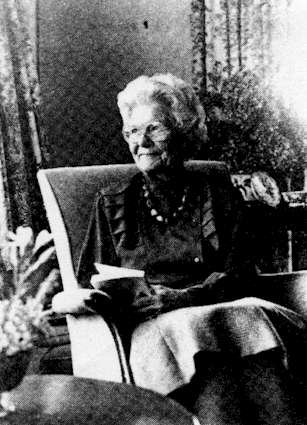
Phyllis SPEIGHT
Suddenly, in 1978, a group of lay practitioners established their own Society of
Homeopaths, a Register, College, Journal and Code of Ethics, inadvertently imitating the
medical professionalisation process of the 1850’s. These had all been students of Thomas Maughan and John
Da Monte, and included Elizabeth Danciger, Misha Norland, Peter Chappell,
Robert Davidson, Martin Miles and Sarah Richardson.

Thomas Maughan (1901-76)

John Da Monte (1916-75)
This activity led to a very rapid expansion of homeopathy in the UK, and more
Colleges became quickly established during the 1980’s and 1990’s, such that there are now
more than 20, including 1 in Wales, 2 in Scotland and a dozen in London and the south of
England. The lay movement is now a semi-legitimised profession with its own mode of
registration, unified teaching syllabuses, training procedures and self-regulation. It sits
on the brink of full legal recognition. There are approximately 1000 registered homeopaths
working in the UK at present with probably the same number of licensed and unregistered
homeopaths, and around 1000 medical doctors who practise some form of homeopathy. Many of
these practitioners only practise on a part-time basis, and thus these numbers are slightly
misleading. The movement is expanding at roughly 8-9% per year. There are thus two strands
of the current movement — the medically qualified, and the lay practitioners. The latter
dislike the pejorative title ‘lay homeopath’, preferring to be referred to as ‘professional
homeopaths’.
In this Paper we shall consider data drawn from both the medically qualified and the
‘professional’ homeopaths in the current UK scene, as well as data from overseas.
GENDER IN CURRENT UK HOMEOPATHY
This Paper presents some data on gender in homeopathy. The data shows the number of
male and female practitioners and students in the colleges. Also presented is data from
Registers and lists of homeopaths from a range of sources, showing their composition by
gender. Some data also comes from outside the UK — USA, Germany, Canada, Switzerland,
Malaysia, New Zealand and Australia. Much of the data is for professional homeopaths, but
some other data for MD homeopaths is also presented and is most interesting for comparison.
Also presented is an analysis by gender, of articles, letters and book reviews
published in a leading homeopathic journal, ‘The Homeopath’, based in the UK. Gender data is
also given relating to the literature of the subject. Finally, a series of ideas and
statements, from primary sources, is presented, which attempts to explain the clear female
dominance of the movement. These ideas relate chiefly to the psychology of gender, the
socio-economics of gender and also to certain aspects of homeopathic case- taking. The Paper
ends with a series of summaries of the key issues, plus a short discussion. This is an
interim Paper of work still in progress, and it is hoped it will stimulate discussion.
‘There are only two things wrong with men: everything they say and everything they
do!’ [Anonymous, post-card, Stoke-on-Trent, UK]
This interim Paper of some work in progress presents and discusses two aspects of
gender in current homeopathy: gender within the movement and gender in the literature. This
study combines the semi- quantitative methods of the influential American Sociologists
Robert K Merton and Harriet Zuckerman, with the more straightforward reportage reminiscent
of an anthropological approach.
It is frequently stated within homeopathic literature that the taking down of the
patient’s symptoms in a truly holistic fashion, is the only approved method of using
homeopathy. Indeed, several leading homeopaths over the years have written tracts quite
specifically on how to do it and how not to do it. Many also suppose that women are more
empathic and intuitive and thus, in the view of some, much better equipped to do this than
men. We shall return to this theme.
Here I will attempt first, to be a ‘passive mirror’ for certain data which is
presented; second, to gather, present and summarise certain numerical data about gender,
containing clear patterns; third, to present and summarise certain interpretations of such
data made by others.
In 1988 50.63% (40 out of 79) of the Society’s Registered Members were women. In
1989 this figure had risen to 60.44% (81 out of 134). By 1990 the figure was 60.73% (99 out
of 163), and in 1994 it leapt to 76.35% (264 out of 346).
Yet the figures for the articles and letters of some recent issues of the Journal
are as follows (51 to 55):
             articles              letters
             total     %           total     %
males         51     69.57%      32      75%
females       17     30.43%      14      25%
It seems rather odd that homeopathy can be so dominated by women, and yet most of
the writing on the subject is done by men. For comparison a random check of 306 entries of
the 1988 Medical Directory, shows 71 of those are female and 235 male. That is 76.8% male
and 23.2% female. That is almost exactly the reverse of Registered homoeopaths.
Register of Society of Homoeopaths is published in June each year. There were 163
(99 female = 61%) members listed in 1990, 346 in 1994 (264 female = 76%) and 389 in 1995
(310 female = 79.7%).
The UK Society of Homeopathy Register for 1996 contains 465 names, 108 of which are
men (= 23.2%) and 357 women (= 76.8%). 21 are non-UK members. The 1997 Register contains 493
names, of which 20 are overseas, 381 are female and 112 males. 77.3% are female in 1997
compared with 76.8% in 1996 and 76% in 1994;
UK Society of Homoeopaths Register
                       total    female
               Year    RSHoms   RSHoms
                1988      82       40 (48.8%)
                1989     132       81 (61.4%)
                1990     165       99 (60%)
                1991     180       112 (62.2%)
                1992     210       137 (65.2%)
                1993     260       182 (70%)
                1994     360       264 (73.3%)
                1995     427       310 (72.6%)
                1996     465       357 (76.8%)
                1997     493       381 (77.3%)
                1998     542       418 (77.1%)
                1999     595       459 estimate
As can be clearly seen from this data, females have gradually come to numerically
dominate professional homeopathy in the UK.
The UK Society of Homeopaths Journal
I have recently conducted several studies of the gender ratio in the Society
journal, The Homeopath. I began by comparing male and female articles and letters.
                issue 51  issue 52   issue 53     issue 54   issue 55
              (Oct 1993)  (Jan 94)   (Apr 94)    (July 94)   (Oct 94)
male articles     11         11          9          12           8
female articles    2          3          3           3           6
male letters       5         15          3           4           5
female letters     3          5          1           2           3
I then undertook a more detailed analysis of journals from issue 50 (July 1993) to
issue 69 (April 1998). This shows that the overall percentage of male to female presence in
this journal ranges from 76.5% in issue 52 and 76.2% male articles and letters in issues 51
and 54 down to only 33% in issue 64. The average before my letter about this pattern
(published in issue 57) was 67.8% male and after my letter 54.7% male. My letter merely
pointed out the above pattern and asked why it was that a Society so numerically dominated
by female practitioners, should have such a huge male domination of its journal. My letter
seems therefore to have had a definite effect on the editor and this change represents a
quite heartening 19% drop in male presence and a 40% increase in female presence. Yet still
the gender difference is stark when we compare it to the Register, which remains numerically
dominated by females.
The overall average composition of this journal is 10 male articles, 6 female
articles, 3.7 male letters and 2.2 female letters. That is based upon the entire range from
issue 51 to 69. This represents an average of 60% male presence and 40% female presence
overall. It is my intention to complete a study of ‘centimetres column length devoted to
each gender’ in the near future.
I have now completed a further analysis, including book reviews and the full data
for articles, letters and book reviews is as follows for issues 50 to 69 inclusive. We can
say that men dominated the journal by 60-80% from issues 50 to 55. Issues 56 to 59 saw a
brief spell of female dominance or equal division ranging between 45% male to 60% male but
averaging around 50%. This was followed by a return to male domination again between issues
60-63 and then again by a period of relative balance for issues 64 to 67, hovering around
the 50% mark. Finally, for the last 3 issues, male domination is creeping back in with
60-70% figures appearing again.
The overall averages are very interesting; 61.5% male and 38.5% female (stdev 7.9);
average articles 62.1% male and 37.9% female (stdev 2.9); average letters male 61.6%, female
38.4 (stdev 11.8); average book reviews male 52%, female 48% (stdev 22.7). This shows that a
woman has a much greater chance (26%) of getting a book review published than either an
article or a letter. There is a slightly higher chance of her getting a letter published
rather than an article (1.3%). If we compare the standard deviations we can see that it is
very low for articles (2.9%), suggesting very little variation in the main pattern, but
moderately high (11.8%) for letters, which suggests a fluid situation. But for book reviews
there is very high variability (22.7%), suggesting, perhaps, that female book reviews are
regarded much more equally and neutrally by editors, than are articles and letters.
Finally, averages for issues 50-59 and 60-69 are interesting to compare:
                  issues 50-59         issues 60-69
                   females              females
overall             34.75%               36.6%
articles            34.8%                34.1%
letters             38%                  33.3%
book reviews        43.9%                53.6%
These figures show that for the more recent issues the situation for women getting
published is getting slightly better overall (a 5.3% improvement), but worse for articles (a
2% drop) and letters (a 12% drop). It is getting much better, however, for book reviews. The
latter, 43.9% rising to 53.6%, is a 22.1% improvement in publication rate for female book
reviews.
We can also summarise an average journal copy as containing 21.5 items, of which 11
are articles, 6 are letters and 4.5 are book reviews. Of these, on average 7 articles are by
men and 4 by women; 4 male letters and 2.3 female letters; 2.5 male book reviews and 1.9
female book reviews. Though this pattern has shifted slightly towards women in recent
issues, there is still a clear and persistent male domination of this journal compared with
a massive 76% female domination of the Society Register. Thus we can state clearly that the
women appear to be doing the work of homeopathy and the men are getting items published. The
data we have presented therefore seems to support the old adage that ‘women do all the work
and men do all the talking’. Not a very big surprise really. It will be interesting to keep
a check on this situation and how it evolves in the near future.
But it is quite clear that until the literature and ‘power centres’ of homeopathy
reflect the same pattern of numerical composition by gender as the membership, the students
and the practitioners, then we are forced to conclude that there is a definite, in-built and
unwarranted male bias, just as there is in many other areas of life. Until 75% of the
articles, letters and book reviews are by women, then the one does not reflect the other.
And until 75% of the teachers in the colleges and the editors of the journals are women
also, then the top of the movement is not a very true reflection of the bottom. I understand
a very similar situation prevails in the nursing profession, where the higher up one goes in
it the more men one finds in positions of power and influence, while at the bottom it is
dominated predominantly by females.
Other UK Data
Some of this information is given as precise figures for actual classes in actual
years, while some is given ‘anecdotally’ just as an overall impression in percentage form.
Please note that the figures presented here are exactly the figures I have been given,
except for those in brackets, which I myself have calculated. Unless otherwise stated, the
figures given are for a specific moment in time, July 1998, when the data was received, or
in some cases are presented by the college concerned as ‘figures for a typical class’.
                                        males            females
British School of Hom. students           6  (10%)       54 (90%)
British School of Hom. staff             50%             50%
Dynamis School students                   5 (11%)        40 (89%)
Purton House School of Homeopathy
    "                   1st yr 98         1              23 (95.8%)
    "     2nd year        1997-98         1              20 (95.2%)
    "     3rd year        1997-98         2              15 (88.2%)
    "     4th year        1997-98         1               4 (80%)
    "     1st year         1998-9         4              15 (78.9%)
Purton House total                        9              67 (88.2%)
Purton House  Staff                       4               4 (50%)
Southern School, 3rd year 1998            3              27 (90%)
London College Of Practical Hom          23             125 (84.5%)
London Coll Class Hom. (LCCH)            10%             90%
LCCH Staff                               30%             70%
The College of Homeopathy, London
Part-time course year 1                  11              54 (83.1%)
ditto                    year 2          13              37 (74%)
ditto                    year 3           6              25 (80.6%)
ditto                    year 4           3              29 (90.6%)
Full-time course year 1                   1              22 (95.7%)
ditto                   year 2            4              15 (79%)
ditto                   year 3            4              12 (75%)
total                                    42             194 (82.2%)
School of Homeopathy (Devon) 1997 data:
Correspondence course                    23              97 (80.8%)
Attendance course                         8              59 (88.1%)
Staff tutors                              3               5 (62.5%)
Northern College, Gateshead
1st years                                 2              18 (90%)
2nd years                                 2              10 (83.3%)
3rd years                                 0              13 (100%)
4th years                                 0               8 (100%)
total                                     4              46 (92%)
staff                                     1               4 (80%)
NorthWestern College, Manchester
1st years                               6                  26 (81.3%)
2nd years                               2                  15 (88.2%)
3rd years                               3                  19 (86.4%)
4th years                               2                  16 (88.9%)
total                                  13                  76 (85.4%)
staff                                  50%                 50%
Soluna School of Homeopathy, Derby
1st year                                1                 11 (91.7%)
2nd year                                1                 12 (92.3%)
3rd year                                1                 12 (92.3%)
4th year                                1                  6 (85.7%)
total                                   4                 41 (91.1%)
Yorkshire School, Ilkley                5                 30 (85.7%)
South Downs School  1997                0                 18 (100%)
   "          "           "      1998   3                 12 (78.6%)
   "          "           "     Staff   3                  3 (50%)
Academy of Classical Hom 1/96           4                 12 (75%)
Academy of Classical Hom 2/97           0                 10 (100%)
Institute of Classical Hom              4                 31 (88.6%)
Lakeside School of Hom Cumbria:
1st year                                2                 16 (88.9%)
2nd  year                               1                 14 (93.3%)
3rd year                                2                 24 (92.3%)
4th year                                0                 23 (100%)
5th year                                4                 35 (89.7%)
new intake                              3                 39 (92.9%)
London School of Classical Hom 1998
students                               23                 81 (77.9%)
staff                                  50%                50%
Contemp Coll of Hom Taunton             2                 12  (85.7%)
(= typical class)
Sue Josling's College                   5                 35  (87.5%)
Sheffield College of Classical Homeopathy:
Year 1:                                 1                 13  (92.9%)
Year 2:                                 1                  8  (88.9%)
Year 3:                                 0                  5  (100%)
Year 4:                                 1                 12  (92.3%)
The Faculty of Homeopathy
                 total   females  percentage
1939      219      28         12.8%
1969      125      41         32.8%
1972      244      43         17.6%
1974      259      37         14.7%
1985      487     106         21.8%
1988      586     154         26.3%
1998     1600     576         36%
The data shows the total members of the Faculty (MFHom) and female MFHom’s. It also
includes Associates. In both cases this data only refers to the UK-resident members, and it
excludes dentists, phamacists, vets and nurses, and those whose names do not reveal (to me)
their gender. All are medically qualified doctors.
We can see from this data firstly that the percentage of females compared with
RSHoms is smaller and also that it is broadly similar to doctors in general. For comparison
purposes, a random check of 306 entries of the
1988 UK Medical Directory, of 306 randomly selected entries shows 71 of those are
female and 235 male.
That is 76.8% male and 23.2% female.
That is almost exactly the reverse of Registered homoeopaths, but very similar
indeed to the above figures for the Faculty.
1993 Medical Directory, 533 randomly selected entries, 351 were male and 182 female.
That is 65.9% male and 34.1% female.
So it is clear that the UK medical profession in general is becoming more balanced
from a gender perspective.
US Data
Herewith the American homeopaths listed in Steve Waldstein’s list, and other data:
                                   males           females
US Homeopaths SW       jan 1997    88 (50%)         88 (50%)
US Homeopaths SW       jul 1998   137 (48.1%)      148 (51.93%)
Minnesota School class jul 1998     2 (11.8%)       15 (88.2%)
Minnesota School staff    1998      4 (50%           4 (50%)
Arizona School          1970-98    10 (5%)         190 (95%)
Colorado School   1994-6            2               20 (90.9%)
     "      "     1996-8            2               10 (83.3%)
From: Bryonia@aol.com
Subject: Re: gender
We have two main instructors. One male and one female. Our classes are
probably 60-70% female.
Homeopathic College, Durham, N.C USA
Australian Data
                                            males        females
Oceanic Institute of Classical Homeopathy
students                         1998         5 (13.9%)   31 (86.1%)
Melbourne College, students      1998         3 (20%)     12 (80%)
New South Wales survey returns   1998        10           24  (70.6%)
New Zealand Data
                                            males    females
Wellington College of Homeopathy, NZ         2            41 (95.3%)
Canadian Data
Herewith the number of Canadian practitioners listed in Steve Waldstein's
list of homeopaths and other data:
                                      males             females
Canada homeopaths    jan 1997         15 (78.95%)         4 (21.05%)
Canada ditto         jul 1998         16 (44.1%)         18 (55.9%)
Brit Inst of Hom, students 1998       40%                60%
QUEBEC DATA
>From - Tue Sep 01 08:34:50 1998
Date: Tue, 11 Aug 1998 08:01:05 -0500
From: sphq@total.net (Syndicat prof. des homeopathes du Quebec)
In 1994, a probe showed that 74% of our members were women. This result
confirmed a general trend of our membership.
Florent Tremblay
President
Syndicat professionnel des homeopathes du Quebec (SPHQ)
QUEBEC DATA
>From - Wed Sep 02 09:17:27 1998
From: Denis Fournier <fdenis@globetrotter.qc.ca>
Dear Friend,
here are some datas on gender in homeopathy among the students of our school the Ecole
d’enseignement superieure en homoeopathie du Quebec (EESHQ).
   Year            Total           Male              Female
   1992            17               4 (24%)            13 (76%)
   1993            30               5 (17%)            25 (83%)
   1994            44               6 (14%)            38 (86%)
   1995            56              10 (18%)            46 (82%)
   1997            69              14 (20%)            55 (80%)
Swiss Data
The Samuel Hahnemann Schule GmbH (professional, non-MD homeopaths)
Year    males  females
1989    25 %    75%
1990    36 %    64%
1991    21 %    79%
1992    35 %    65%
1993    13 %    87%
1994    15 %    85%
1995    19 %    81%
1996    32 %    68%
1997    40 %    60%
1998     6 %    94%
Durchschnittlich 24.2 % Männer pro Klasse;
thus average females 75.8% per class.
SWISS DATA
Date: Wed, 26 Aug 1998 04:51:14 -0400
From: Esther & Stefan Sterchi <Sterchi@compuserve.com>
Here is the data of gender we've found. I hope they suit your needs.
VKH members (professional homeopaths only -- switzerland): =
Total:      41       100%
Male :      17        41.5%
Female:     24        58.5%
participants of VKH seminars: 1992 - 1998
(professional homeopaths and MD's)
Total:      325         100%
Male:       135          41.5
Female:     190          58.5
Total of Adresses (collected from seminars, schools, other
associations, people who requested informations etc etc.)
probably no good source for statistics:
Total     1295  Adresses     100 %
Male:      512                39.5%
Female:    783                60.5
1. professional homeopaths:
Total      907          100%
Male:      277           30%
Female:    630           70%
2. MD's:
Total       388     100%
Male:       235      60.5%
Female:     153      39.5%
good luck an best wishes
Stefan Sterchi
Malaysian Data:
No of students in Faculty of Homeopathy (doctors) Malaysia.
Year        Total       Male  Female
total      1922          97   (avg5%)
ARGENTINA DATA
Subject: RE: gender
Date: Thu, 6 Aug 1998 12:16:02 -0300
Adjunto a la presente los datos solicitados por Ud. Mas adelante
nos pondremos  en contacto.
      total           mujeres       porcentaje
1993     260        104               40    %
1994     248         95               38.3  %
1995     253        114               45    %
1996     264        110               41.7  %
1997     272        117               43    %
1998     288        115               40    %
Dr Tomas Paschero
DENMARK DATA
Date: Tue, 18 Aug 1998 17:48:09 +0200
Subject: Re: gender
>From 1939 to 1988 there was nothing due to a "quakery"-law.
Hereafter our figures are:
1988 total 10, female percentage 50
1998 total 36, female percentage 83
Kaj Helweg-J Forgensen
SWEDEN DATA
Date: Thu, 20 Aug 1998 15:25:43 +0200
From: Lennart Wedberg <lennart.Wedberg@private.dk>
Dear Mr Morrell,
These data concern Sweden. I have no data at all from Denmark.
Active members of the Swedish Association of Homeopaths
          total          females           percentage
1996       81              43                  53.1
1997       87              47                  54.0
1998       87              50                  57.5
The trend you see is perhaps at random because of the short time, but I have a
strong feeling the figures mirror a reality. During the last 25 years the proportion of
women has grown quite substancially so there are a lot more female homeopaths than before.
Lennart Wedberg Ph.D.
SPAIN & PORTUGAL DATA
We are a private school of advance homeopathy that is call Ense-anza Post
Universitaria de Medicina Homeopatica which is directed by Dra. Solange Vallespir. We have a
curriculum of 25 years of teaching in Spain France Portugal and Seminar in these countries
and Canada. We do formation courses and Seminars of high level homeopathy for homeopaths
already formed.
We have had almost 1.000 Doctors formed with us and the porcentage aprox. is 70%
female and the rest male. We do as well special informative seminars of 1 or 2 days and
there the porc. is about 50% each.
I act as a Studies manager. If from us you need anything else please contact me
again. By the way in a few days we will have our web page active and the URL will be www.
homeoform.ORG
Yours Sincerely
Dr. Enrique Fernandez
The Literature
To illustrate how dominated by men the literature of homeopathy is, herewith three
catalogues of ‘Minerva Homeopathic Books’ based in London. Listed are the total number of
books authored by men and those authored by women.
                          males             females
Minerva book cat    1994    802 (93.8%)     53 (6.2%)
Minerva             1995    801 (93.7%)     54 (6.3%)
Minerva             1997    874 (93.18%)    64 (6.82%)
It must be borne in mind that the vast bulk of this literature (as much as 70%) was
written before 1940, and much of it (up to 50%) before 1900. Two useful extensions of this
research therefore, would be first to present some gender-based data by decade of
publication, and also to present some data on the more recent book publications by gender.
One imagines that the latter would present a far more balanced picture with, perhaps up to
30% of the books published since 1980 authored by women.
It would also be useful to present book listings by gender of “Minimum Price
Books” the largest internet supplier of homeopathic books and of those by ‘Amazon.com’
the ‘largest internet book supplier on the planet’. I intend to do this soon.
The above figures clearly show that women authorship of homeopathic books is at
least slowly increasing year on year.
Summary of Data and Patterns
1. women seem to numerically dominate men as homeopathic practitioners, and this
ranges from 70% to 95%;
2. women’s dominance of homeopathy on a percentage basis is seen to be increasing
with time;
3. men still tend to dominate the teaching faculties (50:50 on average) and
especially the literature of homeopathy, of which ~95% is written by men.
4. Women seem to have a harder time than men getting articles and letters to
journals published, but seem to find no such problem for book reviews. Most journal editors
are also men.
5. Men dominate the medically qualified lists of homeopaths, and to almost the same
extent as women dominate professional homeopathy.
Summary of Proposed Reasons
These relate very broadly to three subject areas:
1. the psychology of gender;
2. the socio-economics of gender;
3. the nature of homeopathic practice and its suitability for males and females.
The proposed explanations are as follows:
1. women are portrayed as better carers and healers than men;
2. women ‘relate better to the patient’, are seen as innately more empathic than
men;
3. women are regarded as more intuitive than men;
4. some believe that a well-developed intuition is essential for taking the case;
5. men are very often portrayed as being too aggressive, assertive, egotistical and
‘unsubtle’ to do 1, 2 or 3 very effectively;
6. men can write books and articles and teach and tend to have/make more time to do
this than women;
7. women can make good careers as homeopaths as a second earner in a family or as
mature adults;
8. men find it hard to support themselves (or their family, if they have one) both
on the course and as practitioners as main breadwinners. Thus they manifest higher drop-out
rates (both from the courses and from practice) compared with women;
9. many students are mature adults, amongst whom many more are married women with
children, who seem to do better in their studies than men; thus they manifest lower drop-out
rates on courses and in practice;
10. many women do not get the time to write letters and articles because of their
numerous family commitments, in the evenings, even after a full day’s work;
11. men cannot make a big profit from homeopathy, and as they are usually the main
breadwinners, the college courses thus seem a less attractive option for them;
12. part-time college courses seem to be an attractive option for older women with
children, because they can fit such courses into their lives, either in the day when their
children are at school or at weekends with support from their partner;
13. Women do not seem to get so many articles and letters published. Maybe they
don’t write so much as men. Maybe they are less reflective or analytical about what they do.
Or maybe they do not send in what they write? Or maybe what they write and send in is not
considered worth publishing. It seems unlikely that there is a conscious discrimination by
editors against female writings. Maybe women are too busy to write so much. Or too timid to
rate highly what they do write. Maybe they think it is not worth sharing with others. Maybe
they need encouraging to write and share with others their thoughts about and experiences in
homeopathy.
14. The gender composition of MD homeopaths seems to be much the same as MD’s in
general. Thus it would seem to need little or no explaining: it is essentially still a
male-dominated profession.
15. Maybe women experience more symptoms and visit doctors more often, which attunes
them more to their bodies and centres them more in health matters than men.
16. Stereotypically, men do not get ill or feel pain; big boys don’t cry; it is not
manly to wear glasses, visit doctors or dwell on health matters; to do so is still regarded
by many men as effeminate, unmanly and hypochondriacal!
17. If women are the commonest patients and experiencers of symptoms, then they are
more likely, numerically, to manifest dissatisfactions with allopathic medicine and thus
seek out alternatives.
FUTURE RESEARCH EXTENSIONS
* obtaining more data from many other countries and many other homeopathic societies
and journals for comparison with this data.
* move forwards to a fuller sociological interpretation of the patterns.
* study gender-based drop-out rates from college courses
* obtain more detailed social profiling of the students who are attracted to study
homeopathy in the colleges.
* obtain data re gender of homeopaths’ patients
* obtain gender data on all patients to doctors
* survey females as to why they prefer homeopathic treatment
* survey females as to why they are entering homeopathic profession
* determine to what extent all homeopaths are more ‘feminine’ and empathic than most
non-homeopathic practitioners
* determine to what extent all men in the healing traditions are more ‘feminine’ than
men in other lines of work
In most countries in the 19th century women were not admitted to the medical
profession and even up to the 1940’s most universities did not award degrees to women.
Cambridge University has only just (july 1998) awarded 900 women degrees from pre-1948, when
they first began to issue them to women. Thus it is not surprising that medicine was
entirely a male-dominated profession.
‘Women had always engaged in practical healing, but in 1800 they were everywhere
professionally excluded, not least because they were also barred from university.
Reactionaries warned that young ladies were gynecologically and psychologically unfit for
higher education: dominated by her ovaries, a woman’s place was in the home as wife and
mother…over-exercise of the brain would… lead to sterility and hysteria – and anyway,
with its blood and guts, medicine was no profession for ladies!’ [Porter, 1998, p.357]
Conclusions
The problem we have highlighted in this study revolves around our trying to sort
into rank order of importance three main themes which cluster about this topic.
First, the economics of the courses and final practice, which seem to favour women
more than men. Second, the nature of homeopathic practice, especalliy the psychology of
casetaking seems to suit women more than men. The chief argument against this is that many
sucessful doctors and homeoapths are men.Third, the general interest in society amongst
women, for alternative therapies — this seems to feed the courses. We can also add that an
aspect of this is the undoubted attunement women have towards all health matters compared
with men. One might even say that only men who become ill and then fail to get satisfactory
treatment, are really ever likely to show an interest in homeopathy, or alternative medicine
in general.
Although there have been some notable female homeopaths, they seem to have had less
impact in terms of publication and activity within the movement compared with males. Notable
exceptions are Blackie, Shepherd, Tyler and Speight, all of whom added extensively to
homeopathic literature. Certainly today, not many women homeopaths rise to great fame within
the movement, edit the journals or write many articles. They may numerically dominate the
movement as practitioners, but not yet in any other sense. In that sense modern homeopathy
is still a rather male-dominated profession. But this situation does now seem to be
changing, with increasing numbers of female teachers, writers and administrators swelling
the ranks of homeopathy and contributing to the growth of the movement. And as we have seen,
this change is not confined just to the UK, but is happening on an international level too.
Another important factor undoubtedly related to this, is that the patients of
homeopaths tend to want to become users of homeopathy for their own friends and families.
Thus there is also an invisible snowballing of interest at grassroots level. The final
problem we must decide about is the power and effect of male domination within any
female-dominated profession. Librarians, primary school teachers (4-11 yr olds) and nurses
are professions which also show some parallels with homeopathy. They show an 80- 90%
numerical dominance by women at the bottom of the profession, doing the job, as it were, but
the higher up in the profession you go, the more men you find. And they tend to hold most of
the positions of power and influence within the hierarchy, taking up key managerial,
decision-making and senior teaching positions. How did they get there and why? That is a key
question.
Men also tend to dominate the literature of these professions. All of the most
important texts on Knitting, Sewing, Librarianship and Nursing are written by men, rather
than women. It is the same in homeopathy. One reason may be the social pressure for men to
earn more and progress further in their career than women. Maybe as main breadwinners they
have a stronger urge to do these things. Another reason relates to the male need for power,
to make a mark and to express their ideas to others.
ACKNOWLEDGEMENTS
I am very grateful to the following individuals who provided me with data, feedback
and/or ideas about this theme: Dr Eileen Nauman, Arizona, USA; Anne Waters of Lakeland
College of Homeopathy, Cumbria, UK; Julian Winston, Wellington College, New Zealand; John
Francis, of Oceanic Institute of Homeopathy, Western Australia; Joy Metcalf (USA); Frank
Meredith, Principal, British School of Homeopathy, UK; Lynn Lammer of The Minnesota
Homeopathic Association, USA; Steve Waldstein, Colorado, USA; Jeromie,Jennifer & Aedon
Maver, Melbourne, Australia; Jeremy Sherr Malvern, UK; Patty Smith, Dean & Admissions
Tutor, BIH, Canada; “Phyl Eyre” South Downs School of Homeopathy, Sussex, UK;
Steve Waldstein RSHom (NA) Colorado, USA; Alison Hargreaves, 3rd year student, Southern
College of Homeopathy UK; James Pool, Purton House College, UK; Timothy Gorman, College
Administrator, LCCH, London; Val Det, Administrator, College of Practical Homeopathy,
London; School of Homeopathy Devon, UK; Billie Roberts, Co-Director of Soluna College,
Derby, UK; Will McTaggart, Administrator at North West College of Homeopathy, Manchester,
UK; John Wise, Yorkshire School of Homeopathy, Ilkley, UK; Claudia Rice, Principal, Academy
of Classical Homoeopathy, Sussex, UK; Bryonia@aol.com, Homeopathic College, Durham, N.C,
USA; Florent Tremblay, President, Syndicat professionnel des homeopathes du Quebec (SPHQ)
Canada; Denis Fournier, Ecole d’enseignement Superieure en Homoeopathie du Quebec (EESHQ)
Canada; Samuel Hahnemann Schule GmbH (professional, non-MD homeopaths) Switzerland; Esther
& Stefan Sterchi, VKH members (professional homeopaths only — Switzerland); Dr Tomas
Paschero, Escuela Medica Homeopatica, Buenos Aires, Argentina; Dr. Enrique Fernandez, Spain;
Dr Lennart Wedberg, Denmark (re Sweden data); Kaj Helweg-J Forgensen, Danish data; Malaysian
Faculty of Homeopathy.
Some of the information was received as e-mails, the rest were written in note-form
during telephone conversations.
Sources
Barrow, Logie, 1986, Independent Spirits, RKP
Blackie, 1976, The Patient Not The Cure
Blashford, Alison, 1998, Purity and Pollution: Gender, Embodiment and Victorian Medicine
(Studies in Gender History)
Bradford, Thomas L, 1895, Life and Letters of Hahnemann
Burke’s Peerage, 1940
Cannadine, David, 1996, The Decline and Fall of the British Aristocracy, Routledge, London
Concise Dictionary of National Biography, 1995, OUP
Cook, Trevor, 1981, Samuel Hahnemann The Founder of Homeopathy, Thorsons, Northampton
Cooter, R.(Ed), 1988, Studies in the History of Alternative Medicine, Macmillan, London
Cooter Roger, 1989, Phrenology in the British Isles: An Annotated Historical Biobibliography
and Index, Methuen, London
Debrett’s Peerage, 1950
Desmond and Moore, 1990, Darwin, Michael Joseph, London
Det, Valerie, 1998, Administrator of London College of Practical Homeopathy, telephone
conversation re student numbers, 30 July 1998
Gorman, Tim, 1998, Administrator of LCCH London, Telephone conversation re
LCCH Students, 30 July 1998, and e-mails
Haehl, Richard, 1922. Samuel Hahnemann His Life and Work, 2 vols
Hargreaves, Alison, 1998, Telephone Conversation, 30 July 1998, re Southern College, UK
Hobhouse, Rosa, 1933, The Life of C S Hahnemann
Inglis, Brian, 1964, Fringe Medicine, Faber, London
Jütte, Risse and Woodward, 1998, Culture, Knowlege and Healing, Homeopathy in Europe and
North America, Sheffield Univ Press, UK
Leary, B, 1989, Dr Quin, Founder of the Hospital, BHJ 78:4, Oct 1989, pp.204-9
Leary, B, 1991, Dr Quin, Homeopathy, BHA, London
Leary, B, Lorentzon M and Bosanquet, A, 1998, It Won’t Do Any Harm: Practice & People at
the London Homeopathic Hospital, 1889-1923, In Jütte, Risse and Woodward, Culture,
Knowledge and Healing, Sheffield Univ Press, UK London Homeopathic Hospital, 1915, Sixty
Five Years Work: A Short History of the London Homeopathic Hospital
McTaggart, Will, 1998, Administrator, Telephone conversation re Northwestern College of
Homeopathy, 30 July 1998, and e-mails
Merton, Robert K & Zuckerman, Harriet, 1971, Patterns of Evaluation in Science, Minerva,
9:1, Jan 1971, pp.66-100; also in Merton, The Sociology of Science, Chicago Univ Press,
1974, chapter 21.
Merton, Robert K & Zuckerman, Harriet, 1972, Age, Aging and Age Structure in Science, in
Riley Johnson & Foner: A Sociology of Age Stratification, 1972, Russell Sage Foundation,
New York, 1972
Morrell, Peter, 1995, Lay Practitioners and Medical Heretics – Towards a History of British
Homoeopathy, paper delivered jointly with Dr Phillip A.
Nicholls, at the Conference on the History of Homoeopathy, IGM, Robert Bosch Foundation,
Stuttgart, Germany, April 1995
Morrell, Peter, 1995, Apparent Sexism in the Society of Homoeopaths, Letter, The Homoeopath
57, April 1995, London, UK
Morrell, Peter, 1995, A Brief History of British Lay Homeopathy, The Homoeopath 59, Oct
1995, London UK
Morrell, Peter, 1996, Thomas Maughan, The Homeopath 60, Jan 1996, London
Morrell, Peter, 1998, British Homeopathy During Two Centuries, MPhil Thesis, Staffs Univ,
April 1998
Morrell, 1998, A Condensed History of British Homeopathy, Student Homeopath 72, October
1998, London
Nicholls, Phil, 1988, Homeopathy and the Medical Profession, Croom Helm, London
Pool, James, 1998, Administrator of Purton House School, Telephone Conversaton, 30 July
1998, re Purton House School of Homeopathy
Porter, 1998, The Greatest Benefit to Mankind, A History of Medicine, W Norton & Co, New
York, USA
Rice, Claudia, Data re Academy of Classical Homeopathy (South Downs School), e-mail and
telephone conversation, 30 July 1998
Roberts, Billie, 1998, Co-Director of Soluna School of Homeopathy, Derbyshire, Telephone
conversation
School of Homeopathy, 1998, Telephone conversation re student numbers, 30 July 1998
Society of Homeopaths, UK, Journals and Registers 1980-1998
Waddington, Ivan, 1984, The Medical Profession in the Nineteenth Century
Wise, John, 1998, Co-Director of the Yorkshire School of Homeopathy, Ilkley, Telephone
Conversaton, 30 July 1998,
Witz, Anne, 1992, Professions and Patriarchy, International Library of Sociology
[Peter Morrell is Research Associate in the History of
Medicine, Dept of Sociology, Staffordshire University, UK]