THE
BHS AND THE BHA
by Peter Morrell
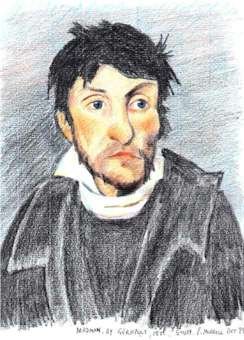
Madman, by Gericault, 1822. Study, October 1999.
The BHS was the forerunner of the Faculty. Founded by Dr Quin in 1844 it
became the Faculty of Homeopathy in Nov 1943. That was eventually established by Royal
statute in 1950 as an officially recognised postgraduate medical teaching facility. It is
surprising how often people confuse the BHS/Faculty and the BHA.
The latter was founded in 1902 by Dr Edwin Neatby and was really a ‘front
organisation’ for doctors wishing to study homeopathy so they could fund their studies. The
idea was that by ‘pretending’ to get ordinary people interested in homeopathy they would pay
a fee, get a few leaflets and access to a library service, and the bulk of the money could
then be handed over to doctors to pay for their studies. Clearly, some docs in the
BHS/Faculty decided at some point that one way to increase the number of doctors adopting
homeopathy might be to assist them financially in their studies. That is really the basis
for the establishment of the BHA. But it’s secondary function was/is to attract public
interest, etc.
It is of interest that this scheme was primarily an idea designed to
increase the numbers of homeo docs in the UK, NOT one to generate excessive interest in
homeopathy, to promote it in the public mind or campaign for its expansion – even though
these are the stated aims of that organisation. In practice that is NOT what happened. It
sounds more like some rip-off scheme to us today. Nor is the BHA a similar organisation to
the BMA, which might be better described as the doctor’s trades union in the broadest sense.
What is of great interest (sociopathologically) is that the BHA was NOT primarily designed
to feed public interest in homeopathy beyond a minimal point, but to take money off them, to
pay doctors to study homeopathy! It is amazing when stated in this way, but it is factually
accurate.
Unfortunately – and this is the rub – the BHA was far more successful at
getting people interested in homeopathy than it was in making money and swelling the ranks
of homeopathic doctors. Thus the scheme backfired somewhat: its secondary function was
vastly overtaken by its primary one and it generated a lot of interest in homeopathy, while
at the same time highlighting – possibly with some embarrassment – the pathetic and
dwindling number of homeo docs who might supply their needs.
And that is the gap that was eventually filled by the politically
discontented lay pracs like Ellis Barker and Co, who boomed throughout the 30’s and Barker
got some big names behind his cause, not all of them homeopaths. He was teamed up with
various osteopaths, aristocrats and health freaks of all types too. Clarke died towards the
end of 1931 and Barker took over the editorship in April 1932 issue. His ‘blistering
attacks’ were based on the fact -in his view -that allopathy was still not working but
homeopathy was and yet was in decline because it hadn’t been given to the masses for ‘fair
trial’. So he just wanted to put it back on the map and stir things up a bit.
Also, another closely connected entanglement concerns the highly
stratified nature of UK society at that time and how that is reflected in the ‘social niche’
homeopathy came to occupy right from its inception in the UK from the 1830’s. For example,
it is not true that homeopathy was freely available to the masses other than through a tiny
minority of lay pracs and a few enlightened (=deviant?) pharmacists. It was in fact an
exclusive form of medicine reserved only for the rich upper classes. It was practised by
doctors for a clientele which was composed ALMOST ENTIRELY of clerics, aristocrats, royals,
bankers, lords and ladies, dukes, military officers and their families, old spinsters,
retired headteachers, stockbrokers, private school folks and top business folk. The same
people, in fact, who ran the BHA and the Faculty by swelling the ranks of their committees.
Thus homeopathy was also confined mainly to London, the rich south of
England and the richer districts of provincial towns, especially such snooty and fashionable
towns like Bath, Buxton, Harrogate, Cheltenham, Bognor Regis, Brighton, etc. Note how this
contrasts very sharply with the huge popularity of Botanic medicine in the grim, industrial,
working-class towns like Glasgow, Leeds, Birmingham, Bradford, Sheffield, Huddersfield,
Nottingham, etc. from the 1840’s on. had any such support or popularity of that size or kind
at grassroots level, except with upper-class toffs. A certain amount of confirmation of this
seemingly trivial yet quite interesting and important point, is obtained when we observe
that homeopathy was never big either in Wales or in Ireland which were and still are far
less socially stratified societies, being essentially working class or even classless
societies. This stands in stark contrast both to England and to Scotland, . This stands in
stark contrast both to England and to Scotland, where, by comparison, homeopathy q z qhas q
z qflourished.
There is a classic series of articles in The Homoeopathic World by Ellis
Barker in 1932-3 (just after he took over its editorship) in which he slams this sorry state
of affairs and describes these various cosy committees as being little better than
‘rich-men’s talking shops’ holding homeopathy back and preventing any expansion of the
therapy for the country at large. Ellis Barker was probably a communist (in the softest,
socialist and broad 30’s sense). He had been a journalist and political historian (on which
he wrote extensively) before turning his hand to homeopathy and nature cure. His books are
well-written and reveal an astute Germanic mind. His father was a non-homeo doctor in
Cologne, Germany and he emigrated to the UK c1910. Certainly, Ellis Barker wished to see
homeopathy widely available to the masses, and not just for a tiny elite of upper class
toffs – to which he was, like his mentor JHClarke, vehemently opposed.
Another problem arose from the BHA being so successful in generating a lot
of interest in homeopathy. During the 1940’s when the National Health Service act was
wending its way through Parliament, it became clear that all doctors under the provisions of
the Act would henceforth give FREE treatment to all people. This was objected to by the docs
in general, but also by the homeopathic docs. They saw this as a direct threat to their
livelihood and to their freedom to make a fast buck. But the numbers of homeo docs were in
decline or stagnation so the increasing interest in homeopathy was translated into
frustration at not being able to find any homeo docs in their area, and with whom they could
register for free treatment.
At this point a group of BHA members demanded that the BHA teach ordinary
folks the rudiments of homeopathy in courses. A ‘take it to the masses’ approach spearheaded
by folks like Ellis Barker. Apart from short courses in first-aid prescribing, they were
most unwilling to do this, as it breached their basic pro-doctor and pro-upper-class ethos.
So, many members left in disgust, some to swell the ranks of the many lay practitioners.
This was mainly in 1946-8 and after the popularity of homeopathy had peaked.
Finally, there is also the peculiar status of the Missionary School of
Medicines (est c1903 by Dr Alva Banjamin) which was a Christian society designed to provide
a smattering of medical knowledge, a good overview of homeopathy, plus practical skills in
acute homeopathic prescribing for the hapless missionary soon to be dumped far off in Africa
or the Far East with only a few dozen remedies in 6 or 30 potency. This has to be regarded
as barefoot homeopathy in one of its earliest incarnations! And also one of those rare
examples of the Christians ‘clambering into bed’ with homeopaths!