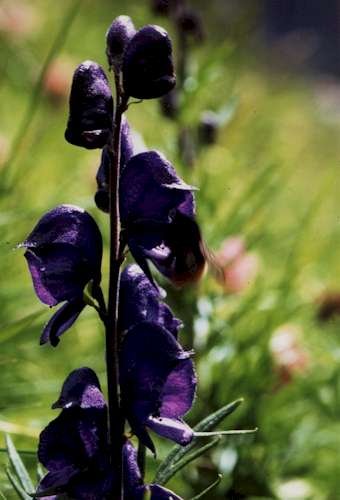
Aconitum
NapellusAconitum
Napellus, L.Synonyms and common names:
Aconite, Aconito, Aconito Napello, A. napellus sensu lato, Auld Wife’s
Huid, Blauer Eisenhut, Blue Rocket, Duivelskruid, European Monkshood,
Friar’s Cap, Kaplanbogan, Monk’Shood, Monk’s-hood, Monkshood, Poison
Aconite, Stormhat, True Monkshood, Tue Loup, Uva Verga, Venus’ Chariot,
Venus’-chariot, Yoshu-Tori-Kabuto, Wolfsbane.Photo: Dr Michel Séret
Aconitum Napellus,
L.J. H. Clarke:
Common Aconite. Monkshood. Wolfsbane. (Moist pastures and waste
places in mountainous districts, Central and Southern Europe, Russia,
Scandinavia, and Central Asia.) N. O. Ranunculaceæ. Tincture of whole
plant with root when beginning to flower.
Characteristics.─The Wolfsbane
“grows in the damp and covered parts of almost every mountainous
country in north or middle of Europe, especially in the Jura, Switzerland,
Germany, and Sweden.” Teste mentions that it has the reputation of
being much more poisonous to carnivorous animals than to the herbivora.
This he partly endorses, and it has recently been apparently confirmed by
a vain attempt to poison an elephant with Aconitine
in this country. A carrot was scraped out and enough Aconitine to poison 2,000 men was put in. The
elephant ate it readily, but nothing at all happened, and three hours
later a large dose of prussic-acid had to be administered, which proved
fatal in a short time.
Photo: Dr Michel Séret
Aconitum Napellus,
L.T. F. Allen:
A. napellus, L. (including also A. Stoerckianum, Reich., in
part).
Nat. order, Ranunculaceæ.
Common name, Monkshood.
Preparation, Tincture from the whole
plant and root when beginning to flower.
Photo: Dr Michel Séret
Aconitum Napellus,
L.® 2001
Article